
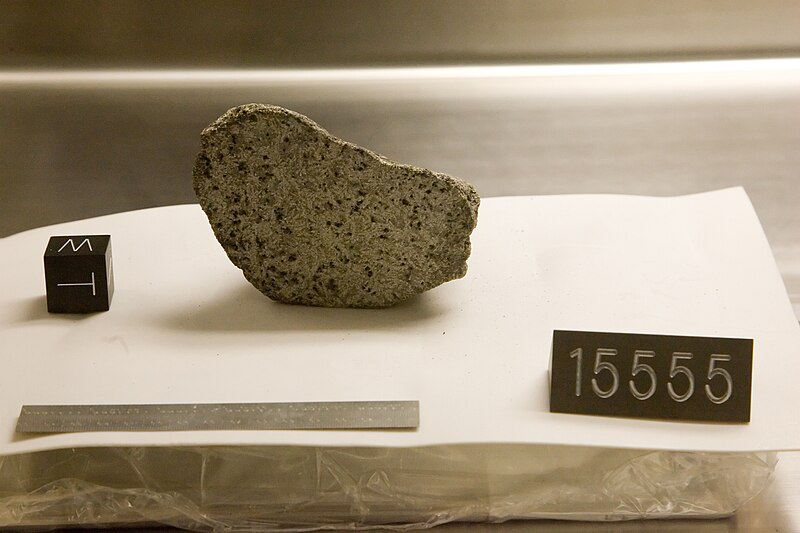
As humans have learned to walk on the moon, we continue to study its characteristics for curiosity, but also for practical reasons. Among the aspects still observed and analyzed in various missions, there are rocks that help us understand which minerals are present on the lunar surface. These rocks can be samples collected during missions, fragments of soil, or even meteorites that have been brought back to Earth.
Moon Rocks: A Brief History
Before diving into the types of minerals found on the moon, let’s take a look at who has brought these rocks back to Earth. There have been six Apollo missions that have collectively gathered and returned 2,415 samples, weighing a total of 382 kg. These lunar rocks were collected using simple tools like hammers, rakes, trowels, pliers, and drills.
Initially, the rocks were photographed in their natural habitat before being collected and stored in specialized containers to protect them from terrestrial contamination. The Soviet Union also contributed to this effort with 326 grams of samples in total.
The Apollo missions were a significant milestone in space exploration, marking the first time humans set foot on another celestial body. These missions not only helped scientists understand the moon’s composition but also paved the way for future lunar research and potential human settlements.
Meteorites and Lunar Minerals
In addition to the rocks collected during manned missions, there are meteorites that have fallen on Earth, carrying lunar minerals. Over 120 meteorites have been discovered, originating from 60 different events, with a total weight of over 48 kg. Researchers from various countries, especially Americans and Japanese, have identified these meteorites in Antarctica.
You might be surprised to learn that there’s even a market for these rare rocks! Some meteorite fragments are sold freely among private collectors at high prices. Similarly, lunar samples collected directly on the moon are also highly valuable and sometimes stolen, like in 2002.
The discovery of meteorites carrying lunar minerals has significant implications for our understanding of the moon’s composition and its history. By studying these meteorites, scientists can gain insights into the moon’s formation and evolution, as well as its potential for hosting life.
The Value of Lunar Samples
The material from both Mars and the Moon has been returned to NASA, estimated to be worth $1 million at the time. This highlights the significance of these samples not only for scientific research but also for their potential monetary value.
In recent years, there have been attempts to sell lunar samples on the black market, sparking concerns about the ethics and legality of such transactions. The value of lunar samples is not only a reflection of their scientific importance but also a symbol of human achievement in space exploration.
Characteristics of Lunar Rocks
Let’s take a closer look at the characteristics of lunar rocks and what they contain. One notable feature is that they’re incredibly old, even compared to Earth’s rocks: dating back 3.16-4.5 billion years, whereas those on Earth only go back to 3.8 billion years.
On the moon’s surface, you’ll find several types of rocks with high concentrations of Anorthite, while basaltic marines have relatively high iron content accompanied by a significant amount of titanium. Occasionally, you might also encounter Armalcolite, discovered by astronauts on Apollo 11 and named after its initials (Armstrong, Aldrin, Collins).
The discovery of Armalcolite has provided scientists with valuable insights into the moon’s geological history. By analyzing this mineral, researchers have been able to reconstruct the moon’s early formation and evolution.
Classifying Lunar Rocks
To classify lunar rocks, we need to consider whether they come from continental regions or marine areas. When coming from continents, the prevailing rocks are plutonic mafic ones. In contrast, those from marine areas can be classified into three main types based on their chemical characteristics and titanium content: high-Ti basalt, low-Ti basalt, and Very Low-Ti (VLT) basalt.
The classification of lunar rocks is crucial for understanding the moon’s geological history and evolution. By studying these rocks, scientists can gain insights into the moon’s formation, as well as its potential for hosting life.
Types of Rocks on the Moon
The moon has rocks that are primarily igneous, comprising three main series: anorthosite ferrous, magnesian, and alcaline. The most common is anorthosite, which is mostly composed of these rocks and dates back to approximately 4.46 billion years ago.
La serie magnesica (Mg) includes Dunite, Troctolite, and Gabbro, forming a less extensive series that stretches from around 4.3-4.1 billion years ago. The third series, alcalina, is rich in alkalis and relatively rare.
The anorthosite ferrous series is characterized by its high iron content and low magnesium levels. This series includes rocks like Anorthite and Pyroxene, which are essential for understanding the moon’s early formation and evolution.
Lunar Rocks: Origin
Most of the rocks brought back to Earth during American and Russian missions are continental in origin. These include breccias, which are aggregates formed from debris and molten material resulting from lunar impacts. There are many different types of breccias depending on the size of the impact craters and their distance from the impact site.
In contrast, rocks found in marine areas show characteristics similar to those on Earth but with higher iron content and lower viscosity. Occasionally, you might also find oxides of iron-titanium present in some lunar rocks.
The origin of lunar rocks is a topic of ongoing research and debate among scientists. By studying these rocks, researchers can gain insights into the moon’s formation and evolution, as well as its potential for hosting life.
Where to See Lunar Rocks
Since we can’t all travel to the moon to see these rocks up close, let’s explore where we can view them from Earth. The majority of lunar samples are housed at the Lunar Sample Building at the Lyndon B. Johnson Space Center in Houston, Texas. A smaller collection is also kept at Brooks Air Force Base in San Antonio, Texas.
The samples are typically stored under pure nitrogen to prevent atmospheric damage. Some pieces have been distributed among museums and governments in other countries for public viewing.
Some of the most notable lunar rocks on display include:
- The Apollo 11 sample, which includes a piece of Anorthite and Armalcolite
- The Lunar Sample Building’s exhibit on the Moon’s geology, featuring rocks from various Apollo missions
- The Smithsonian National Air and Space Museum’s collection of lunar samples, including a fragment of anorthosite
These exhibits provide a unique opportunity for the public to see and learn about lunar rocks up close.
Conclusion
The study of lunar rocks is an essential aspect of space exploration and scientific research. By analyzing these rocks, scientists can gain insights into the moon’s composition, its geological history, and its potential for hosting life.
From the Apollo missions to the discovery of meteorites carrying lunar minerals, there is a wealth of information available about the moon’s geology and composition. As we continue to explore the moon and study its rocks, we may uncover new secrets about this celestial body and its place in our solar system.
Ultimately, the study of lunar rocks serves as a reminder of human achievement in space exploration and our ongoing quest for knowledge about the universe.


