
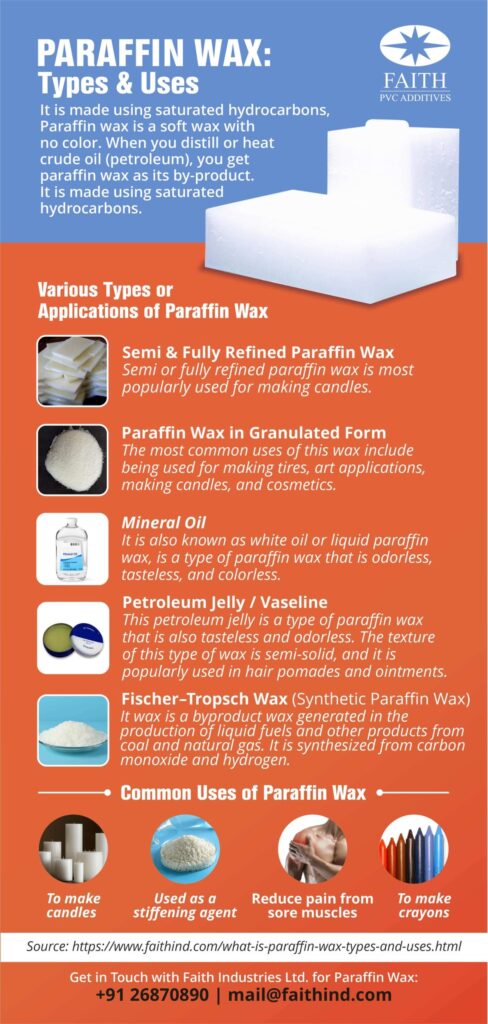
As we go about our daily lives, we often find ourselves surrounded by paraffin, a versatile substance used in various applications. From candle-making to lubricants and cosmetics, paraffin plays a crucial role in many industries.
In this article, we’ll delve into the world of paraffin, exploring its properties, uses, and environmental impact.
Understanding Paraffin
Paraffin is a mixture of hydrocarbons solid at room temperature. It’s primarily composed of alkanes, with chains having more than 20 carbon atoms. The first to produce it was Karl von Reichenbach, an industrialist from Germany, in 1830. The CAS and EINECS numbers for paraffin are 92045-76-6 and 295-458-3, respectively.
Paraffin’s name is derived from the Greek word “paraphaino,” which means “to wax.” This refers to its waxy texture when solidified. Paraffin is a non-toxic, non-reactive substance that is relatively inert and doesn’t react with other materials.
Liquid Paraffin
When discovered by Reichenbach, he was working with wood tar, which led him to this substance. However, paraffin exists naturally as well. Its characteristics include:
- Insoluble in alcohol and acetone but soluble in toluene, chloroform, and xylene
- Soluble in three menthol, benzyl alcohol, and ethyl ether
Paraffin is often used as an oil, which is colorless and odorless. This mixture of hydrocarbons C15-C40 comes from the distillation of petroleum.
Properties of Paraffin
Paraffin has several unique properties that make it useful in various applications:
- High melting point: Paraffin’s high melting point makes it ideal for use in candle-making, cosmetics, and other applications where a solid substance is required.
- Low volatility: Paraffin’s low volatility means it doesn’t easily evaporate or vaporize, making it suitable for use as a lubricant or in the production of candles.
- Water-repellent properties: Paraffin has water-repellent properties, which make it useful in applications such as waterproofing and sealants.
Paraffin in Cosmetics
In the cosmetic industry, paraffin is prized for its emollient properties and is used to create lubricants, candles, and chewing gum. The refined version, called petrolatum, is used in skincare products as a protective barrier. However, less refined versions, like petrol marrone, ambrato, and giallo, have been linked to carcinogenic effects.
Paraffin is also used in the production of cosmetics such as lip balms, lotions, and creams. It helps to moisturize and protect the skin, while also providing a smooth texture.
Pure Paraffin
The purest form of paraffin is white, translucent, odorless, and greasy to the touch. Its purity can be measured by its melting point, ranging from 44°C to 60°C. The oil-free content must be below 1% if it’s a refined paraffin.
Solid Paraffin
This solid form of paraffin has a crystalline structure and is obtained from either crude petroleum or the distillation process. It can be combined with beeswax, for example, to increase its melting point.
Paraffin Stoves
Paraffin stoves, also known as kerosene stoves, use paraffin (also referred to as kerosene) as a fuel source. They are common in many parts of the world, particularly where electricity or natural gas is not readily available. These stoves function by burning paraffin, producing heat that is then distributed throughout the surrounding area.
Environmental Impact
The combustion of paraffin releases greenhouse gases like carbon dioxide into the atmosphere, contributing to global warming and climate change. Additionally, incomplete combustion can also produce air pollutants such as monoxide of carbon and various volatile organic compounds.
While stoves may be efficient from an energy perspective, they are not considered a sustainable or environmentally friendly option due to their contribution to climate change and air pollution.
Alternatives to Paraffin Stoves
If you’re considering using paraffin stoves, there are several alternatives available:
- Electric stoves: These use electricity to heat up and provide warmth.
- Biomass stoves: These burn organic materials such as wood or agricultural waste to produce heat.
- Natural gas stoves: These use natural gas as a fuel source to generate heat.
Benefits of Paraffin
While paraffin has its drawbacks, it also offers several benefits:
- Energy efficiency: Paraffin stoves are relatively efficient and can provide a consistent source of heat.
- Affordability: Paraffin is often cheaper than other fuels, making it an attractive option for those on a budget.
- Availability: Paraffin is widely available in many parts of the world.
Safety Precautions
When using paraffin stoves, there are several safety precautions to keep in mind:
- Make sure to follow proper ventilation procedures when burning paraffin.
- Keep children and pets away from the stove.
- Ensure that the stove is properly installed and maintained.
FAQs
- Q: What is paraffin used for?
A: Paraffin has a wide range of uses, including candle-making, lubricants, cosmetics, and more. - Q: Is paraffin safe for human use?
A: While paraffin can be beneficial in some applications, its less refined versions have been linked to health issues. - Q: How is paraffin extracted?
A: Paraffin is often obtained from petroleum through the distillation process or synthetic methods like catalytic hydrogenation. - Q: Can I use paraffin as a substitute for other fuels?
A: While paraffin can provide energy, it’s not always the best option due to its environmental impact and efficiency. - Q: Is paraffin toxic to animals and humans?
A: While paraffin is generally non-toxic, its refined versions have been linked to health issues in some cases. - Q: Can I burn paraffin as a firewood alternative?
A: Yes, but be aware of the potential environmental impacts associated with burning paraffin. - Q: How can I reduce my reliance on paraffin stoves?
A: If possible, consider switching to more environmentally friendly heating options like electric or biomass stoves.
By understanding the properties and uses of paraffin, we can better navigate its presence in our daily lives while making informed decisions about its impact on the environment.


