
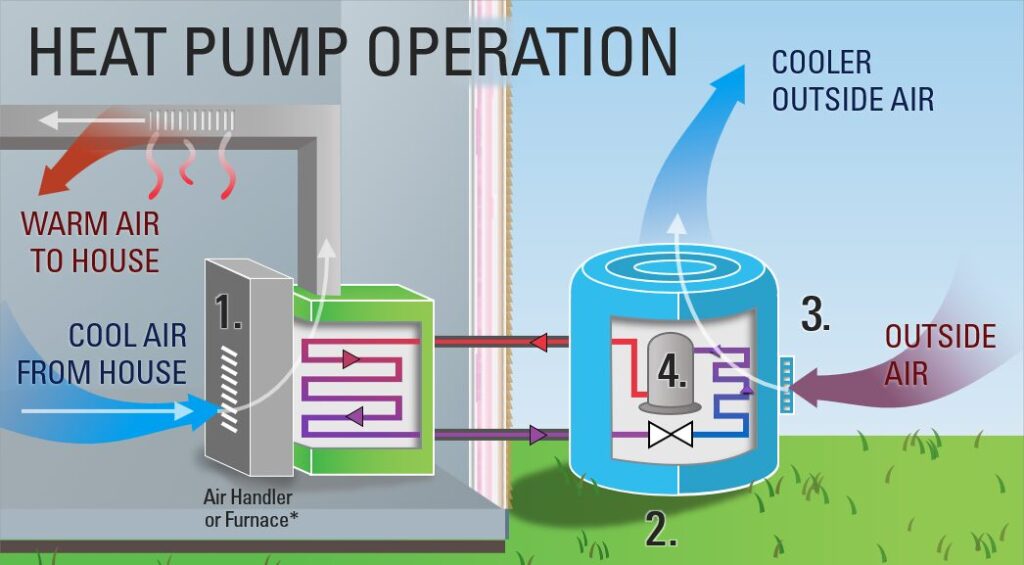
In the domestic setting, the energy used for heating represents the largest electrical consumption. The energy destined for heating exploits fossil sources, which are costly and harmful to the environment. A heat pump can warm up homes with excellent efficiency and, thanks to its ability to function as an air conditioner, represents a great medium to improve the comfort of living and working spaces.
What is a Heat Pump? (Answer from ENEA)
The ENEA answers simply that it’s “a machine capable of transferring heat from one environment with lower temperatures to another with higher temperatures.”
To perform its function, a heat pump is equipped with a compressor, condenser, valve of expansion, and evaporator. Descriptively, we can compare the operation of a heat pump to a “cycle” that occurs within a closed circuit. On one side, there’s the compressor that provides energy to the refrigerant fluid, pushing it until the evaporator absorbs the heat contained in the fluid, which is then released into the environment to be warmed up by the condenser.
In More Detail: How Does a Heat Pump Work?
While the compressor consumes electrical energy to initiate the cycle, the evaporator absorbs heat from the surrounding medium (air or water – cold source*), but the heat is not directly released into the space to be warmed. Instead, it’s transferred to the condenser: in the heat pump, the refrigerant fluid absorbs heat from the cold source through the evaporator.
So, why is this system considered eco-friendly? In proportion, a heat pump is able to produce more energy in the form of heat than the electrical energy consumed by the compressor itself. This is because it’s able to extract heat from the external environment (air-water). The efficiency of a heat pump is measured by its coefficient of performance (COP), which represents the ratio between the energy provided as heat and the electrical energy consumed. The COP values for a heat pump are variable based on the model and operating conditions, but they’re generally close to 3. This means that with one kWh of electricity consumed, three kWh of heat can be generated for the space being heated. In terms of “thermal calories,” for every kWh of electrical energy consumed, two thousand five hundred kcal of heat is produced.
The Principle Behind Heat Pump Efficiency
Heat pumps operate based on the principle of refrigeration. This process involves a refrigerant fluid that absorbs heat from the surrounding medium (cold source) and transfers it to another environment (warm source). The efficiency of this process depends on several factors, including:
- The temperature difference between the cold source and warm source.
- The quality of the insulation used in the system.
- The capacity of the heat pump.
Important Considerations When Installing a Heat Pump
When installing a heat pump, it’s essential to take into account that the thermal power output from the pump is directly dependent on the temperature at which it absorbs heat, i.e., the location where the pump is installed. If the temperature falls below an interval of -2 and 2 °C, the efficiency of the heat pump becomes less appealing because the compressor won’t be able to transmit enough heat.
*The external medium from which heat is extracted is called the cold source.
Types of Heat Pumps
There are several types of heat pumps available in the market, each with its own strengths and weaknesses. Some of the most common types of heat pumps include:
- Air-source heat pumps: These are the most common type of heat pump, which uses outdoor air as the cold source to extract heat from the environment.
- Ground-source heat pumps: These use underground pipes or coils to absorb heat from the ground, providing more efficient heating and cooling.
- Water-source heat pumps: These use water as the cold source to extract heat from the environment.
Benefits of Heat Pumps
Heat pumps offer several benefits over traditional heating systems, including:
- Energy efficiency: Heat pumps can provide more energy in the form of heat than the electrical energy consumed by the compressor.
- Environmental friendliness: Heat pumps are considered eco-friendly because they extract heat from external sources instead of generating it through combustion or other harmful processes.
- Low operating costs: Heat pumps have lower operating costs compared to traditional heating systems.
- Flexibility: Heat pumps can provide both heating and cooling, making them versatile for various applications.
Challenges and Limitations
While heat pumps offer several benefits, there are also some challenges and limitations to consider:
- High upfront costs: Heat pumps can be expensive to install.
- Space requirements: Some types of heat pumps require significant space for installation.
- Maintenance requirements: Heat pumps require regular maintenance to ensure optimal performance.
Conclusion
A heat pump can provide an efficient solution for heating homes while minimizing environmental impact. However, its performance and efficiency depend on various factors, including temperature conditions. By understanding how a heat pump works and its benefits, you can make informed decisions when installing one in your home or office.
Frequently Asked Questions (FAQs)
Q: What is the main difference between a heat pump and an air conditioner?
A: A heat pump can provide both heating and cooling, while an air conditioner only cools.
Q: How efficient is a heat pump compared to traditional electric heaters?
A: Heat pumps are generally more efficient than traditional electric heaters, especially when it comes to thermal energy production.
Q: What temperature conditions affect the efficiency of a heat pump?
A: The efficiency of a heat pump depends on the temperature at which it absorbs heat. If the temperature falls below -2 and 2 °C, its performance decreases.
Q: Can I use a heat pump in areas with very low temperatures?
A: It’s not recommended to install a heat pump in areas with temperatures lower than -2°C due to reduced efficiency.
Q: What is the ideal location for installing a heat pump?
A: The ideal location for installing a heat pump depends on the local climate and temperature conditions. Ideally, it should be installed in an area where it can absorb cold air or water.
Q: Are heat pumps environmentally friendly?
A: Yes, heat pumps are considered eco-friendly because they extract heat from external sources instead of generating it through combustion or other harmful processes.
Q: How long do heat pumps typically last?
A: Heat pumps have a lifespan of around 15-20 years, depending on the model and operating conditions.
Q: Can I install a heat pump myself or should I hire a professional?
A: It’s recommended to hire a professional for the installation process due to the complexity and potential risks involved.


