
The Energy Label of a Washing Machine and the Calculation of Consumptions. How to Read the Energy Label of Your Washing Machine and Interpret Class Energy, Noise Level, Water and Electricity Consumption.
All household appliances in circulation must be accompanied by an energy label that indicates the required information. For washing machines, the current regulation is the Decree no. 1061/2010 of September 28, 2010.
Washing Machine Class Energy
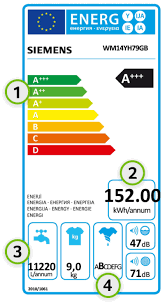
The first information provided by the washing machine’s energy label is its class energy. For washing machines, there are 7 classes of energy that vary from A+++ to D.
Most washing machines currently available on the market have a class A or higher. The highest class for washing machines is not just a single class but two: one for the entire machine and another specific to the centrifuge.
The class energy of the centrifuge is indicated in the bottom part of the label, where the classes range from A to G. The icon representing this class is a “squeezed shirt”.
There is a significant difference between the class A+++ and class A of a washing machine. Although the difference may be smaller between the consumption of a washing machine in Class A++ and Class A++, there are differences.
The washing machines with low energy consumption A+++ are more efficient than those in class A, by 32%.
Energy Label Washing Machine
In addition to the class of electrical consumption, you will also have access to more detailed information such as:
- Annual water consumption expressed in liters
- Basket capacity expressed in kilograms
- Efficiency class of the centrifuge
- Noise level expressed in decibels
The noise level is indicated for two phases of washing: during the actual wash and during the centrifugation phase. Washing machines are generally noisier during the centrifugation phase.
How to Read the Energy Label of Your Washing Machine
To read the energy label, follow these steps:
- Locate the energy label on your washing machine. It is usually located on the front or top of the machine.
- Look for the class energy icon, which is a “squeezed shirt”.
- Check the annual water consumption and basket capacity. These values are expressed in liters and kilograms respectively.
- Verify the efficiency class of the centrifuge, which ranges from A to G.
- Note the noise level for both wash and centrifugation phases.
Interpreting Class Energy
To understand what the energy label is trying to tell you, here’s a brief explanation of each class:
- A+++ (the highest class): Consumes the least amount of electricity per cycle, making it an efficient option.
- A++: Consume less electricity than the previous classes, but still relatively high consumption.
- A+: This class represents a moderate level of energy consumption and is suitable for everyday use.
- B+ to D: These classes represent higher levels of energy consumption and may not be as efficient.
Annual Water Consumption
The annual water consumption is an important factor to consider when choosing a washing machine. Look for the value expressed in liters, and consider how it will impact your utility bills.
In general, a washing machine with low water consumption will cost less on your utility bill over time.
Basket Capacity
The basket capacity indicates the amount of laundry that can be washed at once. Check if it is suitable for your family’s needs.
A larger capacity means more clothes can be washed in one cycle, which may save you time and energy.
Centrifuge Efficiency Class
The centrifuge efficiency class ranges from A to G. Look for a high-efficiency class (A) to minimize energy consumption during the centrifugation phase.
Noise Level
The noise level is an important factor to consider when choosing a washing machine, especially if you plan to use it in a shared living space.
Look for the noise level expressed in decibels and note it down. This will help you decide whether the washing machine suits your needs.
How Much Does a Washing Machine Consume?
The consumption of washing machines varies depending on their class energy, so it’s not possible to give a single answer. The energy label of your washing machine will be able to respond better than me!
A washing machine in class A+++ consumes an average of 130 kWh per year. Although the energy consumption is calculated by referring to specific laundry programs (washing cotton at 60°C full and half load, or washing cotton at 40°C half load), the labels on the energy label may not match your actual consumption but only provide estimates.
Measuring Electrical Consumption
To know how much a washing machine consumes, you can rely on the energy label, but nothing is better than practical experience.
There are various devices available in the market to measure electrical consumption. One simple adapter can be attached to the power cord of your washing machine before plugging it into the wall outlet.
You would use this device as you would a double outlet or an adapter!
A reasonable measuring device for electrical consumption can be purchased on Amazon at 19.06 euros, including shipping fees.
Useful links on Amazon: Electrical Consumption Measurer
This device is quite affordable but does not allow precise measurement of energy absorption by low-energy-consuming appliances.
If you want to measure the consumption of your washing machine during standby or need a more accurate device for measuring electricity usage in other devices such as lamps, decoders, and TVs in standby mode, you should consider investing in a higher-quality model, slightly more expensive than 29.99 euros.
You can find all information on this product by visiting Amazon: RCE PM600 Electrical Precision Measurer
Frequently Asked Questions (FAQs)
- What is the difference between the A+++ and A classes of a washing machine?
The main difference between the A+++ and A classes of a washing machine lies in their energy consumption levels. The class A+++ represents the highest level of energy efficiency, while class A has higher energy consumption.
- How do I calculate the annual water consumption of my washing machine?
To calculate the annual water consumption of your washing machine, you need to multiply the number of liters indicated on the label by the usage frequency. You can also use online tools or consult with a professional if needed.
- What is the average electricity consumption of a washing machine in class A+++?
The energy label indicates that a washing machine in class A+++ consumes an average of 130 kWh per year.
- Can I measure the electrical consumption of my washing machine using an energy label?
While the energy label provides estimates, it’s not always accurate. To get a more precise measurement, you can use a measuring device such as the RCE PM600 Electrical Precision Measurer.
- Are there any devices that can accurately measure the energy consumption of my washing machine during standby mode?
Yes, there are devices available on the market that can accurately measure the energy consumption of your washing machine during standby mode. However, they may be more expensive and require a higher level of technical expertise to use.
Conclusion
The Energy Label of Your Washing Machine is an essential tool for understanding its efficiency, water consumption, and noise level. By following these steps, you can read the energy label accurately and make informed decisions when choosing a washing machine that suits your needs.
Remember to consider factors such as class energy, annual water consumption, basket capacity, centrifuge efficiency class, and noise level when selecting a washing machine. With the right information, you can choose an energy-efficient washing machine that will save you time and money over time.
If you have any further questions or concerns about your Energy Label Washing Machine or need assistance with choosing a new one, please feel free to ask!


