
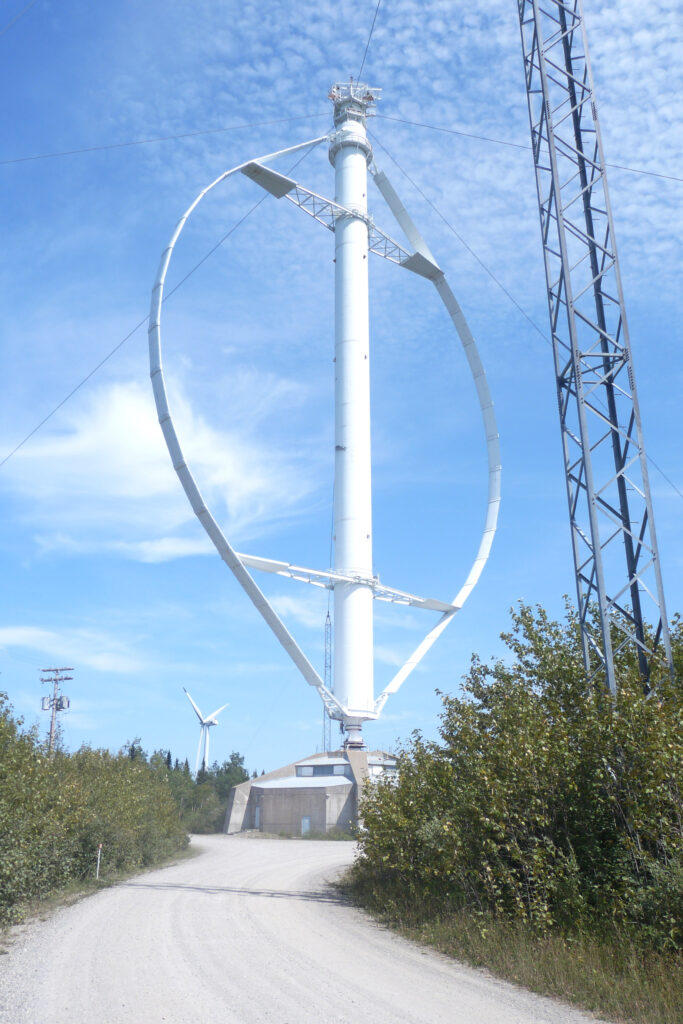
As the first type of aerogenerator created by humans, vertical axis wind turbines (VAWTs) have been a topic of interest for many years. While they offer several advantages over horizontal axis wind turbines (HAWTs), there are also some significant drawbacks to consider.
What are Vertical Axis Wind Turbines (VAWTs)?
VAWTs are a type of wind turbine that features a vertical axis of rotation, meaning the blades rotate around a central vertical axis. This design allows for more flexibility in terms of installation location and can be particularly useful in areas with limited space.
History of VAWTs
The concept of VAWTs dates back to the early 19th century, when Swedish inventor Per Thomas Savonius patented the first VAWT in 1888. However, it wasn’t until the 1990s that VAWTs began to gain popularity as a viable alternative to HAWTs.
Design and Functionality
A typical VAWT consists of one or more blades that rotate around a central vertical axis. The blades are typically curved or wing-like in shape and are designed to capture wind energy as they rotate. The rotation of the blades creates a rotational force that is transmitted to an electrical generator, producing electricity.
The Advantages of VAWTs
1. Location Flexibility
One of the primary benefits of VAWTs is their ability to be installed in locations that would be difficult or impossible to access with HAWTs. This makes them ideal for remote or hard-to-reach areas, such as mountainsides or coastal regions.
2. Lower Maintenance Costs
VAWTs require less maintenance than HAWTs, as they have fewer moving parts and are less prone to mechanical issues. This can lead to significant cost savings over the life of the turbine.
3. Reduced Start-Up Requirements
VAWTs do not require a coupling or gearbox, which means there is no need for an electrical coupling system. This makes them easier to start up and reduces their overall energy efficiency impact.
Types of VAWTs
There are several types of VAWTs, each with its own unique characteristics and advantages. Some of the most common types include:
1. Savonius Turbines
The Savonius turbine is one of the oldest types of VAWT. It features a curved blade that scoops up air as it rotates, creating a rotating motion.
2. Darrieus Turbines
The Darrieus turbine is another popular type of VAWT. It features a straight blade that generates lift as it rotates, creating a rotational force.
3. Giromill Turbines
The Giromill turbine is a more recent development in the field of VAWTs. It features a unique design that allows for greater efficiency and reduced noise levels.
Comparison with HAWTs
While VAWTs have several advantages over HAWTs, they also have some significant drawbacks. Some of the key differences between the two types of turbines include:
1. Efficiency
HAWTs are generally more efficient than VAWTs, particularly at high wind speeds.
2. Noise Level
VAWTs tend to be noisier than HAWTs due to their unique design and operation.
3. Start-Up Requirements
HAWTs require a coupling or gearbox to start up, while VAWTs do not.
Advantages of VAWTs in Specific Applications
1. Residential Energy Production
VAWTs are a popular choice for small-scale energy production due to their ease of installation and lower maintenance costs.
2. Commercial and Industrial Energy Production
VAWTs can be used to generate electricity for commercial and industrial applications, particularly in areas with limited space or high wind speeds.
3. Offshore Wind Farms
VAWTs are well-suited for offshore wind farms due to their ability to withstand harsh weather conditions and install in locations that would be difficult or impossible to access with HAWTs.
Challenges and Limitations
While VAWTs offer several advantages, they also have some significant challenges and limitations. Some of the key challenges include:
1. Higher Upfront Costs
VAWTs are often more expensive than HAWTs due to their unique design and manufacturing process.
2. Lower Efficiency at Low Wind Speeds
VAWTs tend to be less efficient than HAWTs at low wind speeds, which can limit their effectiveness in certain applications.
3. Noise and Vibration Issues
VAWTs can generate more noise and vibration than HAWTs due to their unique design and operation.
Conclusion
In conclusion, vertical axis wind turbines (VAWTs) offer several advantages over horizontal axis wind turbines (HAWTs), particularly in terms of location flexibility and lower maintenance costs. However, they also have some significant drawbacks, including reduced efficiency and higher noise levels. Ultimately, the decision to install a VAWT will depend on a variety of factors, including the specific site conditions and the desired level of energy production.
FAQs
1. What is the difference between VAWTs and HAWTs?
VAWTs are a type of wind turbine that features a vertical axis of rotation, while HAWTs have a horizontal axis of rotation.
2. Are VAWTs more efficient than HAWTs?
No, HAWTs are generally more efficient than VAWTs, particularly at high wind speeds.
3. Do VAWTs require a coupling or gearbox to start up?
No, VAWTs do not require a coupling or gearbox to start up, making them easier to operate and maintain.
4. Can VAWTs be installed in locations with limited space?
Yes, VAWTs can be installed in locations that are difficult or impossible to access with HAWTs due to their vertical axis of rotation.
5. Are VAWTs suitable for residential use?
Yes, VAWTs can be used for residential purposes and are a popular choice for small-scale energy production.
References
- “Vertical Axis Wind Turbines (VAWTs): A Review” by Journal of Renewable Energy
- “Wind Turbine Technology: An Overview” by IEEE Power and Energy Society


