
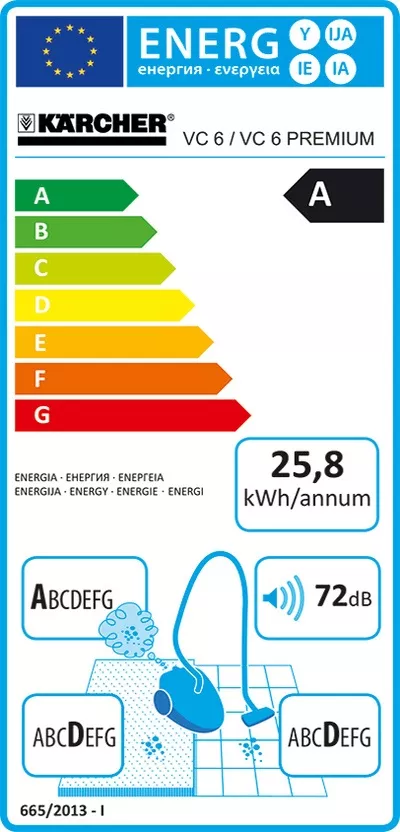
In recent years, the European Union has implemented a set of regulations requiring all household appliances to display an energy label. This label provides consumers with information about the energy efficiency of a product and helps them make informed purchasing decisions. In this article, we will delve into the world of vacuum cleaners and explore what the energy label on a vacuum cleaner tells us about its power consumption and performance.
When Did Vacuum Cleaners Need to Display an Energy Label?
The obligation for vacuum cleaners to display an energy label was introduced with the EU’s Regulation 665/2013, which came into effect in September 2014. This regulation applies to all vacuum cleaners sold in the European Union, while other types of cleaning appliances, such as carpet and floor polishers, are exempt from this requirement.
What Information Does the Energy Label Provide?
The energy label on a vacuum cleaner provides several pieces of information that can help consumers make informed purchasing decisions. These include:
- Manufacturer’s name and product identifier: The label displays the manufacturer’s name and a unique product identifier.
- Energy efficiency class: This is indicated by an “A+++” symbol, with “E” being the lowest rating. The higher the energy efficiency class, the lower the power consumption of the vacuum cleaner.
- Power consumption: The label shows the annual energy consumption of the vacuum cleaner in kilowatt-hours (kWh).
- Noise level: The label indicates the maximum sound level of the vacuum cleaner when used at a medium volume.
The Energy Efficiency Classes for Vacuum Cleaners
Prior to September 2017, vacuum cleaners were classified into seven energy efficiency classes: A+++, A++, A+, A, B, C, and D. However, with the introduction of new regulations, these classes have been revised, and only five classes are now available: A++, A+, A, B, and C.
Why Were These Changes Made?
The changes were made to ensure that vacuum cleaners used energy efficiently while still providing adequate cleaning performance. The new classification system aims to provide a more accurate representation of the vacuum cleaner’s power consumption and help consumers make informed purchasing decisions.
Other Important Classes to Consider
In addition to the energy efficiency class, there are three other important classes to consider when purchasing a vacuum cleaner:
- Class of air exhaust: This class indicates how well the vacuum cleaner captures dust particles and prevents them from being released into the environment. A higher class rating indicates better air quality.
- Pulpette performance: This class measures the effectiveness of the vacuum cleaner in cleaning hard floors and carpets.
- Moquette performance: This class assesses the vacuum cleaner’s ability to clean delicate surfaces like moquette.
How Much Does a Vacuum Cleaner Consume?
The energy consumption of a vacuum cleaner is indicated on the label in kWh, which represents an annual usage. The actual consumption of a vacuum cleaner can vary greatly depending on the model and its energy efficiency class. For example, a high-powered vacuum cleaner with a low energy efficiency class may consume 27.6 kWh per year.
What Does the Energy Label Say About a Vacuum Cleaner’s Performance?
While the energy label provides information about a vacuum cleaner’s power consumption, it does not necessarily indicate its performance. In fact, some of the most efficient vacuum cleaners on the market may have lower ratings than less efficient models.
Therefore, when purchasing a vacuum cleaner, it is essential to consider other factors such as the type of floor or surface you plan to clean, the level of dirt and debris, and the noise level of the device.
Real-World Applications
Here are some examples of real-world applications where understanding the energy label on a vacuum cleaner can be beneficial:
- For homeowners with large families, a more powerful vacuum cleaner may be necessary to handle heavy cleaning tasks.
- For people living in apartments or small spaces, a quieter and more efficient vacuum cleaner is essential for minimizing noise pollution.
- For individuals suffering from allergies, a vacuum cleaner with high air exhaust class can help reduce exposure to dust particles.
Conclusion
The energy label on a vacuum cleaner provides consumers with valuable information about its power consumption and performance. By understanding these labels, consumers can make informed purchasing decisions that align with their specific needs and preferences.


