
Understanding the Troposphere: Significance and Temperature
The troposphere is often considered the most critical layer of the Earth’s atmosphere, as it directly affects our daily lives. While our perspective might be anthropocentric, we are not alone in this atmospheric domain; plants and animals also utilize gases present in the troposphere, including oxygen, nitrogen, carbon dioxide, and water vapor.
The concept of the troposphere is rooted in the study of atmospheric science, which seeks to understand the complex interactions between the Earth’s surface, atmosphere, and hydrosphere. The troposphere is an idealized concept due to its temperature gradient that reverses as you move away from the Earth’s surface. This concept helps us isolate this layer, which encompasses 3/4 of the total atmospheric mass and nearly all the water vapor. It is within this region where most meteorological phenomena occur.
In this article, we will delve into the etymology of the term “troposphere,” explore its significance in our daily lives, and discuss its relationship with other atmospheric layers. We will also examine why air currents matter, their impact on regional climate variations, and how temperature fluctuations affect atmospheric phenomena.
What is the Troposphere?
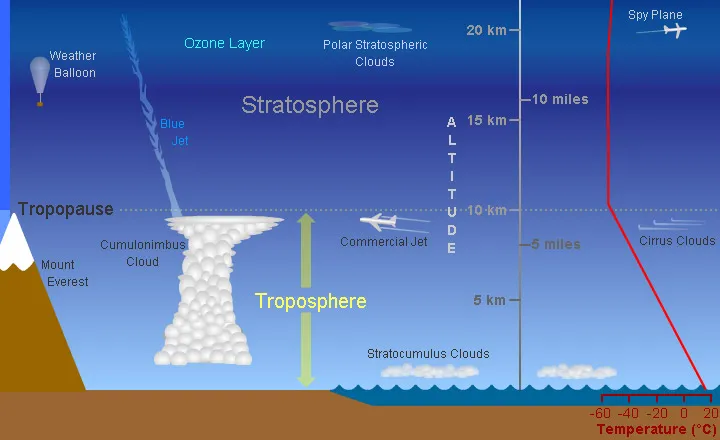
The troposphere is defined as the lowest layer of the atmosphere, extending from the Earth’s surface up to an altitude of approximately 12 km (7.5 miles). This layer contains about 75% of the Earth’s atmospheric mass and nearly all the water vapor present in the atmosphere. The troposphere plays a crucial role in regulating Earth’s climate by influencing weather patterns, seasonal changes, and global temperature.
Etimology of Troposphere
The term “troposphere” originates from the Greek word “trope,” meaning mode, mutation, or change. This refers to the air circulation necessary to restore thermal equilibrium between poles and equator. The sun’s rays strike various points on Earth with different inclinations, resulting in non-uniform absorption of radiation and causing temperature imbalances that lead to air currents.
The concept of troposphere was first introduced by the Swedish botanist and meteorologist Emanuel Swedenborg (1688-1772). He described it as a “tropospheric sphere” containing the gases necessary for plant life. Later, in 1824, the French scientist Nicolas Léonard Sadi Carnot (1796-1832) introduced the concept of troposphere and stratosphere to describe the temperature profiles of these layers.
Why Do Air Currents Matter?
Air currents play a crucial role in distributing heat around the globe, leading to regional climate variations. During winter, cold air masses move from high latitudes towards lower latitudes, while warm air masses move from low latitudes towards high latitudes during summer. This movement creates temperature differences and pressure gradients that drive atmospheric circulation.
Air currents also influence weather patterns by transporting moisture, heat, and pollutants across different regions. They are responsible for the formation of clouds, precipitation, and extreme weather events like hurricanes, tornadoes, and blizzards.
Troposphere vs. Stratosphere
The troposphere and stratosphere are adjacent layers of the atmosphere. The tropopause separates these two regions, marking a significant change in thermal gradient. The stratosphere extends approximately 50 km above the troposphere, with temperatures dropping to -3°C.
In contrast, the troposphere’s temperature decreases with altitude due to heat loss to space. By 12 km altitude, temperatures can drop as low as -50°C with notable temperature fluctuations. This temperature decrease is responsible for the formation of clouds and precipitation within the troposphere.
Characteristics of Tropospheric Temperature
Understanding temperature variations within the troposphere is essential for grasping why phenomena are called what they are. The troposphere’s temperature profile can be divided into several zones:
- Tropical zone: Temperatures in this region range from 20°C to 30°C (68°F to 86°F), with high humidity and precipitation.
- Mid-latitudes: Temperatures decrease by about 5-10°C (9-18°F) per kilometer, reaching -3°C at the tropopause.
- Polar regions: Temperatures can drop as low as -50°C in extreme cold snaps.
Frequently Asked Questions:
- What is the primary factor influencing the temperature in the troposphere?
The primary factor influencing the temperature in the troposphere is the Earth’s surface heat loss, which causes temperatures to decrease with altitude. - Why do air currents play a crucial role in distributing heat around the globe?
Air currents play a crucial role in distributing heat around the globe due to the uneven absorption of solar radiation by different regions, resulting in temperature differences and pressure gradients that drive atmospheric circulation. - What is the main difference between the troposphere and stratosphere?
The main difference between the troposphere and stratosphere lies in their respective temperature profiles and thermal gradients. - How do temperature fluctuations affect atmospheric phenomena?
Temperature fluctuations can significantly impact atmospheric phenomena, such as weather patterns and climate change. - Can pollutants trapped in the troposphere be released into other atmospheric layers?
Yes, pollutants trapped in the troposphere can migrate to higher altitude layers of the atmosphere through vertical mixing processes. - How do changes in stratospheric temperature affect global climate patterns?
Changes in stratospheric temperature can significantly impact global climate patterns by influencing air circulation and heat distribution around the globe. - Can we accurately predict tropospheric temperature using current models?
Current climate models can provide a reasonable estimate of tropospheric temperature, but there is always room for improvement due to uncertainties associated with atmospheric circulation and thermal gradients. - What implications do changes in the troposphere have for human activities such as agriculture and energy production?
Changes in the troposphere can significantly impact human activities like agriculture and energy production by altering regional climate patterns and extreme weather events.
Social Media:
Follow me on Twitter, Facebook, Google+, Instagram for more content!
Related Articles:
- Stratosphere: What is it?
- Pressure Atmosphere: Value and Measurement
- Correnti Ascendenti (Ascending Winds)
- Lithosphere: Meaning
Understanding the troposphere’s significance in our daily lives can help us better grasp the complexities of atmospheric science. By exploring its etymology, characteristics, and relationship with other atmospheric layers, we can gain a deeper appreciation for the importance of air currents and temperature fluctuations in shaping our climate.
As research continues to uncover new insights into the troposphere’s behavior, it is essential to stay up-to-date with the latest findings and developments in atmospheric science. By doing so, we can develop more accurate models and predictive tools to better understand and manage the Earth’s climate system.
In conclusion, a thorough understanding of the troposphere’s characteristics and temperature patterns enables us to grasp many atmospheric phenomena and understand their significance in our daily lives.


