
The Trojan Horse: A Legend from the Iliad
Introduction
We all know the story of the Trojan Horse, but who actually knew it? It’s a testament to the power of literature, legends, and history that have been passed down through generations and mixed with fact, turning everyday wars and conquests into epic tales. The great Homer has given us this legendary tale, which is still widely referenced today, even in the world of computers.
The Legend of the Trojan Horse: From the Iliad
Before diving into the story of this “animal,” let’s spend a few words on its author, who is believed to have been an important poet at the court of a prince from Troy, living around the 8th century BC. We find in his works the poem of Ilio, which is about the city of Troy and its siege by the Greeks during the Mycenaean era, around the 12th century BC. From a historical perspective, there are confirmations that Troia existed; we can see its ruins at the archaeological site of Hisarlik in Turkey, and it was a fortified city in Asia Minor that fell around 1200 BC.
The Greeks’ attack on Troy was successful thanks to a clever war machine designed specifically to breach the city, a stratagem that allowed them to escape an eleven-year siege. Let’s finally tell the story of the Trojan Horse.
We are in war, a war initiated mainly for commercial reasons but narrated from a more dramatic perspective as if it were born from the abduction of the beautiful Helen, wife of the Achaean king Menelaus, carried out by Paris, son of King Priam of Troy.
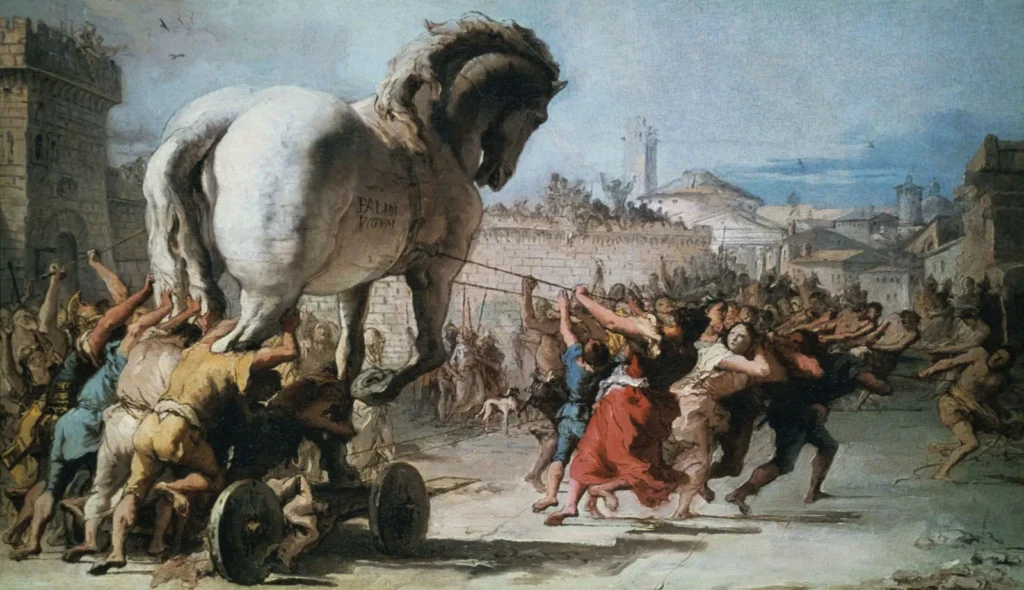
Reading the poem that Homer has given us allows us to experience this entire episode as if it were happening right in front of us. The story of the Trojan Horse is certainly the most well-known and tells about a wooden horse built by Epeo, a real war machine that allowed the Greeks to conquer Troia, putting an end to a long siege lasting more than ten years. The army left this enormous wooden horse outside the city gates as if it were a propitiatory gesture but inside had its strongest men ready to launch a surprise attack on the city. The horse was welcomed by the besieged city with open arms and so could determine their defeat.
The War of Troia: The Contrasting Armies
During the war of Troia, we find the Greeks (Achei) and Trojans as opposing forces in the verses of Homer. The Achei were organized into different contingents led by local rulers who represented the noble warriors and commanded directly the soldiers who had accompanied them. We shouldn’t think of a unified and particularly disciplined army but rather of a collection of alliances, each with its own commander to whom the soldiers had sworn allegiance.
On the other side, we have the Trojans, the defeated ones, those who welcomed the Trojan Horse and in short, were “freaked out.” We are faced with another army composed of various groups corresponding to the different peoples living in those areas at that time. Each group followed a commander, a nobleman. However, there is a difference between Achei and Trojans. The latter had also contingents made up of mercenaries “seasonal,” who were hired on a contract.
Was it Really a Horse? Alternative Theories
Over the years among historians, there has been a debate about the identity of the Trojan Horse or, more accurately, its forms. Was it really a giant wooden horse built for the purpose of war? How and why did they make it enter the city so strange? There are some theories that could be more realistic and connected to reality, and among these we find one proposed by the naval archaeologist Francesco Tiboni, doctor of research at the University of Marseille, collaborator with several foreign and Italian universities. The Trojan Horse as we have imagined from school studying epics would be a product of an error in the translation of subsequent texts following Homer’s works, to which Virgil also drew inspiration when composing the Eneide. The horse was not a horse (hippos) but a Fenician ship, a type of ship that had all effects.
The Use of “Cavallo di Troia” in Common Language
Whether it was a horse or a ship, today we use the term “Trojan Horse” to refer to an insidious thing that allows us to infiltrate a hostile environment and then surprise our adversary and win. It’s therefore synonymous with deception, a very diabolical kind of deception just like the one told by Omero.
The Trojan Horse: A Threat to Our PCs
Using the same term, we can also refer to a type of malware in the field of computer science, known as a Trojan or Trojan Horse. The characteristics are the same; the Trojan hides inside another program that appears harmless and useful, we install it and execute it without realizing that its true purpose is concealed. The name is linked to the fact that this malware is deceptive and deliberately conceals its real intention just like the Achei did with the Trojans.
FAQs
- What inspired Homer to write about the Trojan Horse?
Homer was likely inspired by his observations of ancient Greek warfare and politics.
- Was the Trojan Horse really a horse or ship?
There is ongoing debate among historians about whether the Trojan Horse was a real horse or a ship, with some suggesting it may have been a type of Fenician vessel.
- Why did the Trojans welcome the Trojan Horse without suspicion?
The Trojans were tricked by the Greeks who had promised them that the horse would serve as a peace offering to their gods.
- What does the term “Trojan Horse” mean in modern usage?
It refers to a metaphorical term for an insidious thing or deception, often used in computer science to describe malware that hides inside other programs.
- Is the Trojan Horse still relevant today?
Yes, it remains a widely recognized symbol of cunning and deception, and is often referenced in popular culture.
- Can we learn anything from the story of the Trojan Horse?
The story teaches us about the importance of vigilance and the dangers of underestimating one’s opponents.
- What was the significance of the Trojan War in ancient Greek history?
It marked a turning point in the development of Western civilization, showcasing the clash between East and West.
- Was the Trojan Horse a single horse or multiple horses?
There is no clear answer to this question, with different accounts suggesting either one or multiple horses.
- How did the Greeks develop the Trojan Horse?
According to legend, it was built by Epeo, a skilled craftsman who worked under the direction of Odysseus.
- Why has the story of the Trojan Horse endured for so long?
It remains an enduring tale because of its timeless themes and universal appeal, continuing to captivate audiences to this day.
- Can we find any historical evidence of the Trojan Horse’s existence?
There are no definitive archaeological finds that prove the existence of a single wooden horse.
- How does the story of the Trojan Horse relate to other myths and legends?
It is part of a larger mythological tradition in ancient Greece, where gods and mortals interacted in complex ways.
- Was the Trojan War fought between different city-states or ethnic groups?
The war was fought between Troy and the Greeks, who were primarily from various city-states on the Greek mainland.
- What role did Helen play in the Trojan War?
She was the catalyst for the conflict, as her abduction by Paris sparked a chain reaction of events that led to the war.
- Can we learn anything about ancient warfare from the story of the Trojan Horse?
The tale highlights the importance of clever tactics and deception on the battlefield, which were key components of ancient warfare.
- Why is the Trojan Horse often associated with computer security?
It has become a metaphor for malware that hides in plain sight, waiting to be discovered and exploited.
- Is there any historical evidence that suggests the Trojan War actually occurred?
While there are no definitive proof, archaeological discoveries have confirmed the existence of an ancient city at Hisarlik, which matches descriptions of Troy in Homer’s epics.
- Can we draw parallels between the story of the Trojan Horse and modern-day cybersecurity threats?
The tale serves as a reminder to always be vigilant and cautious when interacting with unfamiliar technology or systems.
- Why has the legend of the Trojan Horse endured across cultures and time?
It is a timeless story that continues to captivate audiences because it taps into universal human experiences, such as deception, cunning, and the thrill of adventure.
- What can we learn from studying the history of the Trojan Horse?
We gain insights into ancient Greek culture, politics, and warfare, as well as the importance of critical thinking and vigilance in a rapidly changing world.
By analyzing the legend of the Trojan Horse, we uncover deeper meanings and parallels that transcend time and cultures.


