
The Performance of Condensing Boilers
As the most eco-friendly and technologically advanced gas boilers available today, condensing boilers offer significant energy savings and reduced emissions. However, they come with a higher upfront cost compared to traditional boilers.
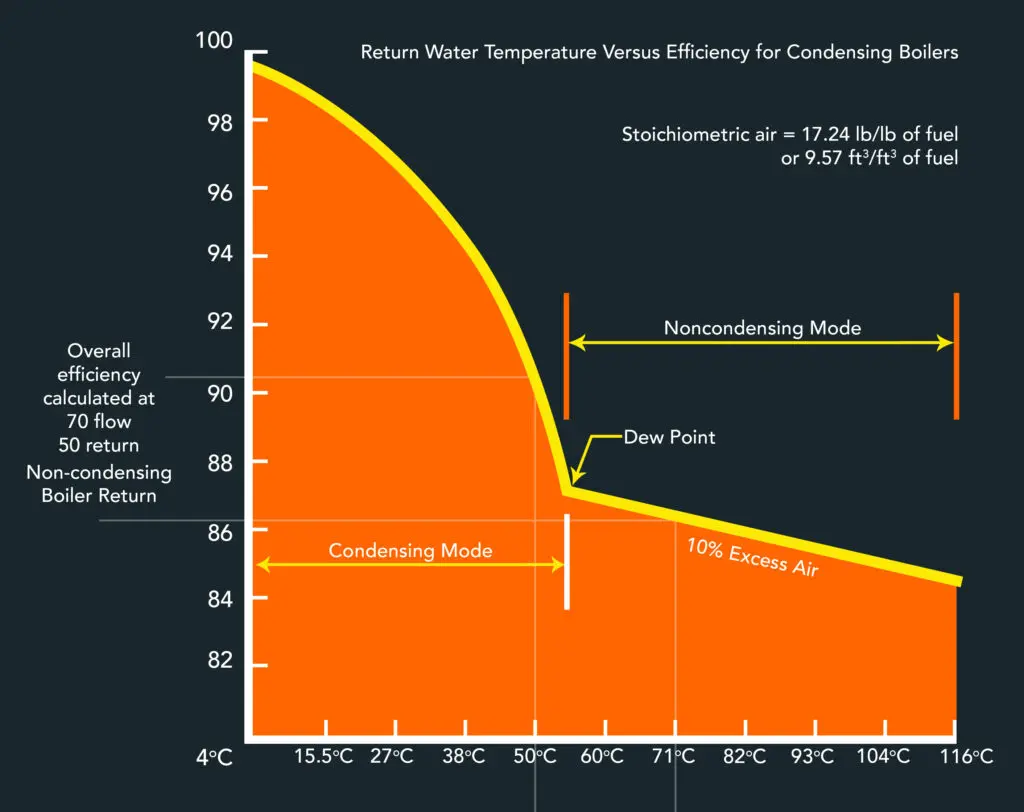
In terms of performance and consumption, condensing boilers can save homeowners up to 15-20% on hot water costs at 80°C (compared to high-efficiency traditional boilers) and 20-30% on costs for hot water at 60°C.
The maximum energy savings are achieved when these systems are used in low-temperature operation settings (between 30°C and 50°C), such as in radiant floor heating without heat exchangers, where the ideal operating temperature is between 25°C and 35°C.
The excellent performance of condensing boilers relies on their ability to capture the latent heat of condensation from the water vapor present in the exhaust gases after combustion.
This heat is equivalent to around 11% of the energy released by combustion, rather than being lost into the atmosphere through the chimney. Instead, this heat is recovered and used to produce hot water or space heating.
However, these advanced boilers are more expensive than their traditional counterparts because they require enhanced corrosion resistance and a smooth surface for heat exchange without fins. Additionally, condensing boilers need to be installed in such a way that the resulting condensation can flow into the neutralizer or wastewater outlet, which complicates installation processes.
In condensing boilers, exhaust gases lose heat to the water circulating through the system, cooling down until they return to liquid form at around 40°C, much lower than the 140-160°C temperatures of high-efficiency boilers and the 200-250°C of traditional boilers.
Understanding Heat Exchangers
A well-designed heat exchanger is crucial for efficient performance. In condensing boilers, this component consists of a series of tubes where hot gases flow through to transfer their heat to cold water or steam.
The most common type of heat exchanger used in condensing boilers is the cross-flow heat exchanger. This design features a series of parallel tubes with a fluid passage between them, allowing for efficient heat transfer.
However, this configuration can lead to issues such as poor heat transfer rates and increased pressure losses. To mitigate these problems, some manufacturers have developed alternative designs, such as the counter-current heat exchanger, which features tubes arranged in an alternating pattern to optimize heat transfer.
The Benefits of Condensing Boilers
Condensing boilers offer several advantages over traditional boilers, including:
- Higher Efficiency: By capturing the latent heat of condensation, these boilers can achieve efficiencies up to 90%, which is significantly higher than traditional boilers.
- Reduced Emissions: Condensing boilers produce fewer emissions, making them a more environmentally friendly option for heating homes and businesses.
- Lower Operating Costs: With their improved efficiency, homeowners can enjoy lower energy bills, especially when using the boiler for hot water.
Applications of Condensing Boilers
Condensing boilers are versatile and can be used in various settings, including:
- Residential Homes: These boilers provide efficient heating and hot water solutions for homes.
- Commercial Buildings: Large-scale applications where condensing boilers can offer significant energy savings.
- Hotels and Hospitality: Condensing boilers are often preferred due to their high efficiency and reliability.
Common Issues with Condensing Boilers
While installing a condensing boiler might seem complex, it’s essential to consider the following factors:
- Proper Venting: The exhaust gases need to be vented properly to ensure efficient heat transfer.
- Insulation: Proper insulation is necessary to minimize heat loss and optimize energy efficiency.
Frequently Asked Questions (FAQs)
Here are some common questions related to condensing boilers:
- What is the average lifespan of a condensing boiler?
- The average lifespan of a condensing boiler is around 15-20 years, but with proper maintenance, it can last longer.
- Can I install a condensing boiler myself?
- It’s highly recommended to hire a professional for installation, as it requires specialized knowledge and equipment.
- What is the most common cause of boiler failure?
- The most common causes of boiler failure include poor maintenance, incorrect sizing, and inadequate ventilation.
Conclusion
Condensing boilers offer numerous benefits, including higher efficiency, reduced emissions, and lower operating costs. By understanding their key components, applications, installation considerations, and maintenance requirements, homeowners can make informed decisions when choosing a heating solution for their property.


