
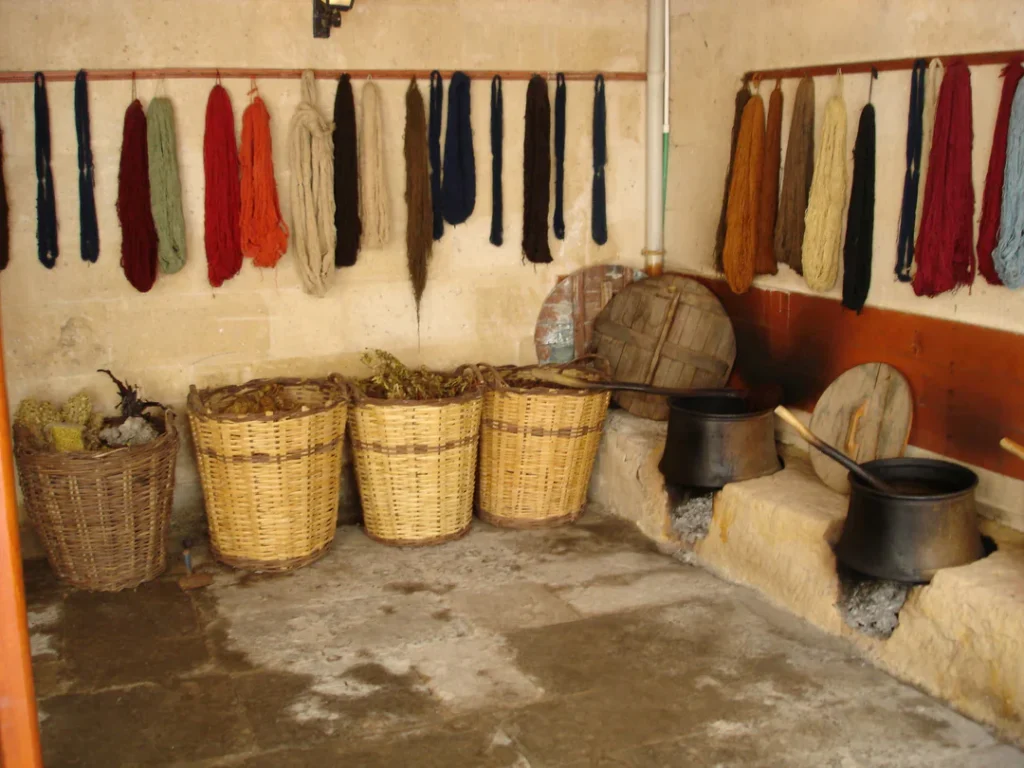
For a long time, textile dyes were exclusively of “natural” origin. The preparation of dye baths began with roots, shrubs, and leaves; less ethically and more rare, was the preparation of dye baths from animal-derived derivatives: for centuries, the red scarlet that tints the robes of cardinals has been obtained from two different species of snails.
Initially, textile dyes were applied only to natural fibers like cotton, linen, wool, and silk. The world of textiles began to change in 1858, when Perkin, an assistant at the Royal College of Chemistry in London, patented the first synthetic textile dye derived from coal fossil. The color in question was a brilliant violet, destined to become a fashion cult for the industry’s tinting of silk fabrics. Later, with the same process, Perkin successfully extracted a fuchsia-tending red color.
The 1862 London Exhibition showcased many textiles dyed with these new substances, those derived from coal. A few years later, synthetic dyes had already surpassed natural ones because they were much more economical to obtain: no longer did one need to wait for a new harvest, the cultivation of crops was no longer necessary… just a few chemical components, coal, and a good laboratory to obtain the necessary dyes for coloring fabric.
The history of textile dyes can be summarized as follows:
Natural Dyes (Henné with Lawsonia inermis extracts, natural equisetum dyes, mirtillo extracts, cherry bark dyes, lichen dyes, robbia dyes…)
These natural dyes have been used for centuries to color textiles. Henné, a plant-based dye, has been used to produce shades of yellow and orange. Lawsonia inermis, also known as madder, is a plant that produces a range of reds and pinks. Natural equisetum dyes are obtained from the leaves and stems of the equisetum plant and can produce a range of colors, including blues and purples. Mirtillo extracts, which are derived from the fruit of the mirtillo plant, have been used to create shades of pink and red.
Synthetic Dyes (Starting from 1877)
The development of synthetic dyes marked a significant turning point in the history of textile dyes. Synthetic dyes were first synthesized by Perkin in 1858, using coal tar as a starting material. The resulting dye was a brilliant violet, which quickly became popular for its vibrant color and ease of use.
In the late 19th century, synthetic dyes began to replace natural dyes more widely. This was due to their greater availability, lower cost, and improved lightfastness (resistance to fading). Synthetic dyes also offered a wider range of colors than natural dyes, making them more versatile for textile production.
The Development of New Colors
In the early 20th century, new synthetic dyes were developed that allowed for even greater shades and hues. These included the development of aniline-based dyes, which produced rich blues and greens, as well as direct dyes, which produced a wider range of colors than previously possible.
The use of synthetic dyes also led to the development of new textile fibers, such as nylon, polyester, and acrylic, which could be colored using a wide range of dye shades. These fibers were highly durable and resistant to wrinkles, making them popular for a range of applications, from clothing to upholstery.
Key Milestones
- 1858: Perkin patents the first synthetic textile dye derived from coal fossil.
- 1862: The London Exhibition showcases textiles dyed with new substances, those derived from coal.
- 1877: Synthetic dyes begin to replace natural ones.
- Late 20th century: Synthetic fibers like perlon, nylon, and dralon emerge, forcing the industry to seek out new colorants.
The Advent of New Materials
In recent years, the textile industry has seen the emergence of new materials that have further expanded the possibilities for dyeing. These include:
- Polyester: A synthetic fiber that can be dyed using a wide range of colors.
- Acrylic: A synthetic fiber that can be colored using a variety of dyes.
- Nylon: A synthetic fiber that was first developed in the mid-20th century and has since become widely used for clothing, upholstery, and other applications.
The Environmental Impact of Textile Dyes
The textile dyeing process has a significant environmental impact. The use of coal-derived substances can lead to environmental pollution, as well as health problems for workers involved in the production process.
Some of the key environmental concerns associated with textile dyeing include:
- Air and water pollution: The production of synthetic dyes can release harmful chemicals into the air and water.
- Health problems: Workers involved in the dyeing process may be exposed to hazardous substances, which can cause a range of health problems.
- Waste disposal: Textile dyes and other chemicals can contribute to waste disposal problems.
Conclusion
The history of textile dyes is a story of innovation and development. From natural extracts to synthetic substances, the industry has come a long way. However, with the advent of synthetic fibers and the resulting need for new colorants, we must also consider the environmental impact of our choices. As consumers, we have the power to make informed decisions about the products we wear.
Frequently Asked Questions
- What are the most common natural textile dyes?
- Henné with Lawsonia inermis extracts
- Natural equisetum dyes
- Mirtillo extracts
- Cherry bark dyes
- Lichen dyes
- Robbia dyes
- When did synthetic dyes begin to replace natural ones?
- 1877
- What are some of the environmental concerns associated with textile dyeing?
- Pollution from coal-derived substances
- Health problems for workers involved in the production process
- How have synthetic fibers affected the textile industry?
- The need for new colorants has forced the industry to seek out alternative options.
- What is being done to address the environmental impact of textile dyeing?
- Research into sustainable and eco-friendly dyes
- Development of more environmentally friendly production processes


