
Have you ever wondered how a sequence of numbers becomes centered around an animal like a rabbit? The story of the Fibonacci sequence can explain this. This fascinating series of digits, almost hypnotic, is important not only for mathematics but also for geometry, art, and computer science. And it’s curious that it’s linked to an innocent-looking creature like the rabbit, let’s uncover why.
Content
- The Fibonacci Sequence and Rabbits
- What is the Fibonacci Sequence?
- Fibonacci and Geometry
- Fibonacci and the Golden Ratio
- Fibonacci Day
- A Book on the Fibonacci Sequence
- Rabbits, Trees, and the Fibonacci Sequence
The Fibonacci Sequence and Rabbits
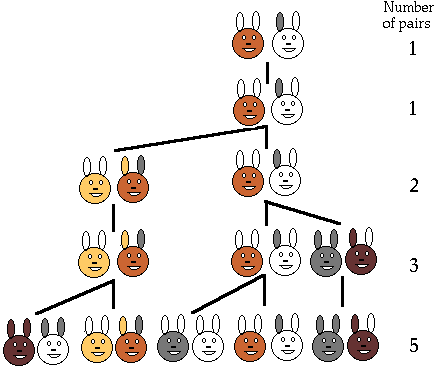
It’s to solve a population and reproduction problem of rabbits that Leonardo Pisano, also known as Fibonacci, found this sequence of numbers. Living between 1175 and 1250, this mathematician from Pisa, son of Bonaccio, first identified this series in 1202 to answer an animal-like puzzle. Here’s the solution.
- How many couples of rabbits are produced in a year by a single couple, assuming that each month (except the first) produces a new couple that becomes fertile from the second month? The answer is 144 rabbit couples.
- This problem was proposed by Emperor Frederick II of Swabia in 1223 during a mathematical tournament at Pisa.
What is the Fibonacci Sequence?
Let’s leave the rabbits and study the Fibonacci sequence to understand how it’s made and what it can be used for, being aware that it may not be essential for many people to know the reproduction rate of rabbits. If we observe the first ten numbers in the series, we notice that each one is the sum of the two preceding ones: 0, 1, 1, 2, 3, 5, 8, 13… We can continue indefinitely.
At first glance, it may seem like a game or a way to learn how to add numbers, and so we have thought for many years, actually, if not centuries. It wasn’t until the 19th century that it emerged that this seemingly “banal” sequence is actually an important element in probability calculations, the golden ratio, and the golden triangle.
Fibonacci and Geometry
The application of the Fibonacci sequence in geometry allows us to discover interesting shapes and balances. If we build squares with sides measured according to Fibonacci’s series and inscribe a quarter-circle arc within each square, we get a hypnotic spiral that grows at a particular pace, known as the golden ratio.
In apparent disconnection from the series, this constant is obtained by dividing a segment into two parts equal in proportion (a) and b, such that the shorter part (b) is proportional to the longer part (a), just as the latter is proportional to the entire segment (a + b). This results in a ratio of a/b equal to 1.61803, exactly the value of the golden ratio (φ), which has been associated with the idea of balance and beauty since ancient times. We find it in famous architectural works and even in our own bodies. If harmonic, it has parts that are ideally related to the golden ratio.
Fibonacci and the Golden Ratio
If we take only the adjacent elements within the sequence, we notice that their ratio approaches the golden ratio as we progress with the series.
Fibonacci Day
If you’ve understood how the sequence works, you can maybe intuit what date it’s celebrated. November 23rd. Let’s write this date in American style and arrange its digits in a row (11/23), so we see the first four of our famous sequence: 1, 1, 2, 3… For now, only few people know about this day, but maybe it will become the balance and harmony day in the future. We could certainly use that.
A Book on the Fibonacci Sequence
For true fans of this mathematician from Pisa, I recommend a book dedicated exclusively to his famous sequence and its life. It’s called “The Magical Numbers of Fibonacci,” written by Keith Devlin and translated into Italian by D. Didero. You can buy it here on Amazon for $6.99 starting from the digital version.
In the text, you’ll discover that Fibonacci was the author of the “Liber abbaci,” the most important algebraic text of its time, which explained how to adopt the Indo-Arabic number system and showed Europeans the practical and commercial benefits of mathematics. The adoption and diffusion of this Indian-based system on zero across Europe favored the scientific and economic dominance of Western Europe over the rest of the world.
A Book on the Fibonacci Sequence
Published by Marta Abbà on September 28, 2021
Rabbits, Trees, and the Fibonacci Sequence
One of the most famous applications of the Fibonacci sequence is in plant growth, where it helps explain how leaves and branches are arranged. This is because trees have a natural tendency to grow in a spiral pattern, which can be described by the golden ratio.
In nature, we find examples of this type of arrangement everywhere: from the structure of pineapples, the arrangement of seeds in sunflowers, or even the branching patterns of rivers. These patterns are not just aesthetically pleasing; they also play a crucial role in the survival and growth of these organisms.
For example, when trees grow, their branches split off at an angle that is related to the golden ratio. This allows them to maximize exposure to sunlight while minimizing competition for resources with other branches. Similarly, the arrangement of leaves on stems follows this pattern, which helps optimize photosynthesis and minimize water loss through transpiration.
This spiral growth pattern is not limited to trees; it can be observed in many other living organisms, including flowers, seeds, and even the structure of some animals. The Fibonacci sequence provides a fundamental framework for understanding these patterns and how they contribute to the overall health and survival of individuals and species.
The Fibonacci Sequence and Computer Science
In computer science, the Fibonacci sequence is used extensively in algorithms and data structures. For example, binary trees are often represented using a Fibonacci-like structure, where each node has two children (left and right). This allows for efficient insertion and deletion operations, as well as optimized traversal of the tree.
Additionally, the Fibonacci sequence is used in algorithms for solving problems related to dynamic programming, such as finding the minimum number of steps required to reach a target state from an initial state. The use of Fibonacci-like structures also enables more efficient solutions to problems involving recursive relationships, where each step builds upon previous ones.
The Fibonacci Sequence and Art
In art, the Fibonacci sequence has been used to create visually pleasing compositions that incorporate mathematical proportions. This is particularly evident in the work of artists who have studied the golden ratio and its relationship to aesthetics. For example, Leonardo da Vinci was known for his use of Fibonacci-like patterns in his paintings, which created a sense of balance and harmony.
Similarly, many famous architects have incorporated Fibonacci sequences into their designs, creating buildings that are both aesthetically pleasing and structurally sound. The Golden Gate Bridge in San Francisco, for instance, features a design based on the golden ratio, which has been shown to reduce stress and fatigue in drivers who use it.
The Fibonacci Sequence and Probability
In probability theory, the Fibonacci sequence is used to model random processes that exhibit long-term dependence. This is because the sequence provides a way to describe how probabilities change over time, allowing for more accurate predictions of future events.
For example, when modeling population growth or financial markets, Fibonacci-like sequences can be used to capture the inherent patterns and rhythms that govern these systems. By incorporating the golden ratio into models, researchers can gain a deeper understanding of how random processes interact with deterministic factors, leading to more accurate forecasts and decision-making.
Conclusion
In conclusion, the Fibonacci sequence is a fundamental element in mathematics, geometry, art, computer science, probability theory, and many other fields. Its appearance in nature, from the arrangement of leaves on trees to the branching patterns of rivers, speaks to its universal significance and beauty.
While it may seem like just a series of numbers at first glance, the Fibonacci sequence has proven to be an incredibly powerful tool for understanding complex systems and optimizing performance. Whether you’re studying rabbit populations or designing bridges, the Fibonacci sequence provides a framework for exploring the intricate patterns that govern our world.


