
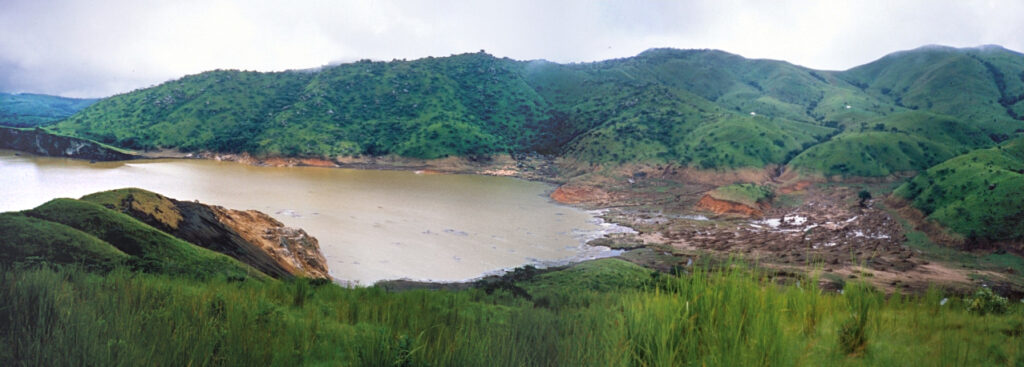
Deep in the heart of Africa, Cameroon is a landlocked country that spans across Nigeria, Chad, and other small western coast states. The Lake Nyos and its neighboring Lake Monoum are volcanic lakes formed when their dormant craters were filled with water, creating vast amounts of carbon dioxide beneath the surface.
On August 21, 1986, people and animals living near the lake began to die. By morning on August 22, over 1,700 bodies had been found dead. While we’re accustomed to discussing natural disasters like tsunamis, hurricanes, and earthquakes, this event stands out as particularly unique – even more so than opening a soda bottle.
When you shake a soda bottle, the pressure release is similar to what happened in Cameroon that fateful August. A gas present in the liquid escapes rapidly. In the case of Lake Nyos, carbon dioxide beneath the surface rose into the air when disturbed, releasing approximately one cubic kilometer of CO2 into the atmosphere.
The carbon dioxide eventually reached the surface and formed a dense cloud, displacing oxygen and causing asphyxiation among nearby villagers. Today, Lake Nyos remains “potentially deadly.” In contrast to other lakes around the globe where water levels change seasonally due to natural circulation patterns (the overturning of aquatic layers), Lake Nyos maintains this stagnation. Geologists studying these lakes have discovered that only the Lake Nyos contains between 300 to 400 million cubic meters of CO2 – an astonishing 1,600 times more than what’s typically found in a lake of similar size.
The lakes are still considered potentially fatal. Scientists speculate that the event occurred when some unknown disturbance upset the lake’s balance. A small underwater landslide or strong wind could have triggered this devastating release. Geologists believe it would take such an incident to result in 1,700 fatalities.
Despite the ominous nature of these events, humans can’t help but be drawn to the power of nature. In Cameroon, geologists, scientists, and enthusiasts converge on the lakes to witness small releases of gas from beneath the surface. A team of French geologists partnered with an American research group is working to address this issue.
In early 2001, researchers deployed a nearly 200-meter-long conduit through which CO2 could escape into the water column, creating a dramatic display as the water rose 55 meters above its resting level. Although this initial attempt was successful in releasing approximately 20 million cubic meters of gas, it’s not enough to render Lake Nyos completely safe. To achieve true safety, additional conduits were designed, allowing enthusiasts to observe real “fountains” of water and gas.
Understanding Natural Gas Release
Carbon dioxide is a naturally occurring gas present in the Earth’s atmosphere. However, when its pressure increases or decreases significantly, it can behave erratically, leading to rapid releases into the environment. This phenomenon can occur due to various factors, including geological events, human activities, or natural fluctuations.
When CO2 levels beneath Lake Nyos were disrupted, it resulted in a catastrophic release of gas into the atmosphere. The subsequent cloud formation and displacement of oxygen caused widespread asphyxiation among nearby villagers. This event highlights the importance of understanding how CO2 behaves under different conditions and pressure changes.
The Scientific Community’s Approach
Researchers have been studying Lake Nyos since the 1986 disaster, focusing on the underlying causes of these events. The scientific community has made significant progress in understanding the complex processes involved in natural gas releases.
In 1993, a research team led by Dr. John M. Kotz from the University of California published a study detailing the mechanisms behind CO2 release events in Lake Nyos. Their findings emphasized the importance of monitoring CO2 levels and understanding the lake’s hydrology to mitigate the risks associated with these events.
Since then, numerous studies have been conducted on Lake Nyos, focusing on various aspects such as:
- CO2 storage and release: Researchers have developed models to simulate CO2 behavior beneath the lake, allowing for better predictions of potential releases.
- Lake hydrology: Scientists are working to improve our understanding of the lake’s circulation patterns, which is essential in predicting when and where CO2 levels might become hazardous.
- Experimental methods: Teams have developed new techniques for observing and monitoring CO2 releases from beneath the surface.
Observing Nature’s Power Up Close
In recent years, scientists and enthusiasts alike have gained access to Lake Nyos through controlled experiments designed to safely observe natural gas release events. These initiatives not only contribute to our understanding of these phenomena but also provide valuable insights into the complex interactions between geology and human activities.
One notable example is the 2013 experiment conducted by a team of researchers from the University of Cameroon, in collaboration with French geologists. They deployed a network of sensors and cameras to monitor CO2 levels and observe real-time releases from beneath the surface.
Lake Nyos: Still Potentially Fatal Today?
Despite the efforts made to mitigate risks associated with Lake Nyos, it remains a significant threat due to its unique combination of geological features and high CO2 levels. Scientists continue to work on refining our understanding of these events and developing effective strategies for managing potential releases.
The ongoing research emphasizes the importance of collaboration between scientists, government agencies, and local communities in addressing these complex issues. By working together, we can minimize the risks associated with Lake Nyos and other similar lakes while appreciating the awe-inspiring power of nature.
Conclusion
Lake Nyos remains a fascinating example of the complexities involved in natural disasters. While we’ve made significant progress in understanding CO2 release events and their potential impacts, there is still much to be learned from these phenomena.
Through ongoing research and collaboration, we can work towards minimizing risks associated with Lake Nyos and other similar lakes. By embracing the power of nature and working together, we can ensure that future generations will have a deeper appreciation for the intricate relationships between geology, human activities, and our planet’s natural processes.
Frequently Asked Questions (FAQs)
- What triggered the CO2 release at Lake Nyos?
- Human disturbance, specifically a sudden event like an underwater landslide or strong wind, can disturb the balance beneath the lake.
- How does carbon dioxide behave under different conditions?
- CO2 expands when its pressure increases and contracts when its pressure decreases, leading to the rapid release of gas from beneath the surface.
- What are the current efforts to manage CO2 levels at Lake Nyos?
- Researchers use conduits to safely release CO2 into the water column, allowing for controlled observation of these natural phenomena.
- Why is it difficult to completely render Lake Nyos safe?
- The sheer volume of carbon dioxide present in Lake Nyos and its ongoing natural processes make it challenging to eliminate the risk entirely.
- Can other lakes with similar conditions be managed similarly?
- While the specific circumstances at each lake can differ, understanding natural gas release mechanisms can guide efforts to mitigate risks elsewhere.
- How does this impact global climate change discussions?
- The study and management of CO2 releases at Lake Nyos provide insights into natural carbon sinks and sources, contributing to broader conversations on global climate change.
- What is the current outlook for monitoring and managing these lakes?
- Ongoing research aims to improve our understanding of these natural events, ensuring that we can mitigate their dangers while still appreciating the power of nature.
By embracing the complexities involved in Lake Nyos and other similar lakes, we can work towards a better understanding of natural disasters and their potential impacts on human societies.


