
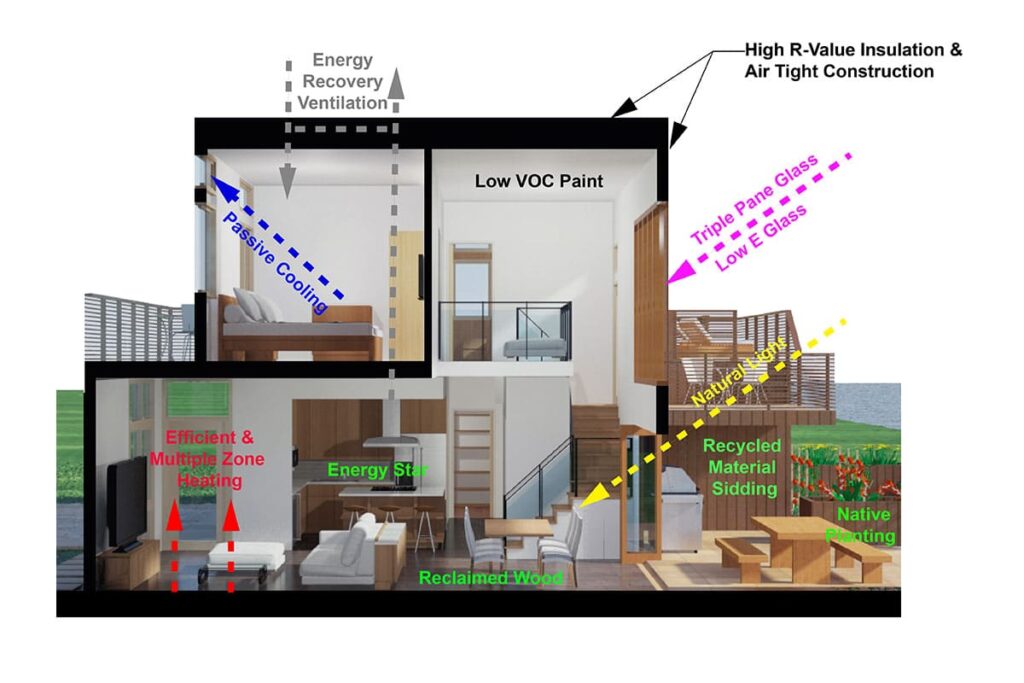
Let’s explore what makes a sustainable home and its main characteristics. The costs of construction and prefabricated eco-friendly homes are becoming increasingly accessible.
A sustainable home can be described as the embodiment of comfortable living and all the principles of bio-edilizia. In fact, a sustainable home should be able to meet modern comfort standards without burdening the environment in terms of:
- Materials used
- Energy consumption
- Geographical location
- Water consumption
A sustainable home must be designed to use resources rationally. It shouldn’t lack systems for energy management and automation, as well as devices for self-production.
Costs of Sustainable Home Construction
Today, the costs of building a sustainable home are much more accessible. Thanks to the diffusion of innovative materials and increased environmental awareness. In addition, there are eco-friendly prefabricated homes made from cement or wood. Before we talk about prefabricated sustainable homes, let’s explore what characteristics an architecture green has.
Sustainable Home Characteristics
When we talk about a sustainable home, we refer to an abode that embodies the good principles of bio-edilizia. We refer to an abode where inhabitants adopt a respectful attitude towards the environment. At a descriptive level, we can reduce the principles of a sustainable home to 10 simple characteristics.
1 – A Sustainable Home Leverages Renewables
The sun is the oldest source of energy we have: in one hour, the Earth receives from the sun an amount of energy equivalent to the world’s annual energy consumption. With a solar panel, it is possible to produce hot water and meet domestic needs. Solar cooling also allows for cool homes in summer and warmth in winter.
In summary, with solar energy, you can really do everything. The photo above shows the photovoltaic quarter of Friburg (Germany) where solar power is its forte.
2 – Specialized Appliances and Lighting
Lighting represents 20% of global electricity consumption. LED lamps, although costing 10 times more than old or incandescent bulbs, last 8 to 10 times longer and consume much less. Those living in a sustainable home can contribute to the cause by turning off non-used lamps, thus a family could save around €60 per year. To further reduce energy consumption, one can count on domotics with timers or sensors that regulate lamp turn-on and turn-off.
Not only lighting. Every appliance and device should be dimensioned properly. The energy label is a good reference point for those who want to furnish an eco-friendly home.
Energy-efficient appliances A++ allow for high electricity savings. Smart devices also need an intelligent attitude: using full-load washing machines and dishwashers allows for water conservation up to 8,000 liters per year!
3 – Well-Insulated Homes
A sustainable home is well-insulated and doesn’t present thermal dispersion. An uninsulated home increases heating and air conditioning costs. Insulation reduces energy consumption dramatically.
In reality, most architectural sustainability principles aim at ensuring good insulation to lower the entire structure’s energy consumption. In this field, materials of construction and involucro edilizio properly designed are crucial.
4 – Windows Don’t Charge Your Bill
Heat disperses mainly through windows: infissi represent the weak point of thermal insulation.
A sustainable home has intelligent infissi that allow natural lighting and guarantee good insulation. Using materials with high insulation properties, the energy consumption of the house will decrease by at least 33%.
5 – People Living in Sustainable Homes Are Environmentally Conscious
Every inhabitant’s habits have a concrete impact on the home’s energy balance. Starting from small things like remembering to turn off LED lights that indicate standby TV, washing machine, or microwave on.
To avoid the problem of standby consumption that consumes electricity, it is better to connect all electrical appliances to a multi-outlet with an interruttore. When not used, just switch off the central power outlet and save up to €80 per year.
6 – Sustainable Homes Properly Manage Waste
It’s very sad but in Italy, we are really few to differentiate waste. We estimate that only 50% of Italian citizens engage in differentiated waste collection. A smart home actually puts inhabitants in a position to manage waste in a simple way… and it’s all about the kitchen! It prefigures separate compartments for recycling without keeping bags or containers here and there!
7 – Sustainable Homes Reduce Waste
With materials isolating and energy-efficient appliances, waste consumption is reduced but not water and food. Every year we throw away an average of 9 billion euros in food. This is a huge amount of money and resources wasted. New designs are being developed to promote smart fridges that help create intelligent grocery lists and monitor food expiration dates! A valuable help to avoid wasting resources.
8 – Sustainable Homes Have Green Spaces
Ideally, a sustainable home should have green spaces, gardens, or vertical gardens where you can grow and consume locally sourced products. Extensive green roofs or intensive green roofs are optimal solutions for urban homes.
Green roofs not only provide excellent insulation but also give clean air along the house perimeter and contribute to making the world a better place.
Instead of an extensive green roof, it’s possible to create vertical gardens like those shown in the photo above: One Central Park, Sydney (Australia).
9 – Exposure and Location with Low Impact
In ideal conditions, a sustainable home should have 30-40% of its surface area oriented towards South to maximize solar radiation in winter and avoid overheating in summer.
Not only exposure is important. A truly eco-friendly home must be designed to have low environmental impact. A home ecologically designed never coincides with abusive urbanism or causes erosion of coastlines, consumption of land… it’s better to replace old buildings with demolition permits rather than occupying new land.
10 – Sustainable Homes Use Sustainably Sourced Materials
A sustainable home should be built using materials with low environmental impact. We talk about non-toxic, safe for inhabitants and the environment. Materials must also be evaluated in terms of durability or guarantee of thermal performance during the design phase. Many insulating materials lose performance over 10-20 years… too few for a house!
Sustainable Home Prefabricated Cost
Prefabricated eco-friendly homes are now available on project basis, not just by browsing a pre-made catalog! The final cost of a prefabricated sustainable home can be around €1,800 per square meter but may increase or decrease depending on the consumer’s wishes.
You might also be interested in reading Yurta: an eco-friendly home and How to Furnish a Sustainable Home
Published by Anna De Simone on February 17, 2017
Conclusion
A sustainable home is not just a dream. It can become a reality thanks to innovative materials and energy-efficient technologies. The costs of construction and prefabricated eco-friendly homes are becoming increasingly accessible.
By adopting the 10 characteristics mentioned above, you can create a comfortable and environmentally friendly home that meets your needs without harming the planet.
So, if you’re thinking of building or buying an eco-friendly home, start by assessing your energy consumption and waste production. Make sure to choose materials with low environmental impact and invest in efficient appliances.
In addition, consider incorporating green spaces, solar panels, and sustainable building practices into your design. With a little creativity and knowledge, you can create a home that not only reduces its carbon footprint but also makes you feel happy and at peace.
So, let’s start building a more sustainable future, one home at a time!
Additional Tips
- Consider using materials with high thermal performance during the design phase.
- Incorporate green spaces into your design to reduce energy consumption and improve air quality.
- Invest in solar panels to produce hot water and meet domestic needs.
- Use energy-efficient appliances with an A++ rating to minimize electricity usage.
- Implement a waste management system that encourages recycling and minimizes waste.
- Consider using natural ventilation systems instead of air conditioning to reduce energy consumption.
What is Bio-Edilizia?
Bio-edilizia is the Italian term for “sustainable architecture.” It refers to buildings and homes designed and constructed with environmental sustainability in mind. Bio-edilizia aims to create structures that minimize their impact on the environment while providing comfortable living spaces for occupants.
Benefits of Sustainable Homes
- Reduced energy consumption
- Lower greenhouse gas emissions
- Increased property value
- Improved indoor air quality
- Enhanced aesthetic appeal
- Compliance with building codes and regulations
Frequently Asked Questions
Q: What is a sustainable home?
A: A sustainable home is an abode that embodies the principles of bio-edilizia, designed to minimize its environmental impact while providing comfortable living spaces for occupants.
Q: How can I make my home more sustainable?
A: Consider incorporating energy-efficient appliances, solar panels, green spaces, and sustainable materials into your design. Also, implement waste management systems and reduce standby consumption.
Q: What are some common misconceptions about sustainable homes?
A: Many people believe that sustainable homes are expensive or difficult to build. However, with innovative materials and technologies, the costs of construction are becoming more accessible.
Q: How can I get started on building a sustainable home?
A: Begin by assessing your energy consumption and waste production. Research local building codes and regulations, and consider consulting with an architect or builder experienced in sustainable design.


