
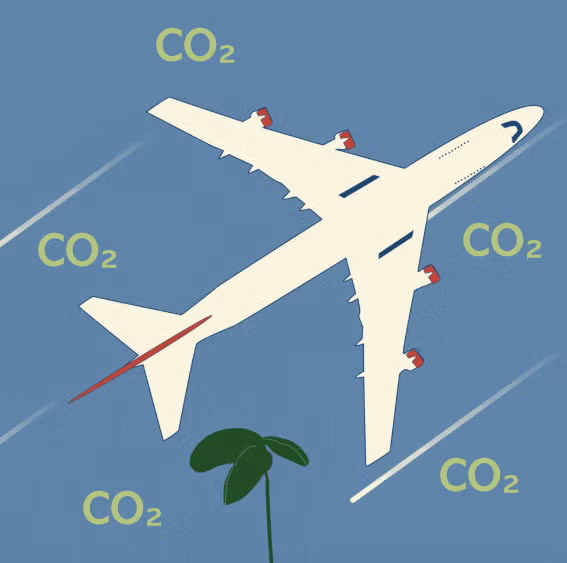
Every day, a large number of people are involved in air travel all around the world, preferring to reach their destination comfortably by flying through the skies. While traveling by air offers a lot of convenience, it also produces significant environmental pollution for each passenger.
The environmental impact of air travel is a growing concern, with 13% of greenhouse gas emissions attributed to the aviation industry and 2% of all human activity due to air travel. With the increasing number of passengers and flights, finding ways to reduce this impact has become essential.
How Airplane Engines Work
Airplane engines have undergone significant development over time, aiming to minimize environmental impact. Modern airplane engines are turbofan engines with double flow, which allows the fan at the beginning of the engine to expel most of the air and produce most of the thrust. This design not only increases fuel efficiency but also reduces emissions.
Modern airplanes typically have two engines mounted on the wings instead of four like in the past due to weight and fuel efficiency considerations. Additionally, many airlines are exploring alternative engine technologies such as turbofans with advanced materials and designs that can improve fuel efficiency by up to 25%.
How Much CO2 Does an Air Traveler Produce
Each air traveler produces 285 grams of CO2 per every kilometer traveled. This is equivalent to seven times more than a passenger in an automobile, which produces 42 grams of CO2 for every kilometer. Airlines are actively working on reducing this figure.
By offsetting carbon emissions from flights, passengers can significantly reduce their environmental impact. Offsetting involves paying a voluntary contribution to support environmental projects initiated by airlines themselves or third-party organizations. This fund is then used to invest in renewable energy sources, reforestation programs, and other initiatives that help reduce greenhouse gas emissions.
Calculating CO2 Emissions from an Air Traveler
To help airlines reduce emissions, the ICAO has developed a process that allows them to calculate carbon emissions from flights. This data can be used to estimate emissions with reasonable accuracy, taking into account various factors such as the type of airplane used by each airline and specific flight routes.
For example, flying from New York to Los Angeles on a Boeing 777-300ER plane burns about 12,000 kilograms of fuel per hour. The CO2 emissions produced during this flight can be calculated using a carbon calculator or a flight emissions calculator, which takes into account factors such as the type of fuel used and the altitude at which the plane flies.
Certifying Green Airlines
The Eco Management and Audit Scheme (EMAS) is widely used for certifying an airline’s environmental commitment. Issued by the EU, this certification enables companies to assess, communicate, and improve their environmental impact performance.
Obtaining EMAS certification is challenging due to strict requirements and opinions from public authorities and specifically trained figures. Airlines must submit a sustainability declaration and an annual report detailing collected data and achieved objectives.
Which Airlines Have Emas Certification
Lufthansa was the first airline to receive an EMAS certification in 2000. Sas, Air Dolomiti, and Air Europa have also received this certification over time. Some airlines offer passengers the option to compensate for carbon emissions from their flights by paying a voluntary contribution, which funds environmental projects initiated by the airlines themselves.
Which Airline is the Most Eco-Friendly
According to the Sustainalytics rating system, which evaluates companies’ adherence to ESG parameters, Wizzair is currently the most eco-friendly airline in the market. This is due to its compensatory policy and low carbon footprint. Low-cost carriers generally have lower emissions because they do not fly on busy routes that require additional fuel for takeoff and landing.
However, some critics argue that Wizzair’s recent cancellations of flights and inconsistent flight schedules are a drawback. Airlines must balance the need to reduce emissions with the need to maintain reliable and efficient operations.
Hydrogen-Powered and Electric Planes
Several options are being explored to reduce CO2 emissions. Airbus is currently developing hydrogen-powered planes. These could potentially be operational by 2035, with initial tests scheduled for 2026. Hydrogen-powered planes might cover all short- and medium-haul flights, which already account for a third of passenger traffic.
However, the cost of liquid hydrogen fuel remains to be evaluated. Currently, liquid hydrogen is more expensive than traditional aviation fuels, making it challenging to adopt this technology on a large scale.
Additionally, there is interest in producing electric planes based on positive results from automobile batteries. The main challenge lies in incorporating powerful batteries into aircraft without causing weight issues or increasing flight times.
To overcome these challenges, researchers are exploring innovative battery designs and materials that can improve the energy density of batteries while reducing their weight.
Innovative Technologies for Sustainable Aviation
Several innovative technologies are being developed to reduce CO2 emissions from air travel. Some of these include:
- Electric Propulsion Systems: Electric propulsion systems use electric motors powered by rechargeable batteries, which provides a significant reduction in emissions and fuel consumption.
- Hybrid-Electric Systems: Hybrid-electric systems combine traditional fossil fuels with electricity generated by an onboard generator or battery pack, reducing emissions and improving efficiency.
- Advanced Materials: Researchers are developing advanced materials that can improve the energy density of batteries while reducing their weight.
- Supersonic Flight: Supersonic flight has the potential to reduce travel times significantly, which would lead to a reduction in fuel consumption and emissions.
Conclusion
Sustainable aviation is becoming increasingly important as air travel continues to grow globally. With the development of innovative technologies and sustainable practices, airlines can reduce their environmental impact while maintaining reliable and efficient operations.
By offsetting carbon emissions from flights, passengers can significantly reduce their environmental impact. Airlines must balance the need to reduce emissions with the need to maintain reliable and efficient operations.
The future of aviation is uncertain, but one thing is clear: reducing CO2 emissions will be crucial for the industry’s long-term sustainability.
Frequently Asked Questions (FAQs)
- What is the environmental impact of air travel?
Air travel has a significant environmental impact, with 13% of greenhouse gas emissions attributed to the aviation industry and 2% of all human activity due to air travel.
- How can I reduce my carbon footprint while flying?
There are several ways to reduce your carbon footprint while flying, including choosing flights with lower emissions or offsetting your emissions through voluntary contributions.
- Which airlines have EMAS certification?
Lufthansa, Sas, Air Dolomiti, and Air Europa have received EMAS certification from the EU.
- What is Sustainalytics rating system?
The Sustainalytics rating system evaluates companies’ adherence to ESG parameters, which includes environmental sustainability.
- Can hydrogen-powered planes be used for commercial flights?
Hydrogen-powered planes are being developed and may potentially be operational by 2035, with initial tests scheduled for 2026.
- What is the main challenge in producing electric planes?
The main challenge lies in incorporating powerful batteries into aircraft without causing weight issues or increasing flight times.
- How can I offset my carbon emissions from flying?
You can offset your carbon emissions by paying a voluntary contribution to support environmental projects initiated by airlines.
- What is the most eco-friendly airline?
According to the Sustainalytics rating system, Wizzair is currently the most eco-friendly airline in the market due to its compensatory policy and low carbon footprint.


