
The new article is the result of a collaboration between the Valorization and Impact of Research Area and Public Engagement – Agorà Science, and the Green Office UniToGO of the University of Turin, in partnership with IdeeGreen S.r.l. Benefit Society.
The article revises the texts of Dr. Osman Arrobbio published in the book “Lessico e Nuvole: le parole del cambiamento climatico”, the second edition of the linguistic and scientific guide to navigate the most urgent issues related to global warming, curated by the Area and the Green Office.
A free version of Lessico e Nuvole is available as a PDF file on the platform zenodo.org.
Printed versions and eBooks are available for purchase online on the following distribution platforms:
– youcanprint.it
– Amazon
– Mondadori (also with Carta del Docente and 18app)
– IBS
– Library University (also with Carta del Docente and 18app)
All revenue generated by paid versions will be used by the University of Turin to finance research and public engagement projects on climate change and sustainability issues.
What is Sufficiency Strategy?
The “sufficiency strategy” consists of a set of measures, actions, and policies aimed at reducing resource consumption through reducing the amount of goods and services needed to meet specific needs or general well-being.
The strategy derives its name from the “principle of sufficiency”. Sufficiency can be defined as a relatively limited area located on a scale between the most extensive area of “insufficiency” and the potentially infinite area of “too much” (or “excess”, “superfluous”, or “eccess”).
Once the level of sufficiency is exceeded in enjoying a good or service, sufficient to satisfy the need that generated it, higher levels of utilization or consumption quickly lead to reaching the “too much”.
The outcomes of overstepping this boundary can manifest in various ways, depending on the activity and its magnitude and duration.
Among the many examples, we can mention indigestion, constipation, physical and mental exhaustion, reduced well-being, and depletion of ecosystems. The peculiarities of the sufficiency strategy become more evident when compared to those of “efficiency” and resource conservation strategies.
The first consists of a set of measures, actions, and policies aimed at increasing efficiency, i.e., reducing the amount of resources needed for each unit of good produced or consumed or service provided or used. The efficiency strategy does not question the idea that additional doses of goods and services are always preferable to their stable or reduced quantities; this, most often, contributes to weakening or nullifying the potential for resource reduction that increases in efficiency (this is known as the “rebound effect” which we will discuss in the next section).
The second strategy (“conservation”) aims directly to reduce resource consumption. For this reason, sufficiency can be considered a component of conservation.
However, while both strategies share some similarities, they differ significantly from one another: conservation does not specifically target processes regulating the appearance of needs for goods and services. Sufficiency, on the other hand, increases the usefulness derived from each good or service and, at the same time, increases the disutility expected from each additional good or service.
Translated into behavioral terms, sufficiency means voluntary abstention (not due to lack of purchasing power), total or partial, from consuming goods and services.
The Rebound Effect
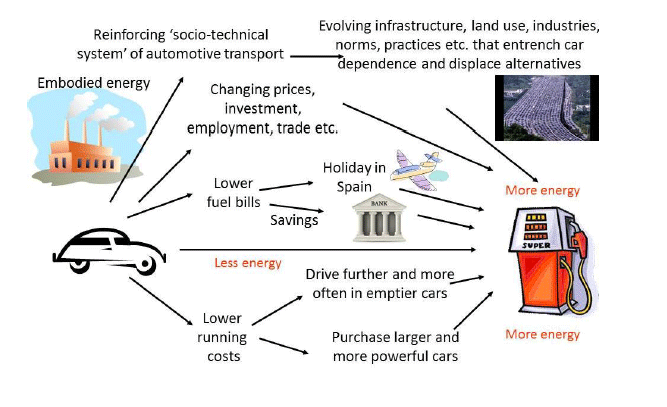
In the context of environmental and energy policies, the rebound effect refers to “response behaviors, or other types of responses, that counterbalance the effects of measures aimed at reducing environmental impacts.”
Among the many definitions of the rebound effect, this one highlights an important aspect: the outcomes of measures result weakened, if not countered, by response behaviors derived or dependent on those measures.
Let’s take a universal accepted fact: performance metrics (technical, energetic, organizational, etc.) have generally improved. This is what we call technological progress, technological innovation, or organizational improvement.
Efficiency, among other areas, has been continuously improving in all fields. The consumption of resources, however, has not decreased but has even increased.
While it’s possible to decrease consumption in some practices, sectors, regions, and years, the overall trend is one of continued increase. In some fields, this can be limited by implementing specific measures or regulations; nonetheless, at a global level, the rebound effect seems to suggest that environmental mitigation strategies and those related to resource depletion should be revised to go beyond current central roles attributed to “efficiency strategy”.
Key Findings
- The consumption of resources has increased despite improvements in efficiency.
- There are various factors driving this increase in consumption, including economic systems, governments, marketing, and consumer weakness in response.
- While past increases in efficiency have been insufficient to counteract these forces, further pursuit of the “efficiency strategy” is recommended (Arrobbio and Padovan, 2018).
- The rebound effect suggests that consumption of resources increases as a result of increased efficiency.
This seeming paradox can be explained with relative ease: when the use of a resource becomes more efficient, it becomes easier to use and less costly. As a result, people tend to use more resources rather than using fewer (Jevons, 1865).
There exists a systemic relationship between efficiency and expansion. Leverage this relationship by leveraging technological innovations.
Objections to this reasoning often rely on assumptions about “satiety of consumers”. These can be more valid in some countries with higher per-capita income levels and already high levels of satisfaction of their needs, as well as in specific fields.
Let’s consider the example of home heating: it is assumed that if additional increases in temperatures are not arrested, they will not continue much beyond, even if better heaters or insulation systems become available. However, in many areas, this has been the case: more efficient lamps have become available, but lighting points have increased; more efficient motors have been introduced, leading to larger vehicle dimensions; bigger fridges have become common; stronger vacuum cleaners are now widespread; and, for home heating, living spaces have become larger or there is an increase in space per-capita.
Even if the demand for these energy services were to decrease, new ways of utilizing the saved resources would continue to manifest. Or they might appear in the future as a result of existing savings.
Not everyone sees the same relationships between cause and effect in this complex scenario. On one hand, it is possible to view the two facts (increase in efficiency and increase in consumption) as causally separate: for example, more efficient lamps have become available, incidentally increasing lighting points. On the other hand, it is possible to see a causal relationship that is diametrically opposed: more efficient lamps were made available because there was an increase in lighting points.
It remains arduous to demonstrate the correctness of one interpretation or the infallibility of another. Nevertheless, there is no sign of a sustainable reversal of the overall trend towards increased consumption of resources.
Whether these increases in efficiency are ineffective in this sense or if they are actually the cause of such a tendency, the rebound effect appears to suggest that environmental mitigation strategies and those related to resource depletion should be revised to go beyond current central roles attributed to “efficiency strategy”.
The Future of Sustainability Initiatives
Considering the rebound effect, it is clear that sustainability initiatives will need to shift their focus from just increasing efficiency to incorporating sufficiency principles into their strategies.
Governments, businesses, and individuals can work together to address the issue of resource depletion by implementing policies that encourage sustainable consumption patterns. This can include measures such as taxes on single-use plastics, subsidies for renewable energy sources, and education campaigns promoting sustainable lifestyles.
Additionally, there is a need for more research on the effectiveness of different strategies in reducing resource consumption and addressing the rebound effect. By understanding the complex relationships between efficiency, sufficiency, and environmental impact, policymakers can make more informed decisions about how to implement effective sustainability initiatives.
The Role of Individuals
Individuals also play a crucial role in addressing the issue of resource depletion. By making conscious choices about their consumption habits, individuals can contribute to reducing their own carbon footprint and promoting sustainable lifestyles.
This can be achieved through simple actions such as using public transport, carpooling, or driving electric vehicles. Additionally, individuals can choose to buy sustainable products, reduce food waste, and use energy-efficient appliances.
Moreover, individuals can also advocate for policy changes that promote sustainability by engaging with their communities and participating in local initiatives.
Conclusion
In conclusion, the sufficiency strategy is a crucial approach to reducing resource consumption and addressing the rebound effect. By incorporating sufficiency principles into environmental policies, governments, businesses, and individuals can work together to create more sustainable futures.
While there are many challenges ahead, it is clear that the future of sustainability initiatives will require a shift from just increasing efficiency to incorporating sufficiency principles into their strategies.
By understanding the complex relationships between efficiency, sufficiency, and environmental impact, policymakers can make more informed decisions about how to implement effective sustainability initiatives. Ultimately, the key to addressing resource depletion lies in promoting sustainable consumption patterns and reducing our reliance on finite resources.
References
– Latini Gianni, Bagliani Marco, & Orusa Tommaso. (2020). Lessico e nuvole: le parole del cambiamento climatico – II ed., Università di Torino. Zenodo. http://doi.org/10.5281/zenodo.4276945
– Herman E. Daly “Steady-State Economics: With New Essays”, Island Press, Washington 1991. (Translation of the first version into Italian: Lo stato stazionario: l’economia dell’equilibrio biofisico e della crescita morale, Sansoni, Firenze, 1981).
– Thomas PRINCEN, “The Logic of Sufficiency”, MIT press, Cambridge (MA) and London, 2005.
– Arrobbio O., Padovan D., (2018) “A vicious tenacity: the efficiency strategy confronted with the rebound effect”. Frontiers in Energy Research 6, 114 – Hertwich E. G., (2005) “Consumption and the rebound effect: an industrial ecology perspective”. Journal of Industrial Ecology 9(1–2), pp. 85–98.
– Jevons W. S., (1865) “The coal question: an inquiry concerning the Progress of the nation, and the probable exhaustion of our coal-mines”. The Macmillan Company, London.
– Santarius T., Walnum H.J., Aall C. (2016) “Rethinking climate and energy policies. New perspectives on the rebound phenomenon”. Springer, New York.
Frequently Asked Questions
- What is sufficiency strategy?
- How does the sufficiency strategy differ from the efficiency strategy and conservation?
- What is the rebound effect?
- Why did consumption of resources not decrease despite improvements in efficiency?
- Can we prevent the rebound effect by increasing efficiency further?
- How can governments, businesses, and individuals work together to address the issue of resource depletion?
- Are there examples of successful implementations of sufficiency strategy or conservation strategies?
- What is the future of sustainability initiatives, considering the rebound effect?


