
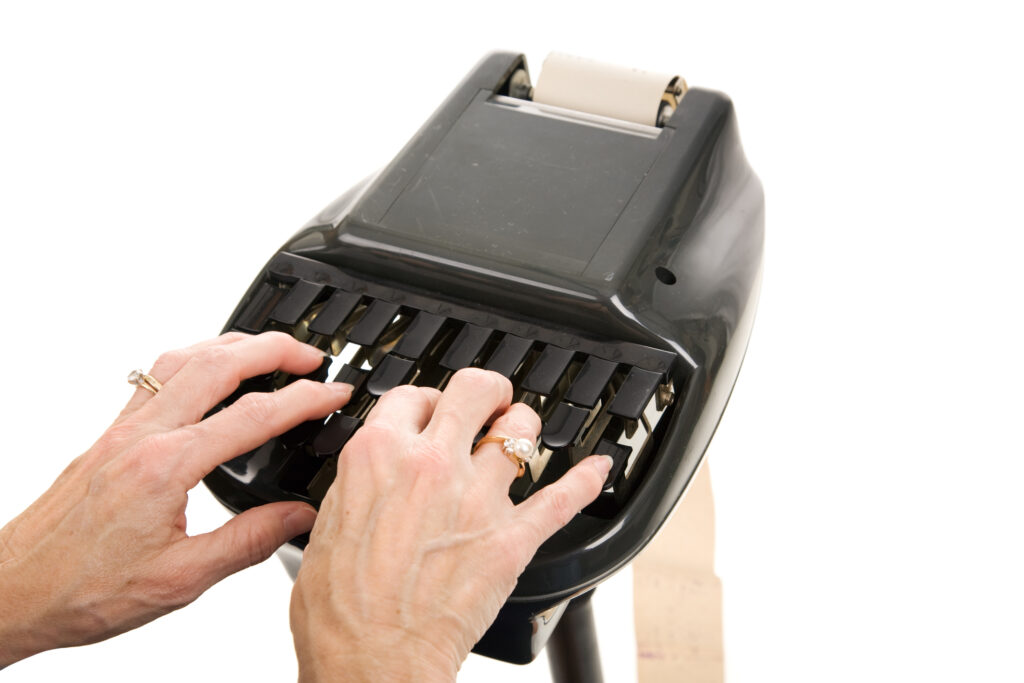
As we navigate the complexities of modern communication, it’s easy to overlook the importance of effective note-taking. However, for those in professions such as law, politics, and journalism, stenotipia is an essential skill that can make all the difference.
What is Stenotipia?
Stenotipia is not exactly stenography, but rather a technique used to abbreviate writing when typing on a machine. It’s a method that has been employed for decades, long before the advent of smartphones and digital tools. To become proficient in stenotipia, one must possess exceptional speed and accuracy, as well as a deep understanding of various systems designed to streamline writing.
The Significance of Stenotipia
Stenotipia’s significance extends beyond its practical applications. It has played a vital role in the history of communication, allowing individuals to capture and convey complex ideas with unparalleled efficiency. As we explore this fascinating topic further, it becomes clear that stenotipia is more than just a technique – it’s a testament to human ingenuity and our ongoing quest for innovation.
The Evolution of Stenotipia
From its humble beginnings in the 19th century, stenotipia has undergone significant transformations. The development of electronic machines has revolutionized the field, enabling faster and more accurate transcription. One notable breakthrough came in 1980, when Professor Marcello Melani introduced a method for digital stenotyping, which was later adapted to other languages.
The Role of Machines in Stenotipia
Modern stenotipia machines are designed to simplify the process, allowing users to focus on their work rather than struggling with cumbersome equipment. These machines have come a long way since their inception, with advancements that enable faster and more efficient transcription.
Stenotipia: A Tool for Professionals
For professionals who rely on accurate note-taking, stenotipia is an indispensable skill. Its use in law courts, parliament, and journalism has become the norm, where every second counts. The technique’s importance cannot be overstated, as it allows individuals to capture complex information with unprecedented speed and accuracy.
The History of Stenotipia
Stenotipia has its roots in the 19th century, when shorthand systems were first developed. One of the earliest known shorthand systems was created by Rev. John Isaac Hawkins, an Englishman who developed a system called “Visible Handwriting.” This system used abbreviations to represent common words and phrases.
The Development of Stenotypes
In 1862, Christopher Latham Sholes invented the first practical stenotype machine. The stenotype was designed to allow users to write at high speeds using a unique keyboard layout that combined letters, numbers, and symbols into a single key press. The first commercial stenotype machines were introduced in the late 1800s.
The Role of Stenotypes in History
Stenotypes played a significant role in history, particularly during World War I. Military personnel used stenotypes to record enemy communications and coordinate military operations. This technology also allowed for the development of early forms of forensic science, as stenotype machines were used to record witness statements.
The Development of Digital Stenotyping
In 1980, Professor Marcello Melani introduced a method for digital stenotyping, which was later adapted to other languages. The introduction of digital stenotypes revolutionized the field, allowing users to capture and record complex information with unprecedented accuracy.
The Impact of Technology on Stenotipia
The advent of digital technology has significantly impacted the field of stenotipia. Digital stenotyping machines have enabled faster and more accurate transcription, as well as greater flexibility in terms of recording locations and user interfaces.
Stenotipia: A Growing Field
In recent years, stenotipia has gained popularity, with online courses and resources becoming increasingly accessible. While these digital alternatives offer many benefits, some argue that they lack the practicality of traditional stenotipia training.
The Benefits of Stenotipia Training
Stenotipia training offers numerous benefits for individuals seeking to develop this skill. Training can be tailored to meet specific needs and goals, allowing users to focus on areas such as speed, accuracy, and comprehension.
Challenges in the Field of Stenotipia
Despite its many benefits, stenotipia is not without challenges. One major challenge facing professionals is the need for continuous practice and training to maintain their skills. Another challenge lies in adapting to technological advancements, which can sometimes lead to changes in stenotype technology.
The Future of Stenotipia
As we look to the future, it’s clear that stenotipia will continue to play a vital role in various fields. Advances in digital technology are expected to further streamline and improve the transcription process, allowing for even faster and more accurate recording.
Conclusion
In conclusion, stenotipia is a fascinating field that deserves attention from scholars, professionals, and enthusiasts alike. As we continue to navigate the complexities of modern communication, it’s essential to understand the significance and evolution of this technique. Whether you’re interested in history, technology, or simply want to improve your note-taking skills, stenotipia has something to offer.
Frequently Asked Questions
- What is the difference between stenotipia and stenography?
Stenotipia is a technique used for abbreviating writing on machines, while stenography refers to the art of taking shorthand notes by hand. - How did stenotipia evolve over time?
Stenotipia has undergone significant transformations since its inception in the 19th century, with advancements in technology and methodology enabling faster and more accurate transcription. - What are some common applications of stenotipia?
Stenotipia is commonly used in law courts, parliament, journalism, and other professions where accurate note-taking is essential. - Is stenotipia a dying art?
While digital alternatives have gained popularity, traditional stenotipia training remains essential for professionals who require high-speed and accuracy. - Can anyone learn stenotipia?
Yes, with practice and dedication, individuals can develop the skills necessary to become proficient in stenotipia. - How does digital stenotyping compare to traditional stenotipia?
Digital stenotyping offers many benefits over traditional stenotipia, including increased speed and accuracy, but some argue that it lacks the practicality of traditional training. - What are some historical milestones in the development of stenotipia?
The first mechanical stenotype was invented by Benoît Gonod in 1827, followed by the introduction of digital stenotyping methods in the 1980s. - Can stenotipia be used for other purposes beyond note-taking?
Yes, stenotipia can be used for various applications, such as writing novels or creating screenplays, where high-speed and accuracy are required.
Additional Resources
If you’re interested in learning more about stenotipia, there are numerous resources available. Online courses and training programs offer a wealth of information on the history, techniques, and benefits of stenotipia.
Recommended Reading
For those seeking to delve deeper into the world of stenotipia, there are several books that offer valuable insights and perspectives. Some recommended titles include:
- “The Stenotype: Its History and Development” by Dr. Thomas P. Miller
- “Stenotyping: A Guide for Beginners” by Helen J. Harris
- “The Art of Stenography” by Rev. John Isaac Hawkins
Conclusion
In conclusion, stenotipia is a fascinating field that offers numerous benefits and opportunities for those interested in communication, technology, and innovation. Whether you’re seeking to improve your note-taking skills or simply want to explore this unique technique, stenotipia has something to offer.


