
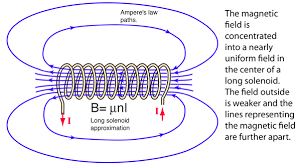
In simple terms, a solenoid is not just a tube, but a device that leverages its magnetic properties to harness energy. This concept might seem like magic, but science can explain it.
What is a Solenoid?
The term “solenoid” originates from the Greek word σωλήν (solen), meaning “tubular conduit.” A solenoid is essentially a cylindrical structure made of a magnetic material, composed of multiple circular coils connected in a single filament. To qualify as a solenoid, there should be at least 10 times more length than the diameter of each coil.
History of Solenoids
The concept of solenoids dates back to the early 19th century, when German physicist Andreas F. von Borowsky discovered that by wrapping a wire coil around a wooden tube, he could create a magnetic field. This fundamental idea laid the groundwork for further research and development in electromagnetism.
Solenoids: Inductance
As an induction device, solenoids are used to study electromagnetism. When we discuss solenoids, we also refer to their inductance. This property enables electrical circuits to induce a magnetic force when current flows through them. The amount of inductance depends on the solenoid’s dimensions and coil design.
Inductance is measured in henries (H) or farads per meter (F/m), which represent the ability of a solenoid to store energy in its magnetic field. When an electric current changes, it creates a magnetic flux that induces a voltage across the solenoid’s coils. This relationship between magnetic fields and currents is known as Faraday’s law.
Solenoid: Magnet Field
When an electric current passes through the filament, it generates a magnetic field inside and outside the solenoid. The strength of this field is directly proportional to the number of coils, current intensity, and inversely proportional to the length of the solenoid. As you move away from the solenoid, the magnetic field dissipates due to the decreasing current intensity and increasing distance from the core.
The magnetic field around a solenoid can be described by the Biot-Savart law, which relates the magnetic field to the current flowing through the coils and the geometry of the solenoid. This fundamental principle is crucial for understanding various electromagnetic phenomena, including induction, electromagnetic waves, and magnetism.
Solenoids: Electro-Valves
The electro-valve is an essential component in various devices, controlling fluid flow through a valve. This mechanism relies on a solenoid’s magnetic properties to actuate the valve’s mechanism. In a simple electro-valve, a membrane can be moved by the solenoid’s current to adjust pressure within a device.
Electro-valves are widely used in hydraulic and pneumatic systems, power generation, and medical equipment. They enable precise control over fluid flow, which is critical for maintaining system efficiency and safety.
Solenoids: Toroidal
One of the many types of solenoids is the toroid, also known as a doughnut-shaped coil. The toroid consists of a ferromagnetic ring wrapped with a solenoid, which has a larger diameter than its radius. When a voltage difference is applied across the solenoid’s ends, current flows through it, generating a magnetic field within the toroid.
Toroids are used in various applications, including electromagnetic resonance devices, superconducting magnets, and high-energy particle accelerators. The unique properties of toroidal solenoids make them an attractive option for advanced research and development.
Applications of Solenoids
Solenoids have numerous practical applications across various fields:
- Electro-mechanical devices: Electro-valves, electromagnetic relays, and motor control systems rely on solenoids to control fluid flow or move mechanical components.
- Medical equipment: MRI machines use toroidal solenoids to generate strong magnetic fields for medical imaging purposes.
- Power generation: Transformers utilize solenoids to step up or step down voltages in electrical grids.
- Aerospace and defense: Electromagnetic devices, such as satellite transponders and missile guidance systems, rely on solenoids to transmit and receive signals.
Conclusion
The solenoid, often misunderstood as simply a tube, holds many secrets about electromagnetism and induction. Its unique properties make it an essential component in various devices, from electro-valves to medical equipment. By understanding the principles of solenoids, researchers and engineers can unlock new applications for this fascinating device.
Frequently Asked Questions (FAQs)
- What is the primary function of a solenoid?
A solenoid’s main purpose is to generate a magnetic field when current flows through its coils. - How does inductance work in solenoids?
Inductance in solenoids is proportional to the number of coils, filament dimensions, and coil design. - What is the difference between a solenoid and a bobbin?
A solenoid has multiple circular coils connected together, while a bobbin typically consists of a single coil. - How does the magnetic field of a solenoid behave outside its shape?
As you move away from the solenoid, the magnetic field dissipates due to the decreasing current intensity and increasing distance from the core. - What is the purpose of electro-valves in various devices?
Electro-valves control fluid flow through valves by using a solenoid’s magnetic properties to actuate their mechanisms. - How does the toroidal solenoid work?
The toroidal solenoid generates a magnetic field within its doughnut-shaped core when current flows through it, creating an electromagnet. - What is inductance used for in various applications?
Inductance plays a crucial role in devices such as transformers, reactors, and electromagnetic sensors. - Can I build my own solenoid at home?
Yes, you can create simple solenoids using materials like copper wire, iron rods, and batteries, but keep in mind safety precautions are essential when working with electrical components.
By understanding the principles of solenoids, researchers and engineers can unlock new applications for this fascinating device. Whether it’s controlling fluid flow or generating strong magnetic fields, solenoids hold many secrets about electromagnetism and induction.


