
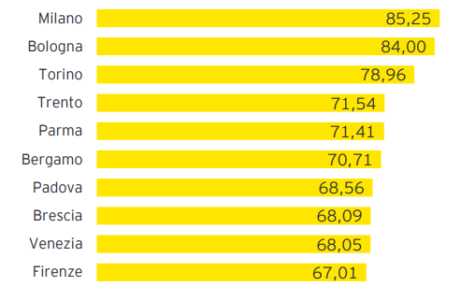
Bologna has taken the top spot in the Smart City Index, a ranking of Italy’s 116 municipal capitals that assesses their Information and Communication Technology (ICT) capabilities. The index, produced by Between, a company that has been monitoring ICT in Italy for over 10 years, evaluates cities based on nine thematic areas: Health, Education, Mobility Alternatives, Energy Efficiency, Broadband, Mobility, Government, Natural Resources, and Renewable Energy.
What is a Smart City?
According to the authors of the Smart City Index, a smart city is one that has implemented innovative solutions in nine key areas. These areas include:
- Health: improving healthcare services and outcomes
- Education: enhancing educational opportunities and access
- Mobility Alternatives: promoting alternative modes of transportation
- Energy Efficiency: reducing energy consumption and increasing renewable energy use
- Broadband: ensuring reliable and fast internet connectivity
- Mobility: streamlining transportation systems and promoting mobility
- Government: improving governance and public services
- Natural Resources: managing natural resources sustainably
- Renewable Energy: transitioning to renewable energy sources
A city becomes a smart city when it can demonstrate significant improvements in the quality of life for its citizens, often by creating a visible difference between the “before” and “after” states. Smart cities are also characterized by their ability to make innovation tangible and widespread.
Correlation between Smart Cities and Quality of Life
While being a smart city does not necessarily guarantee a high quality of life, there is a strong correlation between the two. A study by Sole 24 Ore found that smart cities tend to perform better in terms of livability. In fact, many of the top-ranked cities on the Smart City Index also appear on the list of most livable cities.
Bologna’s success is attributed to its comprehensive approach to innovation, which has led to significant improvements in various aspects of life for its citizens. For example, the city has implemented a range of initiatives aimed at promoting sustainable transportation, such as bike-sharing schemes and electric vehicle charging infrastructure.
Bologna’s Success
So, what makes Bologna stand out as the leading smart city? According to the Smart City Index, it is because the city has achieved high scores across all nine thematic areas. While Bologna excelled in Health, where it ranked first, its performance in other areas, such as Natural Resources, was not quite as strong.
One of the key factors contributing to Bologna’s success is its commitment to innovation and technology. The city has established a number of initiatives aimed at promoting entrepreneurship and start-ups, including a dedicated incubator for ICT companies. This has led to the creation of a thriving ecosystem that supports the development of new ideas and solutions.
Another factor is Bologna’s strong focus on education and research. The city is home to several top-ranked universities and research institutions, which have played a key role in driving innovation and technological advancement.
Interesting Exceptions
The Smart City Index reveals some interesting exceptions when it comes to the relationship between smart cities and livability. For example, cities like Trieste, Belluno, and Aosta show high levels of quality of life but lack the necessary ICT capabilities to be considered truly smart.
Conversely, cities in southern Italy, such as Bari, Salerno, Potenza, and Lecce, demonstrate a higher level of smartness than expected, given their lower quality of life scores. This could be seen as a “smart city renaissance” for the region.
Regional Variations
The Smart City Index also highlights regional variations in terms of energy efficiency. The regions of Lombardy and Emilia-Romagna are at the forefront of innovation in this area, with over 75% of their municipal capitals scoring high in energy efficiency. Other regions, such as Piedmont, Veneto, Umbria, and Molise, follow with a score of 50%.
These regional variations are likely due to a range of factors, including differences in population density, economic development, and cultural influences. However, they also highlight the importance of considering regional specificities when evaluating smart city performance.
Conclusion
In conclusion, the Smart City Index provides valuable insights into the relationship between smart cities and quality of life. Bologna’s success serves as an example of what can be achieved through innovation and ICT capabilities. However, there are also interesting exceptions that highlight the complexities of this issue.
By examining the results of the Smart City Index in more detail, we can gain a better understanding of the factors that contribute to smart city performance and how they impact quality of life. This will help policymakers and urban planners develop more effective strategies for promoting innovation and sustainable development in their cities.
Case Study: Bologna’s Energy Efficiency Initiatives
Bologna has implemented a range of initiatives aimed at reducing energy consumption and increasing renewable energy use. One key example is the city’s electric vehicle charging infrastructure, which provides access to over 100 public charging points.
The city has also invested heavily in energy-efficient buildings, with over 30% of its building stock meeting the highest standards for energy efficiency. This includes a range of initiatives such as green roofs, solar panels, and insulation.
In addition, Bologna has established a number of programs aimed at promoting sustainable transportation, including bike-sharing schemes and electric vehicle incentives.
Best Practices for Smart City Development
Based on the results of the Smart City Index, several best practices can be identified for smart city development. These include:
- Invest in ICT infrastructure: A strong ICT infrastructure is essential for supporting innovation and technological advancement.
- Promote sustainable transportation: Cities should prioritize sustainable transportation options, such as public transport, cycling, and walking.
- Foster entrepreneurship and start-ups: Encouraging entrepreneurship and start-up activity can help drive innovation and job creation.
- Invest in education and research: Education and research institutions play a critical role in driving innovation and technological advancement.
- Prioritize energy efficiency: Cities should prioritize energy efficiency, with initiatives aimed at reducing energy consumption and increasing renewable energy use.
Frequently Asked Questions (FAQs)
- What is the Smart City Index?
The Smart City Index is a ranking of Italy’s 116 municipal capitals based on their Information and Communication Technology (ICT) capabilities. - How does the Smart City Index measure smart cities?
The index evaluates cities across nine thematic areas: Health, Education, Mobility Alternatives, Energy Efficiency, Broadband, Mobility, Government, Natural Resources, and Renewable Energy. - What is the correlation between smart cities and quality of life?
There is a strong correlation between being a smart city and having a high quality of life. - Why did Bologna become the top-ranked smart city?
Bologna achieved high scores across all nine thematic areas, making it stand out as the leading smart city. - What are some exceptions in the Smart City Index?
Cities like Trieste, Belluno, and Aosta show high levels of quality of life but lack the necessary ICT capabilities to be considered truly smart. - Can a city become smart without improving its quality of life?
No, a city must demonstrate significant improvements in quality of life to be considered smart. - How do regional variations affect the Smart City Index?
Regional variations are highlighted in terms of energy efficiency, with Lombardy and Emilia-Romagna leading the way. - What can we learn from the Smart City Index?
The index provides valuable insights into the relationship between smart cities and quality of life, highlighting the importance of innovation and ICT capabilities.
Recommendations for Future Research
Based on the results of the Smart City Index, several recommendations are made for future research:
- Investigate regional variations: Further investigation is needed to understand the factors that contribute to regional variations in smart city performance.
- Examine the impact of smart cities on quality of life: More research is needed to fully understand the relationship between smart city performance and quality of life.
- Develop a framework for evaluating smart city success: A framework can be developed to evaluate the success of smart cities, incorporating key indicators such as energy efficiency, transportation, and education.
By continuing to study and analyze the results of the Smart City Index, we can gain a deeper understanding of what makes a city “smart” and how it impacts quality of life. This will help policymakers and urban planners develop more effective strategies for promoting innovation and sustainable development in their cities.


