
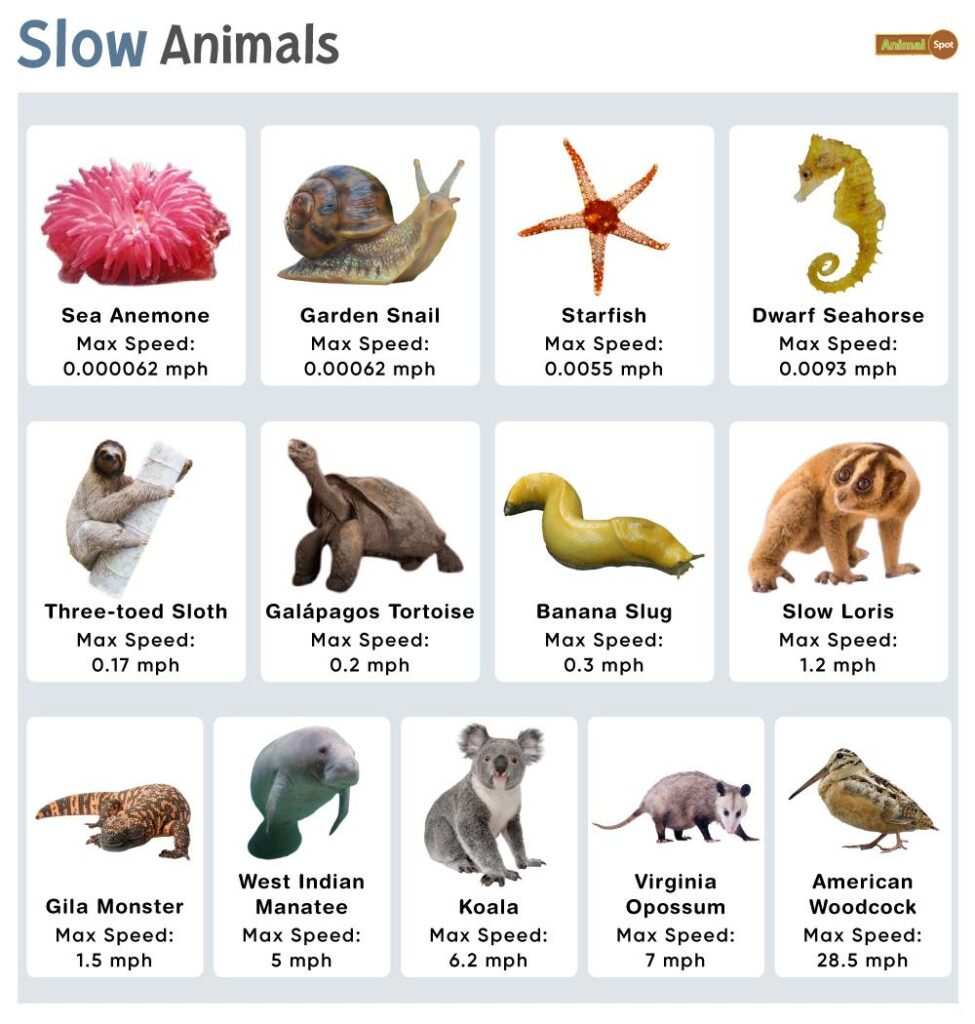
Are you ready to meet some of the slowest animals on our planet? From snails to sloths, we’ll explore the fascinating world of creatures that take their sweet time getting from point A to point B. But before we dive into the list, let’s define what it means to be “slow” in the animal kingdom.
What Does It Mean to Be Slow?
Slowness is a relative term, and different species have different approaches to movement. Some animals may move slowly due to their physical characteristics or habits, while others might simply prefer to conserve energy. Whatever the reason, these creatures have earned a reputation for being, well, slow.
Evolutionary Pressures: The Role of Slowness in Animal Survival
In the animal kingdom, slowness can be an adaptation to environmental pressures. For example, animals that live in areas with high predation rates or limited food resources may evolve to move slowly and conserve energy. This strategy allows them to survive for longer periods without succumbing to hunger or predators.
Examples of Slowness as a Survival Mechanism
- Tortoises: These slow-moving reptiles have shells that protect them from predators, allowing them to live safely in areas with high predation rates.
- Snails: Snails’ slimy trails and ability to withdraw into their shells make them less appealing to predators, reducing the need for speed.
- Manatees: Manatees’ slow movements allow them to blend in with seaweed and other aquatic vegetation, making it harder for predators to spot them.
The Science of Slowness: Physiological and Behavioral Factors
So what makes these animals so slow? Let’s explore some physiological and behavioral factors that contribute to their sluggish pace:
- Muscle Power: Some animals may have weak muscles or a low power-to-weight ratio, making it difficult for them to generate speed.
- Body Size: Larger animals often require more energy to move, which can lead to slower speeds.
- Habitat: Animals that live in environments with limited space or obstacles may need to be more cautious and slow-moving to avoid collisions or injuries.
Meet the Slowest Animals: A Roundup of 10 Species
- Sloths: These arboreal mammals are known for their sluggish pace, with some species moving as slowly as 0.15 miles per hour (0.24 km/h).
- Tortoises: With a top speed of about 0.5 miles per hour (0.8 km/h), these gentle giants take their sweet time getting around.
- Snails: While they might not be the most agile creatures, snails can move at a pace of 0.05 miles per hour (0.08 km/h).
- Sea Turtles: These marine reptiles are known for their slow movements on land, with some species reaching speeds of up to 2 miles per hour (3.2 km/h) in the water.
- Koalas: While they’re not as slow as some other animals on this list, koalas can move at a pace of about 20 miles per hour (32 km/h), which is still relatively sluggish.
- Manatees: These large aquatic mammals can reach speeds of up to 3 miles per hour (4.8 km/h) in the water, but they’re not exactly built for speed on land.
- Corals: While they don’t move around like other animals, corals are incredibly slow-growing and can take years to form a single new individual.
- Lamantins: Also known as “sea cows,” these aquatic mammals can move at a pace of about 5 miles per hour (8 km/h), making them one of the slowest swimming animals in the ocean.
- Starfish: These marine creatures might not be the most agile, but they can slowly crawl across the seafloor at a pace of up to 3 miles per hour (4.8 km/h).
- Sea Stars: Similar to starfish, sea stars are slow-moving and can take their sweet time getting from one place to another.
The Slowest Animals: What Makes Them Tick?
So what makes these animals so slow? Is it due to their physical characteristics, habits, or something else entirely? Let’s explore some possible explanations:
- Energy conservation: Some animals may move slowly to conserve energy, especially in environments where food is scarce.
- Evolutionary adaptations: Slow movement can be an adaptation to the animal’s environment. For example, sloths have evolved to live in trees, where speed isn’t necessary.
- Physical characteristics: Some animals might be slow due to physical limitations, such as a lack of powerful muscles or a large body size.
Conclusion
Meet the slowest animals in the world, and discover what makes them tick. From snails to sloths, these creatures may not be the most agile, but they’re certainly fascinating in their own unique ways. So next time you’re feeling rushed, take a cue from these sluggish friends and remember that sometimes slowing down can be the best way to enjoy life.
Frequently Asked Questions (FAQs)
- What is the slowest animal on Earth?
While it’s difficult to pinpoint a single species as the absolute slowest, the snail takes the crown with its incredible slowness. - Why do animals move slowly?
Animals may move slowly due to various reasons, including energy conservation, evolutionary adaptations, and physical characteristics. - Can animals be both slow and agile?
Yes! While some animals might appear slow at first glance, they can still exhibit remarkable agility in other areas, such as climbing or maneuvering in tight spaces. - Are all snails slow-moving?
Not all snails are created equal. Some species of snails can move faster than others, but most are indeed very slow-moving. - Can sloths be trained to move faster?
Unfortunately, sloths are not exactly known for their speed or willingness to exercise. They’re happy to just hang out and enjoy the ride!
The Importance of Slowness in Animal Behavior
Slowness can play a crucial role in animal behavior, particularly in terms of social interactions and mating rituals. For example:
- Courtship displays: Some animals use slow movements to attract mates or demonstrate their suitability as partners.
- Social interactions: Animals that move slowly may be less aggressive or competitive, allowing them to establish peaceful relationships with other members of their species.
The Benefits of Slowness
Slowness can have several benefits for animals and humans alike:
- Energy conservation: Moving slowly requires less energy, which can help conserve resources in environments where food is scarce.
- Improved accuracy: Animals that move slowly may be more accurate in their movements, allowing them to navigate complex environments with ease.
- Increased awareness: Slowing down can increase an animal’s awareness of its surroundings, helping it detect potential predators or threats.
Conclusion
Slowness is a fascinating aspect of the animal kingdom, and by exploring the lives of these slow-moving creatures, we can gain a deeper understanding of their unique adaptations and behaviors. Whether you’re looking to learn about snails or sloths, there’s always something new to discover in the world of animals that move at a glacial pace.
Additional Resources
For more information on this topic, check out:
- National Geographic: Learn about the fascinating world of animals that move slowly.
- Smithsonian Magazine: Explore the amazing adaptations of slow-moving creatures.
- Scientific American: Read about the latest research on animal slowness and its significance in evolutionary biology.


