
Seismic waves, or earth tremors, are a crucial aspect of seismology that helps us understand the Earth’s internal structure. These waves are a key indicator of earthquakes and can provide valuable information about the Earth’s interior.
What Are Seismic Waves?
Seismic waves are energy waves that travel through the Earth’s crust, mantle, and core, causing the ground to shake. They are created by sudden releases of energy, such as earthquakes, volcanic eruptions, or human activities like mining or injection of fluids into the ground.
Types of Seismic Waves
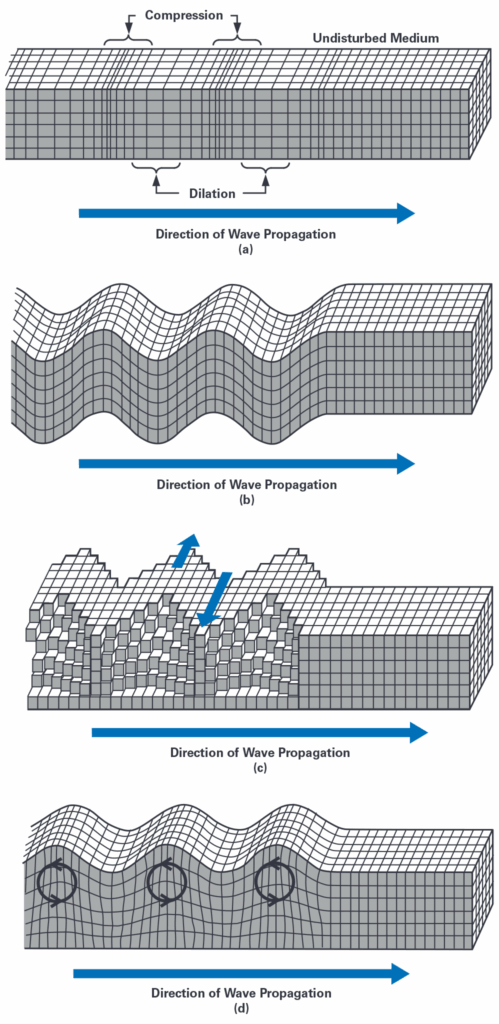
Seismic waves can be classified into three main types: longitudinal, transverse, and surface waves. Each type has distinct characteristics and propagation patterns:
- Longitudinal Waves (P-Waves): These are primary waves that travel through the Earth’s crust, mantle, and core. They compress and stretch the ground in a push-pull motion, causing seismic activity.
- Transverse Waves (S-Waves): These are secondary waves that travel through the Earth’s crust and mantle. They cause the ground to oscillate perpendicular to the direction of propagation.
- Surface Waves: These waves travel along the Earth’s surface, causing the ground to shake in a horizontal motion.
Properties of Seismic Waves
Seismic waves have several properties that affect their behavior:
- Velocity: The speed at which seismic waves propagate through different materials. This is influenced by factors like temperature, pressure, and composition.
- Attenuation: The decrease in wave amplitude as it travels through the Earth’s interior.
- Refraction: The bending of seismic waves around obstacles or changes in density.
Detection of Seismic Waves
Seismic waves can be detected using various methods:
- Seismographs: Inexpensive, homemade devices that record ground motion.
- Digital Seismometers: Advanced instruments that provide high-precision measurements.
- Broadband Sensors: High-sensitivity sensors that detect a wide range of frequencies.
Real-Time Detection and Warning Systems
Real-time detection systems are crucial for earthquake prediction and early warning:
- Seismic Alarm Systems: Home-based detectors that alert users to potential seismic activity.
- National Seismic Networks: Large-scale networks that provide real-time data to scientists and emergency responders.
Seismic waves play a vital role in understanding the Earth’s internal structure and providing early warnings for earthquakes. By studying these waves, scientists can better comprehend the complex processes that shape our planet.
FAQs
- What causes seismic waves?
Seismic waves are created by sudden releases of energy, such as earthquakes, volcanic eruptions, or human activities like mining or injection of fluids into the ground. - What are the three main types of seismic waves?
The three main types of seismic waves are longitudinal (P-waves), transverse (S-waves), and surface waves. - How do seismic waves propagate through different materials?
Seismic wave velocity is influenced by factors like temperature, pressure, and composition. - What is the purpose of seismic detection systems?
Seismic detection systems help scientists understand the Earth’s internal structure and provide early warnings for earthquakes. - Can seismic waves be detected using home-based devices?
Yes, inexpensive seismographs can be used to detect seismic activity at home. - How do real-time detection systems work?
Real-time detection systems use advanced instruments like digital seismometers and broadband sensors to provide high-precision measurements. - What is the significance of seismic wave properties like attenuation and refraction?
These properties affect the behavior of seismic waves as they travel through the Earth’s interior. - Can seismic waves be used for earthquake prediction?
While not yet possible, scientists are working to improve our understanding of seismic waves and their relationship to earthquakes.
Earthquake Prediction Using Seismic Waves
Seismic wave analysis is a key component of earthquake prediction:
- Seismic Anomaly Detection: Identifying unusual patterns in seismic data that may indicate an impending earthquake.
- Seismic Hazard Assessment: Evaluating the likelihood of future earthquakes based on past seismic activity and geological conditions.
Advances in Seismic Wave Analysis
Recent advancements in computational power, machine learning algorithms, and sensor technology have significantly improved seismic wave analysis:
- High-Performance Computing: Allowing for faster data processing and simulation.
- Machine Learning: Enabling the detection of complex patterns and anomalies in large datasets.
Seismic Wave Propagation and Earthquake Physics
Understanding seismic wave propagation is essential to understanding earthquake physics:
- Earthquake Mechanisms: The complex processes that cause earthquakes, including faulting, fracturing, and fluid injection.
- Seismic Energy Release: The sudden release of energy during an earthquake, causing the ground to shake.
Applications of Seismic Waves
Seismic waves have numerous applications in various fields:
- Earthquake Engineering: Designing structures that can withstand seismic activity.
- Natural Resource Exploration: Locating oil and gas reserves using seismic data.
- Environmental Monitoring: Tracking earthquakes’ impact on the environment.
By advancing our understanding of seismic waves, scientists can improve earthquake prediction, detection, and mitigation. This knowledge has significant implications for various fields, from engineering to environmental monitoring.
Conclusion
Seismic waves are a vital component of seismology, providing insights into the Earth’s internal structure and allowing us to predict and prepare for earthquakes. By studying these waves, scientists can unlock new technologies and applications that benefit society as a whole.


