
The Schrödinger Cat Paradox: A Quantum Conundrum
Introduction
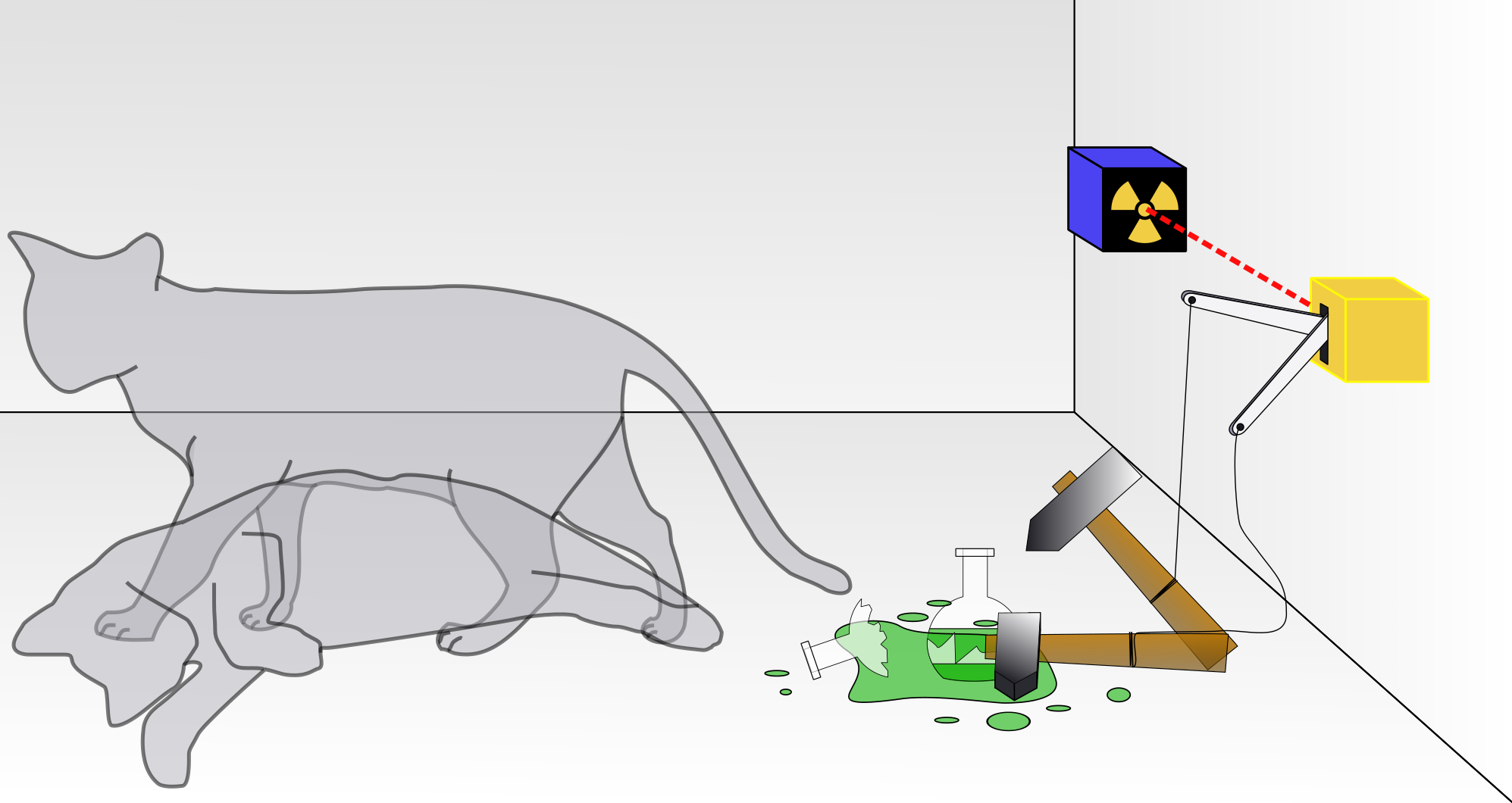
Imagine a scenario where a cat is placed in a sealed box with a radioactive atom, a Geiger counter, and a vial of poison. If the atom decays within a certain time frame, the poison is released, killing the cat. But here’s the paradoxical part: according to quantum mechanics, the cat is both alive and dead until the box is opened and the cat is observed.
In this article, we’ll delve into the Schrödinger Cat Paradox, exploring its history, implications, and the underlying physics that make it so mind-bending. We’ll also discuss some of the key concepts related to quantum mechanics and entanglement.
The Einstein-Podolsky-Rosen (EPR) Paradox
In 1935, Albert Einstein, Boris Podolsky, and Nathan Rosen proposed a thought experiment known as the EPR paradox. This paradox challenged the Copenhagen interpretation of quantum mechanics, which suggests that particles can exist in multiple states simultaneously until observed.
The EPR paradox posits that if two particles are entangled, measuring one particle will instantaneously affect the state of the other, regardless of the distance between them. This idea was seen as a critique of the Copenhagen interpretation and sparked a heated debate among physicists.
The Schrödinger Cat Paradox
Erwin Schrödinger’s cat was born out of this EPR paradox. In 1935, Schrödinger created an analogy to illustrate the absurdity of applying quantum mechanics to macroscopic objects. He proposed a scenario where a cat is placed in a box with a radioactive atom and a Geiger counter.
If the atom decays within a certain time frame, the poison is released, killing the cat. According to quantum mechanics, the cat is both alive and dead until the box is opened and the cat is observed. This seems absurd, but it’s a direct consequence of applying quantum superposition to macroscopic objects.
The Copenhagen Interpretation
To understand why this paradox arises, we need to delve into the Copenhagen interpretation of quantum mechanics. This interpretation suggests that particles can exist in multiple states simultaneously until observed. When an observer measures a particle, its wave function collapses to one definite state.
However, when applied to macroscopic objects like cats, this concept becomes problematic. The cat’s fate is not decided until it’s observed, which raises questions about the nature of reality and observation.
The Decoherence Theory
To address the paradox, physicists have proposed decoherence theory. This theory suggests that quantum systems interact with their environment, causing them to lose their quantum properties. In the case of Schrödinger’s cat, the cat’s fate is not decided until it’s observed because it’s inevitably interacting with its surroundings.
However, this raises another question: what constitutes the “environment” for a macroscopic object like a cat? Is it sufficient to say that the cat interacts with its environment through radiation or other means?
Exploring the Paradox
The Schrödinger Cat Paradox has sparked debate among physicists and philosophers. Some argue that this paradox highlights the limitations of quantum mechanics when applied to macroscopic objects. Others see it as a way to explore the nature of reality and observation.
As we continue to explore the mysteries of quantum mechanics, it’s essential to consider the implications of the Schrödinger Cat Paradox. What does it reveal about our understanding of reality? And what does it tell us about the boundaries between quantum mechanics and classical physics?
Interpreting Quantum Mechanics
Quantum mechanics is a branch of physics that describes the behavior of matter and energy at the atomic and subatomic level. It’s based on the principles of wave-particle duality, superposition, and entanglement.
However, when applied to macroscopic objects like cats, quantum mechanics becomes increasingly difficult to interpret. The Schrödinger Cat Paradox highlights the challenges of extending quantum mechanics to larger scales.
The Many-Worlds Interpretation
One possible solution to the paradox is the Many-Worlds Interpretation (MWI). This interpretation proposes that every possible outcome occurs in a separate universe. According to MWI, when the cat’s fate is decided, it creates a new universe where the cat is either alive or dead.
However, this raises questions about the nature of reality and observation. If every possible outcome occurs in a separate universe, then which one is the “real” universe? And how do we observe these universes?
The Quantum Eraser Experiment
Another experiment that has shed light on the Schrödinger Cat Paradox is the quantum eraser experiment. This experiment demonstrated that entangled particles can be used to retroactively change their past behavior.
However, when applied to macroscopic objects like cats, this concept becomes increasingly challenging. The quantum eraser experiment raises questions about the nature of causality and the relationship between observation and reality.
Solving the Paradox
So, how do we solve the Schrödinger Cat Paradox? There is no straightforward answer, but several possible solutions have been proposed:
- Decoherence theory: This theory suggests that quantum systems interact with their environment, causing them to lose their quantum properties.
- Many-Worlds Interpretation: This interpretation proposes that every possible outcome occurs in a separate universe.
- Quantum Bayesianism: This approach views quantum mechanics as a tool for making probabilistic predictions rather than describing an underlying reality.
Conclusion
The Schrödinger Cat Paradox is a thought-provoking concept that challenges our understanding of quantum mechanics and its application to macroscopic objects. By exploring this paradox, we can gain insights into the nature of reality and observation.
FAQs
- What is the Schrödinger Cat Paradox?
The Schrödinger Cat Paradox is a thought experiment proposed by Erwin Schrödinger in 1935, illustrating the absurdity of applying quantum mechanics to macroscopic objects. - Why was the EPR paradox proposed?
The EPR paradox was proposed to challenge the Copenhagen interpretation of quantum mechanics and explore the implications of entanglement on particle behavior. - What is decoherence theory?
Decoherence theory proposes that quantum systems interact with their environment, causing them to lose their quantum properties and collapse into a definite state. - How does the Schrödinger Cat Paradox relate to our understanding of reality?
The Schrödinger Cat Paradox raises questions about the nature of reality and observation, highlighting the limitations of quantum mechanics when applied to macroscopic objects. - What are some possible solutions to the paradox?
Some possible solutions include decoherence theory, the Many-Worlds Interpretation, and Quantum Bayesianism.
Recommended Reading
- “The Quantum Universe” by Brian Cox and Jeff Forshaw
- “Schrödinger’s Cat: The End of the War Between Philosophy and Physics” by John Gribbin
- “Quantum Mechanics for Dummies” by Steven Holzner
Subscribe to Our Blog
Stay up-to-date with the latest articles on quantum mechanics, physics, and philosophy. Follow us on Twitter, Facebook, Google+, Instagram, and subscribe to our blog for more content like this.


