
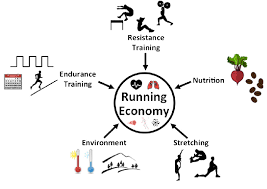
As a runner, it’s essential to comprehend the concept of Running Economy (RE), often referred to as “Economia di Corsa” in Italian. This concept is crucial for amateur runners to maximize their benefits and enjoyment from running.
What is Running Economy?
Running Economy refers to the energy consumed to sustain a specific velocity while running. In simpler terms, it measures how efficiently your body uses oxygen to move forward. A runner with a good RE consumes less oxygen and therefore less energy, while maintaining the same speed as their peers.
To understand RE better, consider the following analogy:
Imagine you’re driving a car on a straight road. The faster you drive, the more fuel you consume. Similarly, when running at higher speeds, your body requires more oxygen to maintain that pace. However, if you can optimize your technique and efficiency, you’ll reduce the amount of energy needed, just like how a car with better fuel economy consumes less gasoline.
Why is a Good Running Economy Important?
Having a good RE allows athletes to achieve better performance at the same VO2max (a measure of aerobic fitness) level. Unlike VO2max, which is only partially trainable due to genetic limitations, RE can be improved through targeted training. By improving RE, runners can optimize their running efficiency and reduce the risk of injuries.
Factors Influencing Running Economy
Several factors contribute to a runner’s RE:
- Muscle Composition: The type and proportion of muscle fibers (red, white, and intermediate) affect RE. Red fibers (slow-twitch) are ideal for efficient energy production and tend to be more abundant in runners with better RE.
- Flexibility: Runners with greater flexibility can generate less force and therefore require less energy to maintain a given speed.
- Body Composition: A lower body mass distribution (e.g., from upper body to lower body) generally leads to improved RE due to reduced energy expenditure.
- Course Conditions: Environmental factors like surface type, altitude, and wind direction can significantly impact RE.
Training to Improve Running Economy
To enhance RE, incorporate strength training sessions into your workout routine, focusing on exercises that improve force production without necessarily increasing muscle mass. These include:
- Squats
- Lunges
- Deadlifts
- Leg Press
- Core exercises (planks, side planks)
- Hill sprints
- Plyometric exercises
Plyometrics and Explosive Power
Plyometric training can help improve RE by enhancing explosive power. This type of training involves rapid, high-intensity movements that mimic the acceleration phase of a run. Examples include box jumps, depth jumps, and burpees.
Sprinting and Intervals Training
High-intensity interval training (HIIT) and sprinting can also contribute to improved RE. These types of workouts push your body to its limits, which can lead to increased efficiency and better oxygen use over time.
Tuning Your Running Technique with an Orologi
Modern running watches can provide valuable insights into your technique by tracking various parameters such as:
- Oscillations: Minimizing vertical oscillation improves efficiency and reduces energy expenditure.
- Ratios: The ratio of vertical oscillation to distance covered (cost-benefit) indicates the runner’s efficiency level.
- Cadence: A higher cadence (steps per minute) reduces energy expenditure and minimizes time spent in contact with the ground.
- Time of Contact: A shorter time of contact between your feet and the ground decreases energy expenditure.
- Balance: Maintaining a balanced stance between both legs helps optimize running efficiency.
Beyond Orologi: The Role of Posture
While orologi can provide valuable data, they cannot measure postural issues that affect running efficiency. Good posture is essential for maintaining optimal technique and reducing the risk of injuries. Consult a certified trainer to ensure you’re using proper form and correcting any errors.
Correcting Poor Posture
Poor posture can lead to inefficient running techniques, increasing energy expenditure and reducing performance. Some common signs of poor posture include:
- Forward head position
- Rounded shoulders
- Swayback or hunched shoulders
- Ankle pronation
To correct these issues, try the following exercises:
- Chest stretches to improve shoulder alignment
- Shoulder blade squeezes to strengthen core muscles
- Ankle strengthening exercises to reduce pronation
- Core engagement exercises to maintain proper posture during running
Conclusion
A good Running Economy is crucial for efficient performance and injury prevention. By understanding the factors influencing RE, incorporating targeted training into your routine, and tuning your running technique with an orologi, you can maximize your benefits from running. Don’t forget to prioritize good posture, as it’s a critical factor in maintaining optimal technique.
Advanced Training Techniques
For more advanced runners, incorporating techniques such as:
- Grounding exercises: Involves placing the foot on the ground and using the body weight to generate force.
- Leg swing drills: Targets hip and leg flexibility.
- Core rotations: Enhances rotational strength and stability.
can help further optimize RE. These advanced training techniques require a high level of fitness and technique proficiency, so it’s essential to work with an experienced coach or trainer.
Case Study: How Improving Running Economy Impacted Performance
One notable example is the Olympic athlete, Eliud Kipchoge. He has consistently pushed the limits of human performance in distance running, achieving world records in various events.
Kipchoge credits his success to a combination of genetic predisposition and targeted training. He believes that improving RE has played a significant role in his ability to maintain high speeds over long distances.
FAQs
- Q: How do I improve my Running Economy?
A: Incorporate strength training exercises that target muscles for efficient energy production, and optimize your running technique through drills and form checks. - Q: Can anyone train to improve their Running Economy?
A: With the right approach, including targeted training and a focus on proper posture, anyone can improve their RE. - Q: How often should I incorporate strength training into my routine?
A: Aim for 2-3 sessions per week, targeting different muscle groups each time to ensure balanced development. - Q: What is the best way to optimize running efficiency with an orologi?
A: Use the data provided by your watch to identify areas of improvement and adjust your training accordingly. - Q: Can postural issues affect my Running Economy?
A: Yes, poor posture can significantly impact your technique and increase energy expenditure. Consult a certified trainer for personalized guidance. - Q: How long does it take to see improvements in Running Economy?
A: With consistent effort, you can start noticing improvements within 4-6 weeks of targeted training. - Q: Is there an ideal running economy for me?
A: As individual performance levels vary, aim to find a balance that suits your fitness level and goals. - Q: Can I train with poor posture without negatively impacting my Running Economy?
A: While it may not be immediately noticeable, chronic poor posture can lead to inefficiencies in technique and increase energy expenditure over time.
By following these guidelines and incorporating targeted training into your routine, you’ll be well on your way to optimizing your running economy and achieving better performance.


