
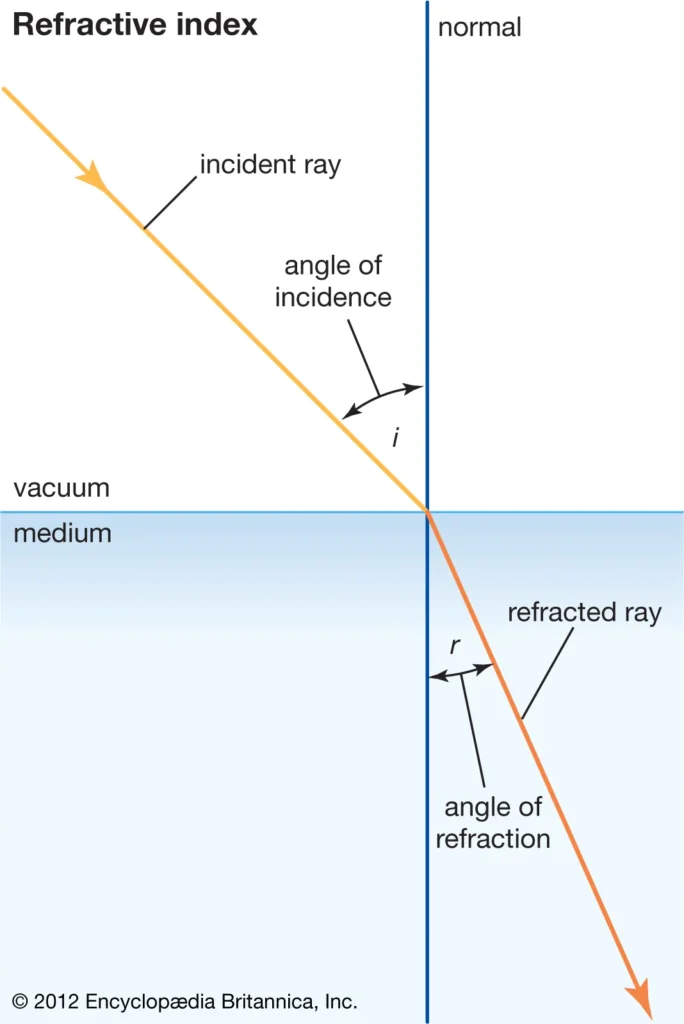
As we navigate through life, we often encounter various materials that can affect the way light behaves around us. Whether it’s a lens, a prism, or even a simple glass of water, understanding the refractive index is crucial in grasping how these materials interact with light. In this article, we’ll delve into the world of refractive indices, exploring what they are, how they work, and their importance in various fields.
What is Refractive Index?
The refractive index is a fundamental concept in physics that measures the ability of a medium to bend light as it passes through. It’s a dimensionless quantity that quantifies the decrease in speed of light when it traverses a material. In other words, it tells us how much a light beam slows down or speeds up when entering a new medium.
The Relationship Between Refractive Index and Light
When light travels from one medium to another, its speed changes due to the interaction with the surrounding particles. The refractive index takes this into account, providing a ratio between the original speed of light in vacuum (c) and its new speed in the material (v). This relationship is crucial in understanding how light behaves when it encounters different materials.
To illustrate this concept, let’s consider a simple example. Imagine a beam of light passing from air into a piece of glass. As the light travels through the glass, it slows down due to the interaction with the glass particles. The refractive index of the glass determines the extent of this slowing down, allowing us to calculate the new speed of the light in the glass.
Applications of Refractive Index
The refractive index has far-reaching implications across various fields. In chemistry, it’s used to analyze samples using a refractometer, which measures the bending of light as it passes through the material. In medicine, it helps determine the concentration of sugars in fruit juices or the alcohol content in beverages.
In industry and food science, refractive indices play a vital role in analyzing materials and detecting substances. For example, in the food industry, refractive index is used to detect the presence of certain compounds, such as sugars or fats, in food products. In medicine, it helps diagnose diseases by measuring changes in tissue density.
Formulas for Refractive Index
To calculate the refractive index, we use the following formula: c/v = n, where c is the speed of light in vacuum, v is the speed of light in the material, and n is the refractive index. This equation shows that the refractive index depends on the frequency of the radiation and the permittivity of the material.
Refractive Index and Vetro
The refractive index varies with the wavelength of light, which means that different materials exhibit distinct properties when interacting with different frequencies. This phenomenon is often exploited in optics to analyze light using prisms or surfaces of various materials.
For example, a vetro (a type of glass) has an index of refraction of 1.579, while another type of glass has an index of 1.517. These differences affect the way light behaves when passing through these materials, allowing us to analyze their properties using refractive indices.
Refractive Index and Plexiglass
Plexiglas, a popular plastic material, has a refractive index of 1.48, which is close to that of common glass but not identical. This difference affects the way light behaves when passing through plexiglass compared to traditional glass.
In applications such as eyeglasses or lenses, this difference can have significant consequences on image quality and optical performance. For instance, a lens made from plexiglas may produce slightly distorted images due to its lower refractive index.
Refractive Index of Lenses
The refractive index of lenses also plays a crucial role in their functionality. In general, the higher the refractive index of a lens material, the thinner and more precise it will be.
This is why organic lenses, which are made from materials like plastic or rubber, have refractive indices ranging from 1.5 to 1.74. These values allow for the creation of thin, flexible lenses that can conform to the shape of the eye.
Refractive Index Assoluto
The absolute refractive index is an important concept in physics that compares the speed of light in a material to its speed in vacuum. This value provides insight into how different materials interact with light and helps scientists understand various phenomena, such as refraction and diffraction.
In applications such as telescopes or microscopes, the absolute refractive index can have significant consequences on image quality and resolution. For instance, a lens made from a material with an extremely high absolute refractive index may produce extremely sharp images due to its ability to focus light accurately.
Indice di Rifrazione Relativo
The relative refractive index, also known as the index of relative refractivity, is another fundamental concept that compares the refractive indices of two or more materials. This value is essential in understanding how different media interact with each other when light passes from one medium to another.
For example, the relative refractive index between air and glass is approximately 1.33:1.52. This means that light travels at a speed of 1.33 times faster in air compared to glass, allowing us to analyze the optical properties of these materials using refractive indices.
Refractive Index of Vacuum
Finally, it’s worth noting that the refractive index of vacuum is a standard reference point for calculating the absolute refractive index of various materials. The speed of light in vacuum (c) serves as a baseline value, allowing scientists to compare and contrast different materials’ interactions with light.
In applications such as optical fibers or fiber optics, the refractive index of vacuum can have significant consequences on signal transmission and propagation. For instance, a fiber optic cable made from a material with a very high refractive index may produce extremely low signal losses due to its ability to guide light accurately.
Conclusion
In conclusion, the refractive index is a crucial concept that helps us understand how light behaves when interacting with different materials. From chemistry to medicine, industry, and food science, refractive indices play a vital role in analyzing various substances and detecting changes.
By grasping the fundamental principles of refractive indices, we can unlock new insights into the natural world and develop innovative solutions for real-world problems. Whether it’s a simple glass of water or an advanced optical material, understanding the refractive index is essential in creating technological advancements that transform our lives.
FAQs
- What is the difference between absolute and relative refractive index?
The absolute refractive index compares the speed of light in a material to its speed in vacuum, while the relative refractive index compares the refractive indices of two or more materials. - Why is the refractive index important in chemistry?
The refractive index helps scientists analyze samples using a refractometer and determine the concentration of substances in various media. - How does the refractive index affect lens functionality?
A higher refractive index results in thinner, more precise lenses, making them ideal for applications such as eyeglasses and telescopes. - What is the significance of the refractive index in medicine?
The refractive index helps determine the concentration of sugars in fruit juices or the alcohol content in beverages. - Can the refractive index be used to detect substances?
Yes, the refractive index can be used to analyze various substances and detect changes in their composition. - How does the refractive index vary with wavelength?
The refractive index changes depending on the frequency of light, which affects its behavior when passing through different materials. - What is the refractive index of plexiglass compared to glass?
Plexiglass has a refractive index of 1.48, which is close to that of common glass but not identical. - Can the absolute refractive index be used to compare different materials?
Yes, the absolute refractive index provides insight into how various materials interact with light and helps scientists understand their properties.


