
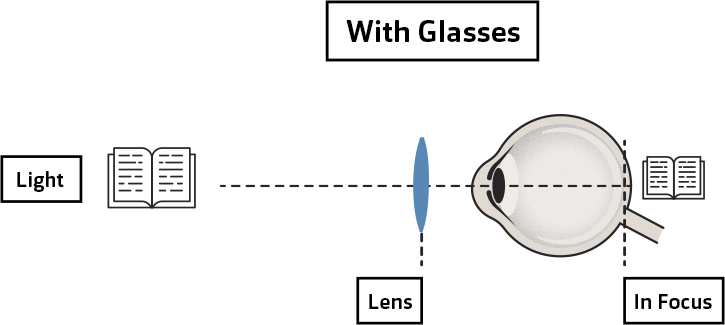
What is Presbyopia?
Presbyopia is a common vision problem that occurs when the lens of the eye loses its flexibility, making it difficult to focus on close objects. This age-related condition typically starts after the age of 40-45 and is not a refractive error, unlike myopia, hyperopia, or astigmatism.
Understanding Presbyopia vs. Hypermetropia
Presbyopia and hypermetropia are two distinct vision problems that can be easily confused with each other. The key difference lies in their causes:
- Presbyopia: A result of the aging process, where the lens of the eye loses its flexibility.
- Hypermetropia: Caused by a shorter-than-normal eyeball shape.
While both conditions share similar symptoms, such as difficulty focusing on close objects, they have distinct characteristics. For instance, hypermetropia can affect distance vision as well, whereas presbyopia is primarily related to near vision.
Presbyopia and Myopia: What’s the Connection?
Research suggests that there may be a link between presbyopia and myopia (nearsightedness). However, it’s essential to note that this connection is not absolute and should not be taken as a hard-and-fast rule. Some studies indicate that:
- Hypermetropia increases the risk of developing presbyopia at an earlier age.
- Myopia, on the other hand, may become more prevalent in older adults.
It’s crucial to understand that these findings are based on statistical data and should not be interpreted as absolute correlations.
Presbyopia: How Can You Correct It?
Fortunately, there are several options available to correct presbyopia:
- Lasik Surgery: A popular choice for treating presbyopia, Lasik uses a laser to reshape the cornea, allowing for clear vision at both near and far distances.
- Multifocal Lenses: Designed to correct multiple focal lengths, multifocal lenses can be worn as glasses or contact lenses.
- Progressive Lenses: Similar to multifocal lenses, progressive lenses offer a gradual transition between different focal lengths.
Choosing the Right Eyewear for Presbyopia
When selecting eyewear for presbyopia, consider the following options:
- Monofocal Lenses: Suitable for reading and distance vision only.
- Progressive Lenses: Offer a gradual transition between different focal lengths, making them ideal for both near and far distances.
- Multifocal Lenses: Designed to correct multiple focal lengths, these lenses can be worn as glasses or contact lenses.
Presbyopia vs. Vision Offuscation: What’s the Difference?
Presbyopia and vision offuscation are two distinct conditions that should not be confused with each other:
- Presbyopia: A result of the aging process, where the lens of the eye loses its flexibility.
- Vision Offuscation: Characterized by a decrease in visual acuity, often accompanied by blurred vision.
While both conditions affect vision, they have distinct causes and treatments. Vision offuscation can be caused by various factors, including age-related changes, eye diseases, or certain medications.
Treatment Options for Presbyopia
In addition to the options mentioned earlier, there are several other treatment options available for presbyopia:
- Refractive Lens Exchange: A surgical procedure that involves replacing the natural lens with an artificial one.
- Implantable Lenses: Artificial lenses that can be implanted in the eye to correct vision problems.
Conclusion
Presbyopia is a common vision problem that affects millions of people worldwide. By understanding its causes, symptoms, and treatment options, individuals can take control of their vision health and make informed decisions about their eye care. Whether you’re considering Lasik surgery, multifocal lenses, or progressive lenses, it’s essential to consult with an eye care professional to determine the best course of action for your unique needs.
FAQs
- Q: What is the primary cause of presbyopia?
A: Presbyopia is caused by the aging process, where the lens of the eye loses its flexibility. - Q: How does hypermetropia relate to presbyopia?
A: Hypermetropia can increase the risk of developing presbyopia at an earlier age. - Q: Can myopia (nearsightedness) become more prevalent in older adults?
A: Research suggests that myopia may become more common in older adults, but this is not a universal correlation. - Q: What are some options for correcting presbyopia?
A: Options include Lasik surgery, multifocal lenses, and progressive lenses. - Q: How do I choose the right eyewear for presbyopia?
A: Consider monofocal lenses, progressive lenses, or multifocal lenses, depending on your specific needs.
By understanding these key points, individuals can make informed decisions about their eye care and take steps to protect their vision health.


