
1. Introduction to Mercury
Mercury, often referred to as the “closest planet to the Sun,” has fascinated scientists and astronomers for centuries. As we explore this enigmatic world, let’s first understand why it’s so unique and what makes it stand out from the rest of our solar system.
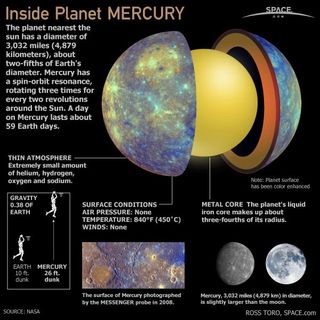
Mercury is the smallest planet in our solar system, with a diameter of approximately 4,879 kilometers. It’s also one of the densest planets, composed mainly of iron and silicates. Despite its small size, Mercury has a significant impact on the solar system due to its proximity to the Sun and its unique orbit.
2. The Challenges of Observing Mercury
One of the biggest obstacles in studying Mercury is its proximity to the Sun. Located just 58 million kilometers away, it’s difficult to observe due to the intense sunlight that overwhelms any attempt at discovery. In fact, Mercury can only be visible for a brief period shortly before sunrise or after sunset.
This challenging observation has led scientists to rely on spacecraft observations and telescopic studies to gather data about Mercury’s surface features, composition, and orbit. The Mariner 10 and MESSENGER missions provided valuable insights into Mercury’s geology, magnetosphere, and orbital characteristics.
3. Mercury’s Distinctive Features
Despite its challenging observation, Mercury boasts some remarkable characteristics. Its orbit is extremely elliptical, making it appear nearly flattened compared to other planets. This unique shape allows Mercury to complete its orbit in just 88 days, making it one of the fastest-moving planets in our solar system.
Additionally, Mercury’s rotation on itself is remarkably slow. It takes 59 times longer than Earth to rotate once, resulting in extreme temperature fluctuations between day and night. This slow rotation period has significant implications for Mercury’s surface features, geology, and atmospheric conditions.
4. The Slow Rotation of Mercury
Mercury’s slow rotation period is a result of its unique orbital characteristics. Its high eccentricity and close proximity to the Sun lead to strong tidal forces that cause Mercury’s rotation to slow down over time.
This slow rotation has significant consequences for Mercury’s surface features, including the formation of large scarps, craters, and impact basins. The Caloris Basin, one of the largest impact basins in our solar system, is a prime example of this geological activity.
5. No Atmosphere to Speak Of
Unlike other planets with satellites or rings, Mercury has neither. Its thin layer of gases offers no protection from the intense solar rays, making it impossible for water to exist on its surface. This lack of atmosphere is a direct result of its proximity to the Sun and low mass.
Mercury’s atmosphere is composed mostly of helium, oxygen, and hydrogen, but it’s extremely tenuous, offering little protection against solar winds or meteoroid impacts. The absence of an atmosphere also means that Mercury has no magnetic field, making it vulnerable to charged particles from the solar wind.
6. The Smallest Planet in Our Solar System
Mercury is the smallest planet in our solar system, with a diameter of approximately 4,879 kilometers. Its mass is also relatively low, with estimates suggesting it’s only 6% of our planet’s mass.
This small size has significant implications for Mercury’s surface features, geology, and atmospheric conditions. The lack of gravitational influence from other planets means that Mercury’s orbit is largely independent, allowing it to maintain its unique characteristics over time.
7. A Liquid Iron Core at its Center
Further exploration reveals that Mercury is composed primarily of iron, making up approximately 80% of its mass. This massive core is likely liquid due to the immense pressure exerted by the overlying strata.
The composition and structure of Mercury’s core are not well understood, but scientists believe it may be responsible for the planet’s unique magnetic field and geological activity. The study of Mercury’s core provides valuable insights into the formation and evolution of our solar system.
8. Temperature Extremes on Mercury
As a result of its combined rotation and revolution, Mercury experiences extreme temperature fluctuations. The surface temperature can soar as high as 420 degrees Celsius during solar exposure, while dipping to -180 degrees below zero in the shade.
These extreme temperatures have significant implications for Mercury’s geology, atmospheric conditions, and potential habitability. The lack of atmosphere means that there is no insulation or heat retention, leading to drastic temperature fluctuations between day and night.
9. The Cycle of Sunrise and Sunset
Mercury’s unique orbit allows for an unusual sunrise and sunset cycle. As it rotates on its axis, it experiences a brief period of sunlight, followed by a short period of darkness before rising again.
This cycle is a result of Mercury’s slow rotation period and extreme temperature fluctuations. The prolonged periods of darkness allow the surface to cool rapidly, while the brief periods of sunlight cause the surface to heat up quickly.
10. The Color of Mercury: A Moon-like Appearance
Observers from afar may notice that Mercury bears a striking resemblance to the Moon due to its numerous craters covering its surface. These vast impact basins can reach diameters of up to 200 kilometers, creating an otherworldly landscape.
The color of Mercury is also notable, with a pale grayish hue dominating its surface. This coloration is likely due to the presence of iron oxide and silicates, which are common minerals in planetary surfaces.
11. Astrological Significance of Mercury
In astrology, Mercury is considered the dominant planet of Gemini and Virgo, representing communication, rationality, speed, cunningness, intelligence, and rapid learning. Its association with water in Chinese astrology symbolizes life and purification.
Mercury’s astrological significance is also reflected in its role as a messenger between the physical world and the spiritual realm. The planet’s swift movement through the zodiac signifies quick communication and swift adaptation to changing circumstances.
12. The Fast Apparent Motion of Mercury
Mercury’s rapid apparent motion in the sky means it stays only 7.33 days in each constellation of the zodiac. This fast-paced movement has captivated astronomers for centuries, making it a fascinating subject of study.
The speed at which Mercury moves through the zodiac is due to its close proximity to the Sun and its relatively small size. This rapid motion allows astronomers to observe changes in Mercury’s surface features, composition, and atmospheric conditions over time.
13. Understanding Mercury’s Composition and Temperature
By studying Mercury’s unique features, we gain insight into its composition and temperature fluctuations. The extreme temperatures on its surface are a direct result of its proximity to the Sun and low mass.
Mercury’s composition is also notable, with a high iron content dominating its structure. This iron-rich core may be responsible for the planet’s magnetic field and geological activity.
14. Exploring Mercury’s Surface Features
Further exploration reveals an array of fascinating surface features, including enormous scarps, smaller craters producing dust, and the Caloris Basin, one of the largest impact basins in our solar system.
The study of Mercury’s surface features provides valuable insights into its geological history, atmospheric conditions, and potential habitability. The unique landscape of Mercury offers a glimpse into the early formation and evolution of our solar system.
15. Conclusion: Unraveling the Mysteries of Mercury
As we conclude our journey through the fascinating world of Mercury, it’s clear that this enigmatic planet continues to captivate scientists and astronomers alike. By exploring its unique characteristics, temperature fluctuations, and composition, we gain a deeper understanding of our solar system and the mysteries that lie within.
The study of Mercury offers valuable insights into the formation and evolution of our solar system, as well as the potential for life beyond Earth. The challenges and opportunities presented by Mercury’s extreme environment make it an exciting subject for further exploration and research.
Frequently Asked Questions:
Q: How long does it take for Mercury to complete one orbit around the Sun?
A: It takes 88 days for Mercury to complete one orbit around the Sun.
Q: What is the temperature range on Mercury’s surface?
A: The temperature can reach as high as 420 degrees Celsius during solar exposure and drop to -180 degrees below zero in the shade.
Q: Is Mercury a gas giant?
A: No, Mercury is not a gas giant; it has no atmosphere to speak of.
Q: What is the most notable feature on Mercury’s surface?
A: The Caloris Basin, one of the largest impact basins in our solar system.
Q: Can humans live on Mercury due to its extreme temperatures?
A: Due to the extreme temperature fluctuations, it is impossible for humans to live on Mercury without advanced protective measures.
Q: How does Mercury’s slow rotation period affect its surface features and geological activity?
A: Mercury’s slow rotation period leads to extreme temperature fluctuations, which in turn influence the formation of large scarps, craters, and impact basins.
Q: What is the composition and structure of Mercury’s core?
A: The exact composition and structure of Mercury’s core are not well understood, but scientists believe it may be responsible for the planet’s unique magnetic field and geological activity.


