
As the most luminous planet in our solar system, Jupiter is a fascinating subject of study and exploration. Often overshadowed by the Sun and Moon, but not for lack of interest, this gas giant is full of surprises waiting to be discovered.
What Makes Jupiter a Gas Giant?
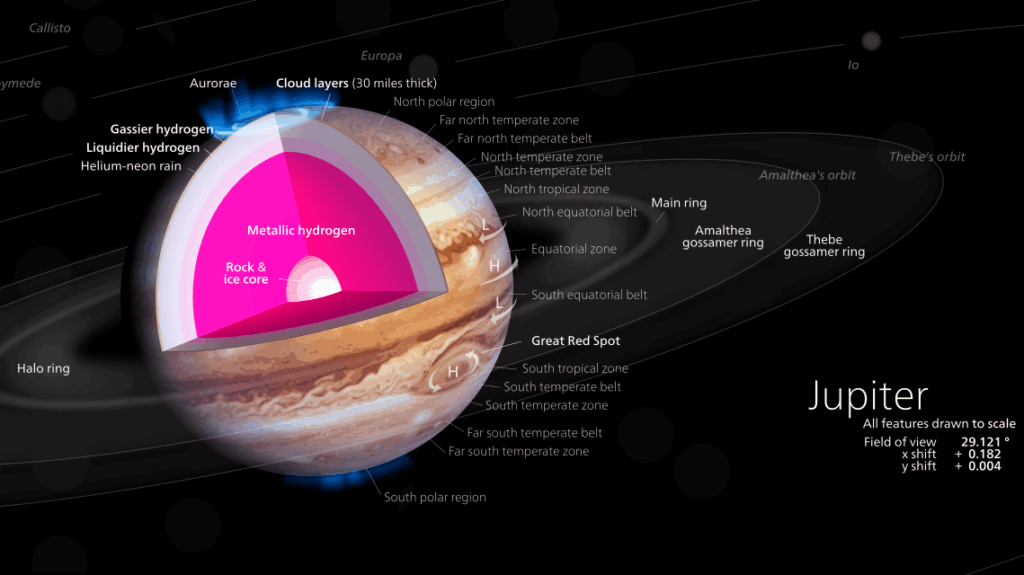
Jupiter is often referred to as a gas giant, but it’s more than just a nickname. Its density is much lower than that of Earth, composed primarily of liquid hydrogen and helium gases. Surrounding this massive body is an atmosphere thick with gases like hydrogen, helium, and methane. But here’s the interesting part: Jupiter has a solid core at its center, contrary to what one might expect from a gas giant.
The Atmosphere of Jupiter: A Complex System
Observing Jupiter’s atmosphere reveals a fascinating system of clouds and hazes. These clouds are made up of ammonia ice crystals, which have been identified as the primary components of the planet’s atmosphere. The cloud formations create striking patterns, with bands of different colors that alternate in orientation. But what’s most remarkable is the sheer force of the winds on Jupiter – gusts reaching speeds of over 600 km/h (373 mph). These powerful winds give rise to vortices, or storm systems, like the infamous Great Red Spot.
The Great Red Spot: A Fierce Storm
One of the most striking features of Jupiter’s atmosphere is the Great Red Spot, a massive anticyclonic storm that has been raging for centuries. This behemoth of a storm measures 25,000 km (15,000 miles) in diameter and stretches up to 12,000 km (7,500 miles) high. First observed over 300 years ago, this storm is still a subject of fascination and study among astronomers.
Jupiter’s Characteristics: A Unique World
Despite its gaseous composition, Jupiter has a surprising amount of structure and movement within our solar system. It orbits the Sun every 12 Earth years and completes one rotation on its axis in about 10 hours. This means that a day on Jupiter is approximately half the length of an Earth day. Another interesting fact is that Jupiter’s magnetic field is incredibly strong, but with a twist – its poles are inverted compared to those of Earth.
Jupiter’s Moons: A Diverse and Luminous System
Jupiter is not alone in our solar system; it has 16 known moons, each with unique characteristics. The four largest moons, Io, Europa, Ganymede, and Callisto, are collectively known as the Galilean moons, named after their discoverer, Galileo Galilei. These moons offer insights into Jupiter’s formation and evolution.
Io: A Volcanic Moon
Io is the innermost of the four largest moons and is the most volcanically active body in the solar system. Its surface is covered with volcanic features, including lava flows and calderas, which are a result of tidal heating caused by Jupiter’s gravitational pull. This unique feature makes Io a fascinating subject for scientific study.
Europa: A Frozen Surface
Europa is the second-largest moon of Jupiter and has a surface composed primarily of water ice. Beneath this icy crust lies a liquid water ocean, making Europa a potential candidate for supporting life. Scientists believe that Europa’s subsurface ocean could be heated by tidal forces caused by Jupiter’s gravitational pull, potentially creating conditions suitable for life.
Ganymede: The Largest Moon
Ganymede is the largest moon in our solar system, with a diameter of approximately 5,262 kilometers (3,270 miles). It has its own magnetic field and a surface composed primarily of water ice. Ganymede’s unique properties make it an interesting subject for scientific study.
Callisto: The Outermost Moon
Callisto is the outermost of the four largest moons and is thought to be one of the oldest bodies in the solar system. Its surface is composed primarily of water ice and has a unique cratered terrain, suggesting that it has undergone little geological activity over time.
Jupiter’s Temperature: A Scorching Hot Core
Recent studies have revealed that Jupiter’s core is incredibly hot, reaching temperatures of up to 20,000 degrees Celsius (36,000°F). This heat could be the result of Jupiter’s gradual contraction over time, releasing stored energy in the form of heat. This remarkable temperature is a testament to Jupiter’s internal dynamics.
Jupiter in Astrology: A Symbol of Abundance and Wisdom
In astrology, Jupiter is often associated with masculine energies and abundance. As the largest planet in our solar system, it represents the potential for growth and expansion. In this context, Jupiter is considered a symbol of wisdom, spiritual development, and personal growth.
The Formation of Jupiter
Jupiter’s formation is still shrouded in mystery, but scientists believe that it may have formed from a disk of gas and dust that surrounded the Sun after its formation. This disk would have undergone a process called accretion, where small particles stuck together to form larger bodies, eventually leading to the formation of Jupiter.
The Role of Jupiter in Our Solar System
Jupiter plays a significant role in our solar system, particularly in terms of its impact on nearby planets and moons. Its massive size and gravitational pull have a profound effect on the orbits of nearby celestial bodies, making it an important consideration for astronomers studying planetary motion.
Conclusion: Unraveling the Mysteries of Jupiter
Jupiter’s fascinating characteristics, atmosphere, temperature, moons, and symbolism make it a captivating subject of study and exploration. As we continue to unravel the secrets of our solar system, Jupiter remains an enigmatic yet awe-inspiring world that inspires us to reach for the stars.
Frequently Asked Questions (FAQs)
- What is the largest moon in our solar system?
Jupiter’s largest moon, Ganymede, is the largest moon in our solar system, with a diameter of approximately 5,262 kilometers (3,270 miles). - How long does it take Jupiter to orbit the Sun?
It takes Jupiter approximately 12 Earth years to complete one orbit around the Sun. - What is the temperature at Jupiter’s core?
Jupiter’s core reaches temperatures of up to 20,000 degrees Celsius (36,000°F). - How strong are Jupiter’s magnetic fields?
Jupiter’s magnetic field is incredibly strong, but with an inverted polarity compared to Earth’s. - What is the Great Red Spot on Jupiter?
The Great Red Spot is a massive storm system on Jupiter that has been raging for centuries. - Is Jupiter a gas giant or a liquid planet?
Jupiter is primarily composed of liquid hydrogen and helium gases, with a solid core at its center. - How many moons does Jupiter have?
Jupiter has 16 known moons, including the four largest Galilean moons: Io, Europa, Ganymede, and Callisto. - What is Jupiter’s significance in astrology?
In astrology, Jupiter represents masculine energies, abundance, wisdom, spiritual development, and personal growth.
Additional Resources
For those interested in learning more about Jupiter, there are several additional resources available:
- NASA’s Jupiter Fact Sheet: Provides an overview of Jupiter’s characteristics, atmosphere, and moons.
- The European Space Agency’s (ESA) Jupiter Mission: Offers a wealth of information on Jupiter’s exploration history and future missions.
- The International Astronomical Union’s (IAU) Definition of the Solar System: Defines the boundaries of our solar system and provides insight into its structure.
Glossary
Here is a list of key terms related to Jupiter:
- Anticyclonic storm: A type of storm that rotates in the opposite direction of a hurricane.
- Accretion: The process by which small particles stick together to form larger bodies.
- Aurora: A display of colored light that occurs at the poles of a planet due to charged particles from the solar wind interacting with its atmosphere.
- Galilean moons: The four largest moons of Jupiter, discovered by Galileo Galilei in 1610.
By exploring Jupiter’s fascinating characteristics and properties, we can gain a deeper understanding of our solar system and the mysteries that lie within. Whether you’re an astronomer or simply a curious individual, Jupiter is sure to captivate your imagination and inspire you to reach for the stars.


