
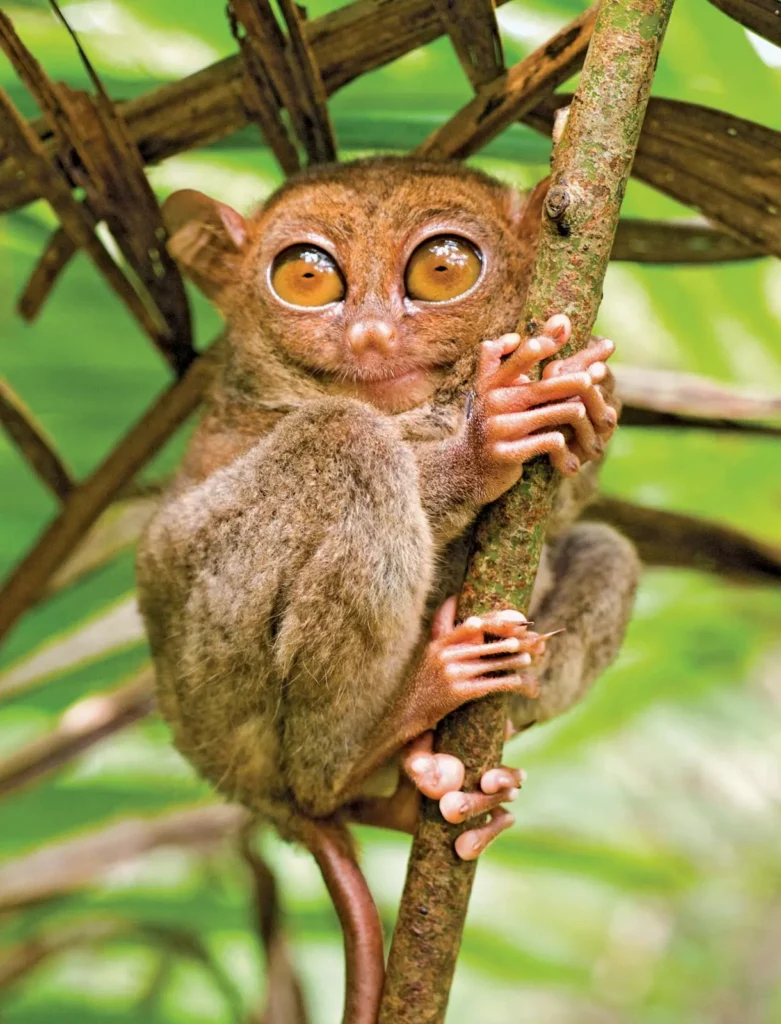
Deep in the forests of Southeast Asia, there lives a small but fascinating primate that has captured the hearts of many – the Philippine tarsier, also known as Carlito syrichta. This incredible animal is renowned for its gigantic eyes, which give it exceptional vision. But that’s not all; the Philippine tarsier is one of the oldest primates on Earth, with a history dating back around 45 million years.
Classification and Evolution
The Philippine tarsier (Carlito syrichta) belongs to the family Tarsiidae and is an endemistic species found only in the Philippines. Recently, it has been classified as a unique species within the genus Carlito. Interestingly, the tarsier was first described by Carl Linnaeus in 1758.
The Philippine tarsier is believed to have evolved around 45 million years ago, making it one of the oldest primates still alive today. Its ancestors roamed the Earth during the Eocene epoch, long before humans even existed. This ancient lineage has allowed the Philippine tarsier to thrive in its native habitat for millions of years.
Habitat and Distribution
The Philippine tarsier is an endemic species found only in the Philippines, inhabiting various geographical areas throughout the archipelago. These animals are known to live in primary and secondary forests as well as agricultural fields and banana plantations.
Specifically, they can be found on the islands of Samar, Leyte, Bohol, Mindanao, and Biliran. In these regions, they prefer living in wooded areas and are particularly common in the rainforests of Bohol, where sightings have been reported in large numbers.
The tarsier’s habitat is characterized by dense vegetation, with trees reaching heights of up to 30 meters. The forest floor is often covered with a thick layer of leaves, making it difficult for humans to navigate without causing harm to these animals. The Philippine tarsier is adapted to living in this environment, with its large eyes and long arms allowing it to move effortlessly through the forest canopy.
Conservation Status
The Philippine tarsier is currently listed as “vulnerable” by the International Union for Conservation of Nature (IUCN). Its population is declining due to habitat loss and illegal hunting. Efforts are being made to protect its habitat, including the establishment of national parks and wildlife reserves. Additionally, education programs have been implemented to raise awareness about the importance of conservation.
The Philippine tarsier’s vulnerability status is a result of the destruction of its natural habitat, which has led to a decrease in its population size. The main threats to this species are:
- Habitat loss: The destruction of forests and the expansion of agricultural land have resulted in the loss of the tarsier’s primary habitat.
- Hunting: Tarsiers are hunted for their meat, eyes, and other body parts, which are believed to possess medicinal properties.
- Climate change: Changes in temperature and precipitation patterns are altering the tarsier’s food supply and making it more difficult for them to survive.
Behavior and Diet
The Philippine tarsier is a nocturnal and solitary creature that lives in trees. During the day, it rests in hollow logs or leaf nests, while at night it ventures out to hunt for its favorite food – insects like mosquitoes, flies, and beetles. Although they primarily feed on arboreal animals, they can also catch small vertebrates such as frogs and lizards.
The tarsier’s diet consists mainly of insects, which are caught using its long, thin arms. Its eyesight is exceptional, allowing it to spot prey in the dark forest canopy. The tarsier’s diet varies depending on the season, with more insects being eaten during the dry season and fewer vertebrates during the wet season.
Reproduction
The Philippine tarsier reaches maturity at around one year of age. Its reproductive season is year-round, but most births occur between March and May. Female tarsiers give birth to a single infant after about two months of gestation. This young animal becomes independent within six months.
The reproductive cycle of the tarsier is unique in that it can breed throughout the year. The female tarsier can store sperm from multiple males, allowing her to control when she releases it and when she mates again. This reproductive strategy allows the tarsier to adapt to changing environmental conditions and ensures the survival of its species.
Interesting Facts
- Gigantic eyes: The Philippine tarsier has the largest eyes among all primates, which gives it exceptional night vision.
- Nocturnal behavior: Tarsiers are nocturnal animals that rest during the day and hunt at night.
- Solitary animal: Tarsiers are solitary creatures that only come together for mating or to protect their territory.
- Unique communication: Tarsiers use a variety of calls, including whistles, chirps, and grunts, to communicate with each other.
FAQs
- What is the primary threat to the Philippine tarsier?
Habitat destruction and poaching are major threats to this species. - Where can I find the Philippine tarsier?
They inhabit various regions of the Philippines, particularly in the islands of Samar, Leyte, Bohol, Mindanao, and Biliran. - What is unique about the eyesight of the Philippine tarsier?
Their large eyes provide exceptional night vision, allowing them to hunt effectively even in low-light conditions.
4. Why are efforts made to conserve the Philippine tarsier?
Efforts aim to protect its habitat and prevent further decline of this endangered species.
5. How long does it take for a young tarsier to become independent?
Within six months, they can fend for themselves after birth.
6. Is the Philippine tarsier threatened by human activities?
Yes, hunting and habitat destruction are significant threats that need urgent attention.
7. Can I help protect the Philippine tarsier?
Supporting conservation efforts through donations or spreading awareness can contribute to its preservation.
8. What organizations are working to save the Philippine tarsier?
Several organizations are involved in protecting this species, including wildlife reserves and research initiatives.
Conclusion
The Philippine tarsier is a fascinating creature that has captured the hearts of many with its unique characteristics and adaptations. However, it faces significant threats from habitat destruction and hunting. Efforts to conserve this species are underway, but more needs to be done to protect its habitat and prevent further decline.
As we learn more about the Philippine tarsier and its habits, we can work together to ensure the survival of this incredible animal. By supporting conservation efforts and spreading awareness about the importance of protecting our planet’s biodiversity, we can make a difference in the life of this amazing creature.


