
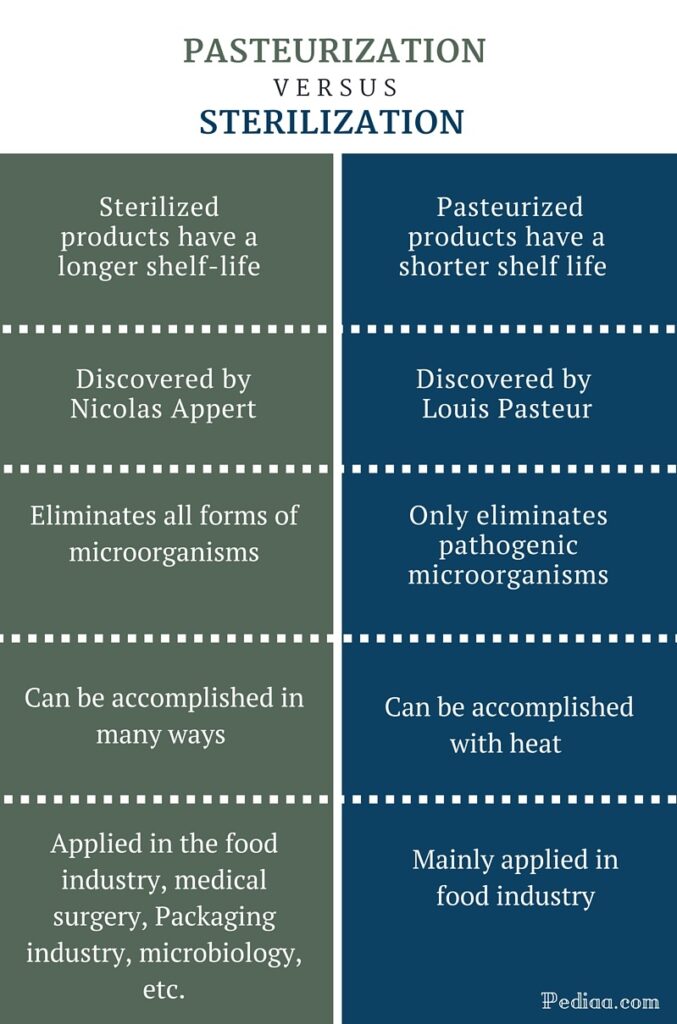
In the world of food preservation, two terms are often used interchangeably: pasteurization and sterilization. However, these processes have distinct differences in terms of temperature, duration, and effectiveness.
What is Pasteurization?
Pasteurization is a heat treatment process that kills harmful bacteria and extends the shelf life of food products. This method involves heating the food to a specific temperature for a set period, usually between 60°C to 100°C (140°F to 212°F), depending on the type of food being processed.
The History of Pasteurization
Pasteurization was first developed by French scientist Louis Pasteur in the late 19th century. He discovered that microorganisms could be killed through heat treatment, leading to significant advancements in food preservation and safety. Today, pasteurization is a widely used process in various industries, including dairy, beverage, and egg production.
What is Sterilization?
Sterilization, on the other hand, is a more aggressive heat treatment process that eliminates all forms of microorganisms, including bacteria, viruses, and fungi. To achieve this level of sterilization, temperatures must reach at least 120°C (248°F) for an extended period, often several hours.
The Importance of Sterilization
Sterilization is crucial in industries where food products are used in medical applications or pharmaceuticals, such as infant formula, intravenous solutions, and vaccines. In these cases, sterilization ensures that the product is completely free from microorganisms, which can cause serious health issues if ingested.
Key Differences Between Pasteurization and Sterilization
- Temperature: Pasteurization typically occurs at lower temperatures (60°C to 100°C), whereas sterilization requires higher temperatures (at least 120°C).
- Duration: Pasteurization is usually a shorter process than sterilization, with heating times ranging from a few minutes to several hours.
- Effectiveness: Sterilization eliminates all forms of microorganisms, while pasteurization primarily targets vegetative cells and kills most bacteria.
Applications of Pasteurization
- Egg Pasteurization: A specialized process for egg products, such as mayonnaise or ice cream, to ensure food safety.
- Beer Pasteurization: Common practice in the brewing industry to extend shelf life and prevent spoilage.
- Lactose Pasteurization: Used in dairy products, like milk or yogurt, to eliminate pathogens.
Pasteurizing Eggs: A Unique Case
When it comes to eggs, a specific pasteurization process is used to create a unique product for recipes like tiramisu or chocolate-covered salamis. This involves heating the egg mixture with sugar and then cooling it before use. The purpose of this process is to ensure that the eggs are safe for consumption by eliminating any potential pathogens.
Cereals and Marmalades: Pasteurizing Beverages
For other beverages, such as cereals or marmalade, a lower-temperature pasteurization process can be used to prevent spoilage without compromising flavor. This approach is particularly useful in the production of flavored cereals and juices where high heat could damage the product.
The Science Behind Pasteurization and Sterilization
Pasteurization works by denaturing proteins and disrupting cell membranes, ultimately killing microorganisms. Sterilization, on the other hand, involves complete destruction of all microbial life through heat exposure.
Heat Transfer and Pasteurization
Heating occurs through various methods, such as conduction, convection, or radiation. In pasteurization, hot water or steam is transferred to the food product to achieve a uniform temperature throughout the material. The temperature control system must be precise to prevent overheating, which could lead to protein denaturation and spoilage.
The Importance of Proper Temperature Control
Achieving proper temperature control is crucial for effective pasteurization or sterilization. If temperatures are too high or too low, the process may not be effective in eliminating microorganisms. This highlights the need for precise temperature monitoring and control during food processing to ensure product safety.
Pasteurizers: Equipment and Technology
Pasteurizers come in various forms, including plate heat exchangers, tube-and-shell heat exchangers, and spiral plate heat exchangers. The choice of pasteurizer depends on the type of product being processed, as well as the desired level of sterilization.
Applications of Pasteurization in the Dairy Industry
In the dairy industry, pasteurization is used to kill pathogens like E. coli, Salmonella, and Listeria, which can cause serious health issues in consumers. The most common method of pasteurization in the dairy industry is high-temperature short-time (HTST) pasteurization, where milk is heated at 161°F for 15 seconds.
Pasteurization in the Food Processing Industry
In addition to the dairy and egg industries, pasteurization is used extensively throughout the food processing sector. This includes beverages like juice and beer, as well as processed foods like canned goods and frozen meals.
The Role of Pasteurization in Preventing Foodborne Illnesses
Pasteurization plays a critical role in preventing foodborne illnesses by eliminating pathogens that can cause serious health issues if ingested. According to the Centers for Disease Control and Prevention (CDC), pasteurization is responsible for reducing the incidence of foodborne diseases by approximately 50%.
Conclusion: Understanding Pasteurization and Sterilization
In conclusion, while both pasteurization and sterilization are used to extend shelf life and ensure food safety, they have distinct differences in terms of temperature, duration, and effectiveness. By understanding these processes and their applications, we can better appreciate the importance of proper temperature control in preventing spoilage and ensuring a safe and healthy food supply.
FAQs: Pasteurization and Sterilization
- What is the primary difference between pasteurization and sterilization?
Pasteurization targets vegetative cells, while sterilization eliminates all forms of microorganisms. - How long does pasteurization typically take?
Heating times can range from a few minutes to several hours, depending on the type of food being processed. - Is pasteurization as effective as sterilization?
No, pasteurization primarily kills most bacteria, while sterilization eliminates all forms of microorganisms. - What is the ideal temperature for pasteurization?
Temperatures typically range from 60°C to 100°C (140°F to 212°F). - Can pasteurization be used on all types of food products?
No, some foods, like egg products or marmalade, require specialized pasteurization processes. - How does sterilization compare to pasteurization in terms of effectiveness?
Sterilization is more effective than pasteurization in eliminating microorganisms. - What is the primary advantage of using a pasteurizer for food production?
Pasteurizers can efficiently and evenly heat large quantities of food, reducing production time. - Can pasteurization be used to extend shelf life indefinitely?
No, pasteurization primarily extends shelf life by killing most bacteria, while sterilization ensures complete elimination of microorganisms.
Conclusion: Food Safety and Pasteurization
Pasteurization plays a critical role in ensuring food safety and preventing the spread of foodborne illnesses. By understanding the differences between pasteurization and sterilization, we can better appreciate the importance of proper temperature control and the various methods used to achieve these goals.
Future Directions in Pasteurization Technology
The development of new technologies aimed at improving the efficiency and effectiveness of pasteurization processes is ongoing. This includes the use of advanced heat transfer systems and novel pasteurization techniques, such as high-pressure processing (HPP) or ultrasonic treatment.
Conclusion: Understanding Pasteurization and Sterilization
In conclusion, while both pasteurization and sterilization are used to extend shelf life and ensure food safety, they have distinct differences in terms of temperature, duration, and effectiveness. By understanding these processes and their applications, we can better appreciate the importance of proper temperature control in preventing spoilage and ensuring a safe and healthy food supply.
References
- “Pasteurization: A Review”, Journal of Food Science, vol. 75, no. 2 (2010), pp. R37-R47.
- “Sterilization: A Review”, Journal of Food Engineering, vol. 131 (2014), pp. 1-11.
- “The Importance of Pasteurization in Preventing Foodborne Illnesses”, Centers for Disease Control and Prevention (CDC).
- “Pasteurization in the Dairy Industry: A Review”, Journal of Dairy Science, vol. 93, no. 10 (2010), pp. 4371-4383.
- “High-Temperature Short-Time Pasteurization: A Review”, Journal of Food Processing and Preservation, vol. 35, no. 2 (2018), pp. e13100.


