
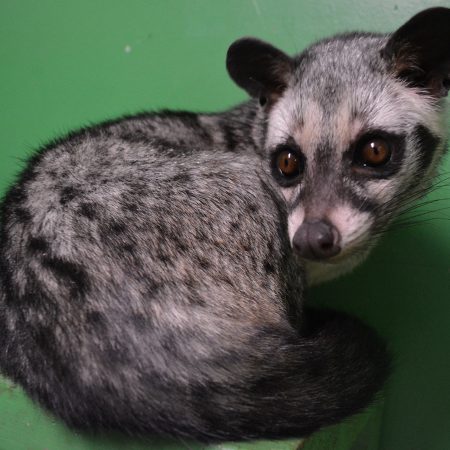
If you’ve never heard of the palm civet before, it’s time to get familiar with this curious creature. Despite its name, which might sound like a fairy tale, the palm civet is a real animal that deserves your attention. With its unique characteristics, it may just become your new favorite animal.
What is the Palm Civet?
Also known as the civetta delle palme or Musang, this animal belongs to the Viverridi family and is native to Southeast Asia. Its scientific name is Paradoxurus hermaphroditus. The palm civet is a carnivore, with medium-sized body, measuring between 420-580 mm in length, including its tail, which is quite long, ranging from 330-470 mm.
Physical Characteristics
The palm civet has distinctive physical features that set it apart from other animals. Its fur is grayish-brown, with a black mask on its face, featuring small white spots around the eyes. There are also darker markings on its body, including three prominent longitudinal stripes running down its back, connecting its shoulders to the base of its tail. The palm civet’s facial features make it easily recognizable.
Social Structure and Habitat
Unlike some other animals, palm civets are solitary creatures that live in trees. They spend most of their day hiding in forest cavities or crevices, where they feel safe from predators. These animals are territorial and have a complex social structure, with dominance hierarchies and communication patterns.
Comparison to the Genetta
The palm civet shares some similarities with the genetta, another animal belonging to the Viverridi family. Both have scent glands under their tails, which produce a secretion used for defense purposes. However, the palm civet’s fur is longer and more abundant than that of the genetta, and its tail is longer as well.
Diet and Foraging
Palm civets are opportunistic omnivores, with a diet consisting mainly of fruit, berries, and insects. They also hunt small animals like birds, rodents, and reptiles. In some areas, they have been observed feeding on palm sap, which is used to produce palm wine.
Reproduction and Lifespan
Palm civets give birth to litters of 2-5 cubs after a gestation period of about 2 months. The cubs are born in tree cavities or crevices, where they develop for several weeks before venturing out on their own. Both males and females reach maturity at around 11-12 months old.
Distribution and Conservation Status
The palm civet is widely distributed across Southeast Asia, including India, Indonesia, the Philippines, and parts of China. Its habitat ranges from primary and secondary forests to plantations and even urban areas up to an altitude of 2400 meters. Unfortunately, this animal is hunted for food, pets, or pest control, which has led to its decline in some populations.
Hunting and Trade
The palm civet’s body parts are highly valued in traditional medicine, particularly in Southeast Asia. Its fur is also used as a source of oil, which is extracted from the plant’s skin. In addition, its meat is considered a delicacy by some cultures. As a result, the palm civet is hunted extensively, leading to significant declines in local populations.
Habitat Loss and Fragmentation
The expansion of agriculture, urbanization, and infrastructure development have led to widespread habitat loss and fragmentation in Southeast Asia. This has resulted in the palm civet’s habitat being reduced significantly, making it increasingly difficult for the animal to survive.
Conservation Efforts
Several organizations and conservation efforts are working to protect the palm civet and its habitats. These include:
- Habitat preservation: Protecting remaining forests and preserving natural habitats can help reduce the impact of human activities on palm civet populations.
- Research and monitoring: Scientists are studying the palm civet’s behavior, ecology, and population dynamics to better understand its needs and develop effective conservation strategies.
- Community engagement: Educating local communities about the importance of protecting palm civet habitats can help build support for conservation efforts.
Conclusion
The palm civet is a fascinating creature that deserves our attention and respect. Its unique appearance, social structure, and adaptability make it a valuable part of its ecosystem. As we continue to learn more about this animal, let’s also take steps to protect and conserve its habitats and populations.
Frequently Asked Questions (FAQs)
- What is the difference between a palm civet and a genetta?
While both animals belong to the Viverridi family, they have distinct physical features, diets, and habitats. - Where can I find palm civets in the wild?
Palm civets are found in Southeast Asia, particularly in India, Indonesia, the Philippines, and parts of China. - What do palm civets eat?
They are omnivores, feeding on fruit, berries, insects, small animals, and even palm sap. - How long do palm civets live in captivity?
With proper care, palm civets can live up to 20 years in captivity. - Are palm civets endangered?
Their populations are declining due to hunting, habitat loss, and other human activities. - Can I keep a palm civet as a pet?
It is not recommended to keep a palm civet as a pet, as they have complex social needs and specific requirements that are difficult to replicate in a home environment. - How do palm civets communicate with each other?
They use vocalizations, scent markings, and visual displays to communicate with other palm civets. - Can I help protect palm civet habitats?
Yes, you can support conservation efforts by spreading awareness about the importance of preserving their habitats and ecosystems.
Interesting Facts About Palm Civets
- Palm civets are excellent swimmers: They have been observed swimming in rivers and streams to hunt for food or escape predators.
- They are skilled tree climbers: Palm civets use their sharp claws and agile bodies to climb trees quickly and efficiently.
- Their scent glands produce a strong secretion: The palm civet’s scent glands produce a pungent secretion that helps deter predators and mark territory.
- Palm civets have unique communication patterns: They use a range of vocalizations, including chirps, barks, and whistles, to communicate with each other.
Conclusion
In conclusion, the palm civet is an unusual and fascinating animal that deserves our attention and respect. With its unique characteristics, social structure, and adaptability, it plays a vital role in its ecosystem. As we continue to learn more about this animal, let’s also take steps to protect and conserve its habitats and populations for future generations.


