
What is OLED?
OLED stands for Organic Light Emitting Diode, which is a type of semiconductor that emits light when an electric current is passed through it. The invention of OLED technology dates back to the 1980s, but its practical application didn’t gain momentum until the year 2000.
In 2006, the Japanese company Konica Minolta announced the development of a lighting device based on OLED technology. This device boasted high luminous efficiency and a lifespan equivalent to that of an incandescent fluorescent lamp, with significantly lower energy consumption.
How Does OLED Technology Work?
OLED technology is able to emit light by using two different materials, each with distinct properties. One material has a relatively low emission coefficient (less than 25%) and the other material has a high emission coefficient (100%). This second material offers two significant benefits: it generates minimal heat (low thermal generation) and allows for maximum energy savings.
It’s clear that OLED technology requires the use of the phosphorescent material, but this wasn’t possible before the advent of OLED technology. Manufacturers had previously favored using fluorescent materials because they were easier to develop. The materials used in OLED devices have a layered organic structure, which allows for varying combinations of characteristics such as color or durability.
The Structure of OLED Technology
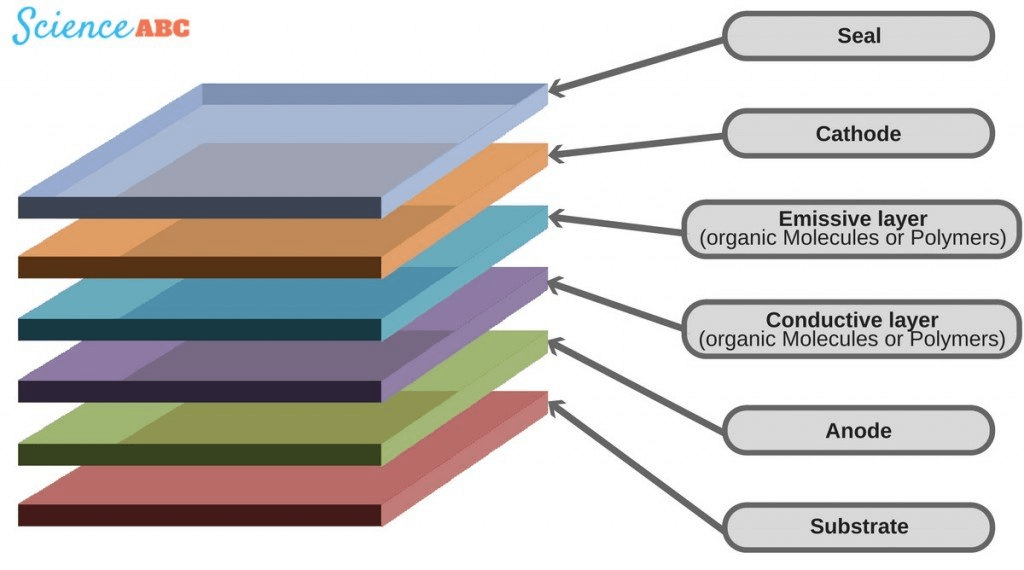
OLED technology can be described by comparing it to a multi-layer sandwich. An OLED unit is composed of a thin film made from an organic material, laminated on a substrate of glass or plastic. The organic material is placed between two electrodes that apply tension.
An OLED unit consists of three layers where the emission layer is inserted between two transport layers that come into contact with an anode and cathode. The function of the transport layers is to conduct electric charge from the anode and cathode to the emission layer.
Comparing OLED Technology to LED Technology
When comparing OLED technology to LED technology, the first differences become apparent in the principle of light emission: while LEDs rely on an inorganic semiconductor, OLEDs apply tension to a material (like incandescent bulbs apply tension to a metal filament).
While LED technology relies on point sources of light, OLED technology uses the entire surface. This allows for various possibilities with OLED technology, such as obtaining flexible displays, ultra-thin screens, and other units that produce extremely low heat.
Advantages of OLED Technology
OLED technology offers several advantages over traditional display technologies like LCDs and LEDs:
- Higher contrast ratio: The organic material used in OLED devices can be designed to have a higher contrast ratio than the phosphors used in LCDs.
- Wider viewing angles: Since the entire surface is illuminated, OLED displays offer wider viewing angles compared to LCDs.
- Lower power consumption: OLED technology consumes significantly less energy than LED technology and has lower backlight power requirements.
Challenges of OLED Technology
Despite its advantages, OLED technology also faces several challenges:
- Lower lifespan: While the lifespan of an OLED device is still increasing, it remains a concern compared to LCDs.
- Color accuracy: The organic material used in OLED devices can exhibit color shifts over time, which may affect color accuracy.
- Production costs: The manufacturing process for OLED panels is more complex and expensive than LCD or LED technology.
Applications of OLED Technology
OLED technology has a wide range of applications:
- Display devices: OLED displays are used in smartphones, TVs, smartwatches, and other consumer electronics.
- Lighting: OLEDs can be used for general lighting purposes due to their low heat generation and high efficiency.
- Automotive: OLED technology is being explored for use in automotive displays, such as dashboard screens.
Future Developments
Researchers continue to improve OLED performance by optimizing materials and manufacturing processes:
- New organic materials: Researchers are developing new organic materials with improved brightness, color accuracy, and lifespan.
- Improved manufacturing techniques: Advancements in manufacturing processes are enabling mass production of high-quality OLED panels.
- Integration with other technologies: OLED technology is being integrated with other display technologies to enhance performance and functionality.
Environmental Impact
OLED technology contributes less to heat and energy consumption compared to traditional lighting methods, making it a more environmentally friendly option:
- Reduced greenhouse gas emissions: By reducing the amount of energy consumed, OLED technology can help lower greenhouse gas emissions.
- Lower waste generation: The production process for OLED panels is designed to minimize waste and reduce environmental impact.
Conclusion
OLED technology offers several advantages over traditional display technologies like LCDs and LEDs:
- Higher contrast ratio
- Wider viewing angles
- Lower power consumption
Despite its challenges, OLED technology continues to evolve and improve in performance and efficiency:
- New organic materials
- Improved manufacturing techniques
- Integration with other technologies
As researchers continue to explore the possibilities of OLED technology, it is likely that we will see increased adoption in various applications, from display devices to lighting systems.


