
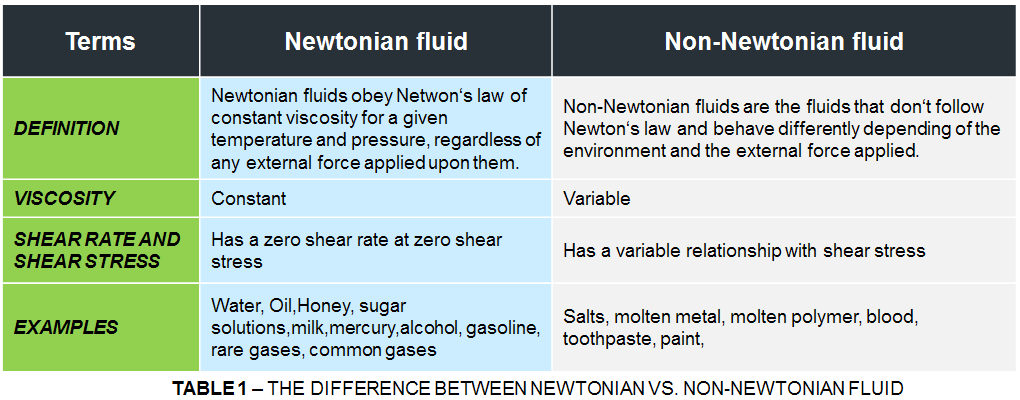
Have you ever wondered why some liquids behave like solids, while others flow like water? The answer lies in the world of fluid dynamics, where we encounter two types of fluids: Newtonian and non-Newtonian. In this article, we’ll delve into the characteristics of these fluids, explore their applications, and even provide a simple recipe to create a non-Newtonian fluid at home.
What are Fluids?
Fluids are substances that can flow and change shape in response to external forces. They can be liquids or gases, and their behavior is determined by the interactions between molecules. In this article, we’ll focus on two types of fluids: Newtonian and non-Newtonian.
The History of Fluid Dynamics
The study of fluid dynamics dates back to ancient Greece, where philosophers such as Aristotle and Archimedes experimented with water and air flow. However, it wasn’t until the 17th century that Sir Isaac Newton laid the foundation for modern fluid dynamics with his laws of motion. Newton’s work established the concept of a “fluid” as a substance that can be described by its velocity, pressure, and density.
Newtonian Fluids: The Classic Liquids
Newtonian fluids are those that exhibit linear relationships between stress (force per unit area) and strain rate (velocity of deformation). Think of water, oil, or honey – these liquids behave predictably when subjected to different forces. When you apply a force to a Newtonian fluid, the resulting deformation is directly proportional to the applied force.
Examples of Newtonian Fluids
- Liquids: Water, oil, honey, and most other common liquids are examples of Newtonian fluids.
- Gases: Air, helium, and all other gases are also considered Newtonian fluids.
- Plastics: Most plastics, such as polyethylene or polyester, exhibit Newtonian behavior when subjected to stress.
Characteristics of Newtonian Fluids
Newtonian fluids have several key characteristics that distinguish them from non-Newtonian fluids:
- Linear viscosity: The relationship between shear stress and strain rate is directly proportional.
- Constant density: The density of a Newtonian fluid remains constant over time and temperature changes.
- Predictable behavior: Newtonian fluids exhibit predictable behavior under constant stress, making them ideal for many industrial applications.
Applications of Newtonian Fluids
Newtonian fluids have numerous applications in various industries:
- Aerospace industry: Newtonian fluids are used in aircraft fuel systems, hydraulic systems, and other critical components.
- Food processing: Newtonian fluids are used in the production of foods like juice, milk, and sauces.
- Cosmetics: Newtonian fluids are used in personal care products like shampoo, conditioner, and moisturizer.
Non-Newtonian Fluids: The Unpredictable Ones
Non-Newtonian fluids, on the other hand, exhibit non-linear relationships between stress and strain rate. These fluids can behave like solids or liquids depending on the situation, making them more complex and fascinating. Think of ketchup, cornstarch mixture, or even your blood – these substances display unique properties when subjected to different forces.
Examples of Non-Newtonian Fluids
- Ketchup: Ketchup is a classic example of a non-Newtonian fluid due to its pseudoplastic behavior.
- Cornstarch mixture: A mixture of cornstarch and water creates a dilatant fluid that becomes thicker under stress.
- Blood: Blood is a complex fluid that exhibits thixotropic behavior, becoming thinner with repeated stress and thicker over time.
Characteristics of Non-Newtonian Fluids
Non-Newtonian fluids can be broadly classified into three categories:
- Pseudoplastic fluids: These fluids become thinner and more fluid-like when subjected to higher shear rates (e.g., ketchup).
- Dilatant fluids: These fluids become thicker and more resistant to flow when subjected to higher shear rates (e.g., cornstarch mixture).
- Thixotropic fluids: These fluids exhibit both pseudoplastic and dilatant behavior, becoming thinner with repeated stress and thicker over time (e.g., some types of paint).
Applications of Non-Newtonian Fluids
Non-Newtonian fluids have a wide range of applications in various industries:
- Paints and coatings: Thixotropic fluids are used in paints and coatings to provide improved flowability and leveling properties.
- Pharmaceuticals: Non-Newtonian fluids are used in some medications, such as eye drops and ointments, to improve delivery and absorption.
- Food industry: Non-Newtonian fluids are used in foods like ketchup, sauces, and dressings to enhance texture and consistency.
Creating a Non-Newtonian Fluid at Home
Want to experiment with non-Newtonian fluids? Here’s a simple recipe to create a pseudoplastic fluid using cornstarch and water:
Ingredients:
- 250g cornstarch
- 3 cups water
- A large bowl
Instructions:
- Mix the cornstarch and water in the bowl until well combined.
- Knead the mixture for several minutes to break down the starches and create a smooth, consistent texture.
- Test the fluid by applying gentle pressure with your fingers. If it flows easily, add more water. If it becomes too thick, add more cornstarch.
Conclusion
Understanding Newtonian and non-Newtonian fluids is crucial in various fields, from materials science to food technology. By exploring their characteristics and applications, we can unlock new possibilities for innovation and problem-solving. Whether you’re a scientist, engineer, or simply curious about the world around you, this article has provided a solid foundation for further exploration.
Frequently Asked Questions
- What is the difference between Newtonian and non-Newtonian fluids?
Newtonian fluids behave predictably under constant stress, while non-Newtonian fluids exhibit non-linear relationships between stress and strain rate. - Can I use cornstarch to make a pseudoplastic fluid at home?
Yes, mix 250g of cornstarch with 3 cups of water, knead until smooth, and test the fluid for consistency. - How do I distinguish between dilatant and thixotropic fluids?
Dilatant fluids become thicker under stress, while thixotropic fluids exhibit both thinning and thickening behavior over time. - Are non-Newtonian fluids more stable or less predictable than Newtonian fluids?
Non-Newtonian fluids can be more unpredictable due to their non-linear behavior, but they also offer unique advantages in specific applications. - Can I create a non-Newtonian fluid using other ingredients besides cornstarch and water?
Yes, various combinations of ingredients like flour, starches, or even blood can create unique non-Newtonian fluids with distinct properties.
Future Research Directions
While we’ve made significant progress in understanding Newtonian and non-Newtonian fluids, there’s still much to be discovered. Future research directions include:
- Development of new materials: Creating novel materials with tailored properties using non-Newtonian fluids.
- Biological applications: Exploring the use of non-Newtonian fluids in medical devices and biological systems.
- Environmental monitoring: Using non-Newtonian fluids to monitor environmental pollutants and contaminants.
By continuing to explore the fascinating world of fluid dynamics, we can unlock new opportunities for innovation and discovery.


