
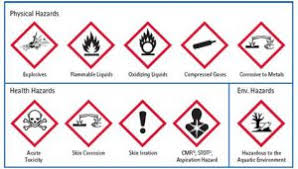
Have you ever wondered about the symbols of danger? The answer isn’t surprising, as between 2010 and 2015, they changed gradually to be equal across all of Europe. Today, we have the symbols of chemical risk, or hazard pictograms, or simply the symbols of danger.
The symbols of danger serve to inform us about the types of hazards related to the use, handling, transportation, and storage of hazardous chemicals. Previously, they were black in a yellow square surrounded by black, today they are inserted into a red rhombus.
New criteria for classifying risks and new symbols of danger were introduced with the CE Regulation 1272/2008, which replaced the Annex II of Directive 67/548/EEC. The obligation began on December 1, 2010 for “substances” and June 1, 2015 for “mixtures”.
Symbols of Danger or Hazard Pictograms
In recent years, the Globally Harmonized System of Classification and Labeling of Chemicals (GHS) has been implemented across the world. The GHS aims to provide a standardized system for classifying and labeling chemicals based on their hazards. This has led to changes in the symbols used to indicate hazardous chemicals.
Explosive
Denomination GHS01: indicates substances or preparations that can explode with a spark or extremely sensitive to impacts or friction. Avoid fire, heat sources, shocks, and friction. Example: nitroglycerin.
The explosive symbol is one of the most recognizable symbols of danger. It serves as a warning to individuals handling explosives or chemicals that could potentially cause an explosion. The symbol has undergone changes over the years, with some countries adopting different designs for their versions of the GHS.
Corrosive
Denomination GHS05: indicates products that destroy living tissues or equipment. Avoid inhalation and contact with eyes, skin, and clothing. Example: sulfuric acid.
The corrosive symbol is a warning to individuals handling chemicals that could potentially cause burns or damage to living tissue. This includes not only liquids but also solids that can still cause harm if ingested or come into contact with the skin.
Flammable
Denomination GHS02: indicates all products and preparations that can heat up and burn when exposed to ignition sources but also when in contact with water and air. This pictogram combines the previous “flammable” and “extremely flammable” classifications. Avoid contact with materials, water, and air. Examples: benzene (flammable), hydrogen (extremely flammable).
The flammable symbol serves as a warning to individuals handling chemicals that could potentially ignite or cause a fire. This includes not only liquids but also solids that can still cause harm if ignited.
Acute Toxic
Denomination GHS06: substances or preparations that provoke serious risks, acute or chronic, and even death when inhaled, ingested, or penetrated through the skin. Avoid contact with the body. Example: cyanide.
The acute toxic symbol is a warning to individuals handling chemicals that could potentially cause harm if ingested, inhaled, or come into contact with the skin. This includes not only liquids but also solids that can still cause harm.
Severe Effects – Long-term Toxicity
Grave effects. Denomination GHS08: substances or preparations that provoke severe risks, acute or chronic, and easily death when inhaled, ingested, or absorbed through the skin. Avoid contact and repeated exposure even at low concentrations. Example: methanol.
The severe effects symbol serves as a warning to individuals handling chemicals that could potentially cause long-term harm if ingested, inhaled, or come into contact with the skin.
Combustible Oxidizer
Oxidizing agent. Denomination GHS03: products that can easily oxidize or release oxygen when reacting with other substances, worsening combustible substance fires. Avoid contact with combustible materials. Example: oxygen.
The combustible oxidizer symbol is a warning to individuals handling chemicals that could potentially cause a fire if ignited in the presence of combustible materials.
Irritant – Harmful
Irritant harmful. Denomination GHS07: non-corrosive substances or preparations that provoke irritation or allergic reactions when in immediate or prolonged contact with the skin. Vapors should not be inhaled, and contact with the skin should be avoided. Examples: calcium carbonate, laudanum.
The irritant-harmful symbol serves as a warning to individuals handling chemicals that could potentially cause irritation or allergic reactions if ingested, inhaled, or come into contact with the skin.
Gas Under Pressure
Gas under pressure. Denomination GHS04: this symbol of danger, which did not exist in the previous classification, indicates gas cylinders or other containers under pressure, dissolved, liquefied, compressed, or refrigerated. The symbol prescribes caution when transporting and handling. Example: acetylene.
The gas under pressure symbol serves as a warning to individuals handling chemicals that could potentially cause an explosion if not handled properly.
Environmentally Hazardous
Environmentally hazardous. Denomination GHS09: indicates that contact with these substances and preparations causes damage to the ecosystem (plants, animals, water, air …). These substances should not be dispersed in the environment. Example: sodium hypochlorite.
The environmentally hazardous symbol serves as a warning to individuals handling chemicals that could potentially harm the environment if released into it.
Why Are New Symbols of Danger Needed?
In recent years, there has been an increased focus on safety and environmental protection. This has led to the development of new symbols of danger to better inform individuals about the hazards associated with different types of chemicals. The GHS provides a standardized system for classifying and labeling chemicals based on their hazards, which has helped to reduce confusion and improve safety.
However, despite these efforts, there are still many challenges in terms of enforcing the use of new symbols of danger across all industries and countries. This includes ensuring that workers and consumers have access to accurate information about chemical hazards, as well as developing policies and regulations to prevent exposure to hazardous chemicals.
The Role of Education
Education plays a crucial role in raising awareness about the importance of safety and environmental protection. This includes educating individuals on how to handle chemicals safely, as well as promoting best practices for reducing exposure to hazardous chemicals.
In addition, education can also play a key role in promoting the use of new symbols of danger. By providing clear information about chemical hazards, individuals can better understand the risks associated with different types of chemicals and take steps to minimize their exposure.
Conclusion
The symbols of danger serve as an important tool for informing individuals about the hazards associated with different types of chemicals. The introduction of new symbols of danger has helped to improve safety and reduce confusion in terms of classifying chemical hazards.
However, despite these efforts, there is still much work to be done to ensure that workers and consumers have access to accurate information about chemical hazards. Education plays a crucial role in this process, and by promoting awareness and understanding of chemical hazards, individuals can better take steps to minimize their exposure.
By working together to promote safety and environmental protection, we can create a healthier environment for everyone.


