
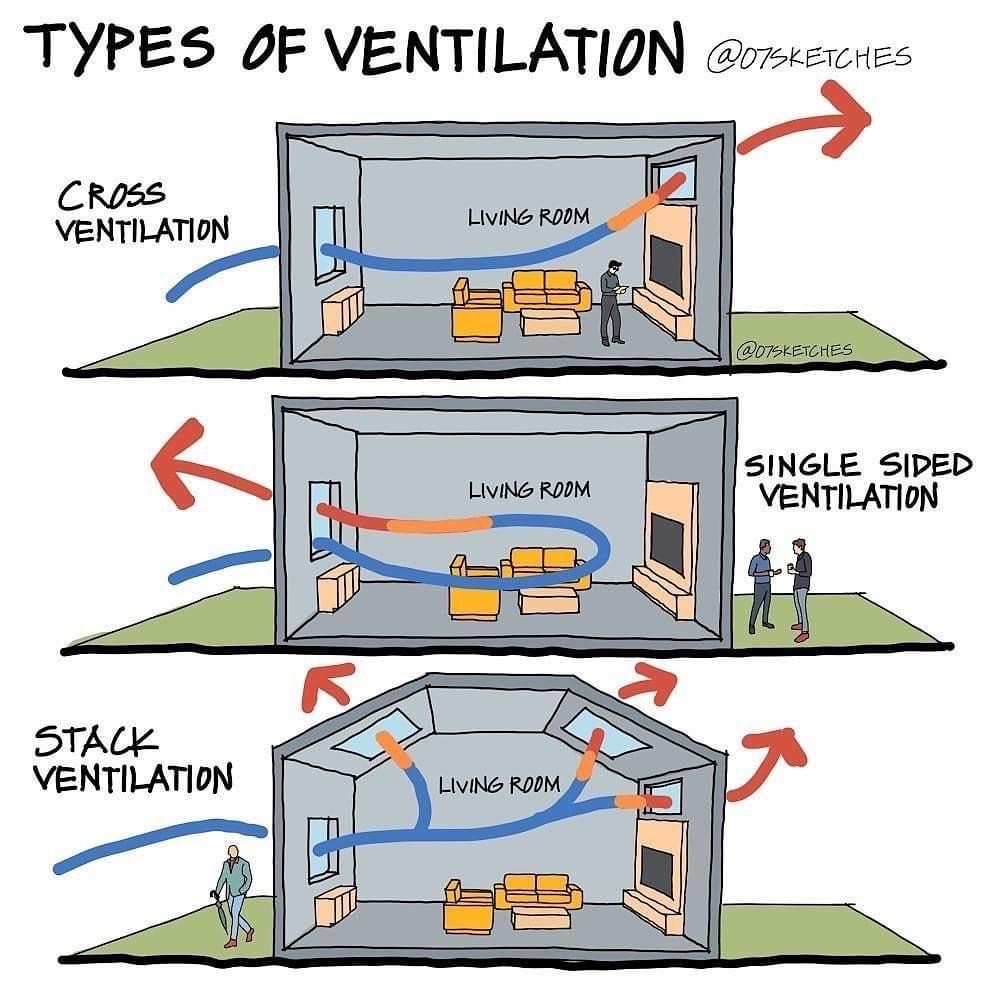
Natural ventilation is the solution to ensure adequate air exchange and, in some cases, cool down the environment. Natural ventilation and controlled ventilation are two distinct approaches that serve different purposes. In a well-designed building, natural ventilation plays a crucial role in ensuring domestic comfort and energy efficiency.
The purpose of natural ventilation is to regulate humidity levels, temperature, prevent condensation and mold growth, and most importantly, ensure fresh air exchange to eliminate indoor pollutants and cooking vapors. This is achieved by creating a pressure gradient between the inside of the house and the outside environment or by manipulating temperature differences within the building.
To ensure effective natural ventilation, some environments are placed “under pressure” while others are under “negative pressure”. A practical example can be seen in residential buildings where living rooms and bedrooms are under positive pressure while kitchens and bathrooms are under negative pressure, as they produce more moisture (stove fumes and bathroom condensation).
Natural ventilation is made possible through specially designed airflow systems or by opening windows and doors. In addition to these physical methods, natural ventilation can also be enhanced through clever design strategies such as strategic placement of windows, the use of solar chimneys, and careful planning of building orientation.
Ventilation due to Infiltration
In our homes, we’re often victims of an involuntary natural ventilation system; we’re talking about drafts! Drafts are air infiltrations that occur because of pressure gradients between the inside of the house and the outside environment or temperature differences. The cause of drafts (air infiltration) is poor window sealing.
We mentioned air infiltration to highlight that natural ventilation is present in all domestic environments but not always in a functional way. It’s essential to recognize these involuntary systems and address them to create more effective natural ventilation.
Effect of Chimneys and Natural Ventilation
The chimney effect, also known as stack effect, occurs when warm air rises from the bottom of a multi-story building. This creates a natural airflow that can be harnessed for natural ventilation. The natural ventilation induced by the chimney effect is possible in buildings with multiple floors where it’s possible to create upward-airflow mechanisms.
In this case, the gradient is provided by the difference in air density between the lower and upper parts of the building (between the lowest floor and the highest floor). Warm air is less dense and always finds its way to the higher part of the edifice.
Air infiltration from the lower level triggers natural airflow that moves upwards, potentially escaping outside the building. A similar mechanism occurs with a ventilated roof. For more information: ventilated roofs, how do they work?
Natural Ventilation due to Wind
This is the simplest form of natural ventilation, which can take advantage of specially designed conduits or open windows and doors.
Openings (windows, doors, vents), if covering less than 20% of the facade, do not have control over internal building pressure. The wind pushes against the walls of the building, increasing pressure on the external walls. If windows represent more than 20% of the facade, they become crucial in natural ventilation mechanisms because cross-ventilation depends on the distribution of pressure across different parts of the building.
Ventilation for Cooling
With careful planning of openings, natural ventilation can be used to cool buildings. Natural ventilation plays a key role in maintaining comfortable temperatures in modern residential buildings: thanks to natural ventilation, it’s possible to maintain an indoor temperature around 26°C even when outside temperatures reach as high as 40°C.
In this context, different strategies are employed: nighttime air exchange made possible by lower external temperatures compared to the interior of the building or continuous airflow that increases the sense of freshness in the domestic environment.
Natural ventilation has several benefits for domestic comfort and energy efficiency:
- Energy Savings: Natural ventilation reduces the need for artificial cooling and heating systems, leading to significant energy savings.
- Increased Fresh Air: By ensuring a constant supply of fresh air, natural ventilation helps maintain indoor air quality and reduce the risk of respiratory problems.
- Reduced Humidity: Natural ventilation helps regulate humidity levels within the building, reducing the likelihood of condensation and mold growth.
- Improved Indoor Climate: Natural ventilation contributes to an improved indoor climate by regulating temperature, humidity, and air quality.
Frequently Asked Questions
- What is natural ventilation?
Natural ventilation refers to the use of openings (windows, doors) to provide a comfortable and healthy indoor climate without relying on mechanical systems. - Why is natural ventilation important for comfort and energy efficiency?
Natural ventilation helps regulate humidity levels, temperature, prevents condensation and mold growth, and ensures fresh air exchange, reducing the need for artificial cooling and heating systems. - How does chimney effect work in natural ventilation?
The chimney effect occurs when warm air rises from the bottom of a multi-story building, creating an upward airflow that can be harnessed for natural ventilation. - Can natural ventilation be used to cool buildings?
Yes, with careful planning and design, natural ventilation can help maintain comfortable temperatures in buildings even during hot weather. - How effective is natural ventilation compared to mechanical systems?
Natural ventilation is often more energy-efficient than mechanical air conditioning systems, especially when combined with passive strategies like insulation and shading. - What are some common mistakes that can reduce the effectiveness of natural ventilation?
Poor window sealing, inadequate opening size or placement, and lack of design consideration for pressure gradients between indoor and outdoor environments can all hinder natural ventilation. - Can natural ventilation be used in all types of buildings?
While natural ventilation is generally suitable for most building types, it may not be practical or effective in extreme weather conditions, such as areas with high winds or very hot/cold climates. - Are there any regulatory requirements for using natural ventilation?
Local building codes and regulations often specify minimum requirements for natural ventilation, such as the use of certain opening sizes or placement guidelines.
Best Practices for Natural Ventilation
To make the most of natural ventilation in your home or office:
- Careful Building Orientation: Ensure that windows are oriented to maximize natural airflow.
- Proper Window Sealing: Inspect and maintain window seals to prevent air infiltration.
- Balanced Airflow: Create a balanced airflow by opening windows on opposite sides of the building to ensure cross-ventilation.
- Strategic Opening Placement: Place openings (windows, doors) in a way that creates a positive pressure gradient between indoor and outdoor environments.
- Day/Night Ventilation Strategies: Employ nighttime air exchange strategies to cool buildings during hot weather.
By implementing these best practices and understanding the benefits of natural ventilation, you can create healthier, more comfortable, and energy-efficient living and working spaces.


