
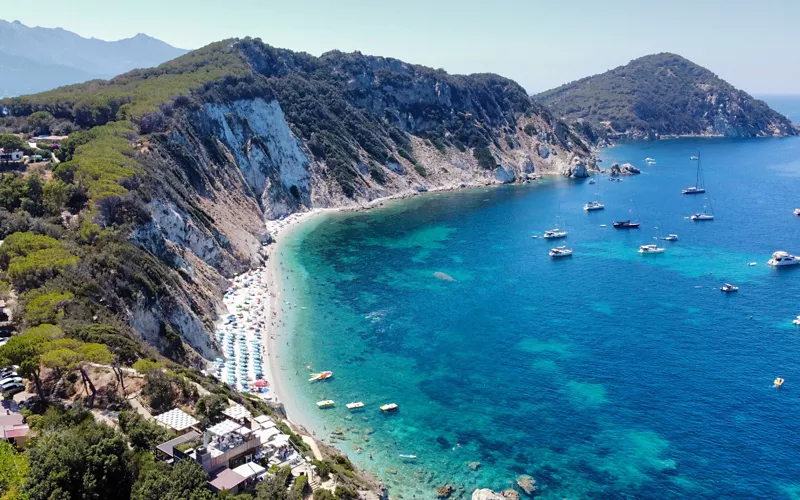
The Arcipelago Toscano National Park, a haven of Mediterranean and isolated climates that fosters the growth of evergreen plants with small flowers like gorse, is a must-visit destination. But what lies beyond its stunning beauty? Let’s dive into the world of this incredible park.
Where is the Arcipelago Toscano National Park Located?
Established in 1996, the Arcipelago Toscano National Park spans across 16,856 hectares of land and 56,766 hectares of sea, covering 50% of the island of Elba, 40% of the Isola del Giglio, 80% of the Isola di Capraia, and 100% of the minor islands. The park is divided between two provinces: Livorno and Grosseto.
The Arcipelago Toscano National Park is strategically located in the Tyrrhenian Sea, which provides an ideal environment for marine life to thrive. The unique geography of the area has created a variety of ecosystems that support an incredible range of flora and fauna.
The Development of the Park’s Coastline
The park’s coastline stretches approximately 250 km, featuring numerous small islands, rocks, and scogs like the Formiche di Grosseto or Scoglio d’Africa, located near the Isola del Giglio. These unique features make the Arcipelago Toscano National Park an essential destination for nature lovers.
Some of the notable features of the park’s coastline include:
- The Monte Capanne, a mountain that dominates the northern part of Elba, with its snow-capped peak visible from several miles away.
- The rocky outcrops and hidden coves found on the coastlines of the islands, creating secluded beaches and bays.
- The sea caves and tunnels that dot the coastline, providing shelter for marine life.
The Management of the Park
The management of the park is handled by the Ente Parco Nazionale dell’Arcipelago Toscano, which has the crucial responsibility of overseeing the largest marine park in the Mediterranean. The entity also relates administratively with the two southernmost provinces of Tuscany: Livorno, home to the islands Elba, Gorgona, Capraia, Pianosa, and Montecristo, while Grosseto covers the islands del Giglio and Giannutri, as well as the island of Capraia, which is close to Corsica.
The Ente Parco Nazionale dell’Arcipelago Toscano works tirelessly to protect the delicate balance of the ecosystem within the park. They implement various conservation efforts, such as habitat restoration, species monitoring, and education programs for visitors.
The Island of Elba: A Haven for Nature
Elba, the third-largest Italian island, boasts 22,350 hectares of land and a maximum width of 27 km. It’s also home to eight communes and features a mix of mountains, hills, and coastlines. The Monte Capanne, at 1,019 meters, is the highest peak on the island.
Elba has been an important habitat for many species over the centuries. Its unique geology and climate have created a variety of ecosystems that support a diverse range of flora and fauna.
Some of the notable features of Elba include:
- The rugged mountains that cover much of the island, providing shelter for wildlife such as the European rabbit and the red fox.
- The rolling hills that give way to scenic coastlines, featuring picturesque beaches and coves.
- The forests that dot the landscape, home to a variety of plant species including the olive tree and the chestnut.
Portoferraio: A Hub for Information
While Elba offers stunning natural beauty, Portoferraio is an essential stop for any traveler. This town serves as a hub for information about the park’s regulations and activities, as well as accommodation options for visiting all the islands in the Arcipelago Toscano National Park.
Portoferraio has been an important port city since ancient times. Its strategic location on the coast of Elba made it a vital center for trade and commerce, and it continues to be a hub for tourism today.
Some of the notable features of Portoferraio include:
- The historic harbor, which dates back to the 16th century.
- The charming old town, featuring narrow streets and colorful buildings.
- The local market, where visitors can find fresh produce, handicrafts, and souvenirs.
Pianosa: A Nature Lover’s Paradise
The fifth island of the park, Pianosa, is a nature enthusiast’s dream destination. Covering 10.2 km², it’s located approximately 14 kilometers southwest from Elba and about 40 kilometers east of Corsica. While not ideal for beach-goers, Pianosa boasts rugged coastlines, rocky cliffs, and unique flora such as lentisco, rosemary, myrtle, and juniper.
Pianosa is a haven for nature lovers due to its untouched natural beauty. The island’s rugged coastline provides an ideal habitat for a variety of marine species, while the forests and grasslands support a range of terrestrial wildlife.
Some of the notable features of Pianosa include:
- The towering cliffs that plunge into the sea, creating isolated beaches and bays.
- The dense forests that cover much of the island, home to a variety of plant species.
- The unique geological formations that dot the landscape, including granite peaks and limestone caves.
The Official Website: Your Guide to the Park
For a comprehensive guide to planning your trip, we recommend visiting the official website of the Arcipelago Toscano National Park. This valuable resource provides detailed information on each island, up-to-date advice, and activity suggestions for a truly unforgettable experience.
The official website is an excellent starting point for any traveler looking to explore the Arcipelago Toscano National Park. It offers a wealth of information on everything from park regulations to local events and activities.
Some of the features of the official website include:
- A comprehensive overview of each island, including maps, descriptions, and information on wildlife and habitat.
- Up-to-date advice on visiting the park, including tips on accommodations, transportation, and activities.
- Activity suggestions for a range of interests, from hiking and camping to snorkeling and diving.
FAQs
-
What is the purpose of the Ente Parco Nazionale dell’Arcipelago Toscano?
The Ente Parco Nazionale dell’Arcipelago Toscano has the primary responsibility of overseeing the largest marine park in the Mediterranean. -
How large is the Arcipelago Toscano National Park?
The park covers 16,856 hectares of land and 56,766 hectares of sea. -
What are some of the unique features of the park’s coastline?
Some of the notable features include the Formiche di Grosseto (Grosseto Rocks) and Scoglio d’Africa (Scoglio of Africa). -
How many islands make up the Arcipelago Toscano National Park?
The park encompasses seven islands, numerous small islands, rocks, and scogs. -
What is the history of the Arcipelago Toscano National Park?
-
Why should I visit Pianosa?
-
Where can I find more information about the Arcipelago Toscano National Park?
-
Is the park open year-round?


