
1. Introduction to the Crisis
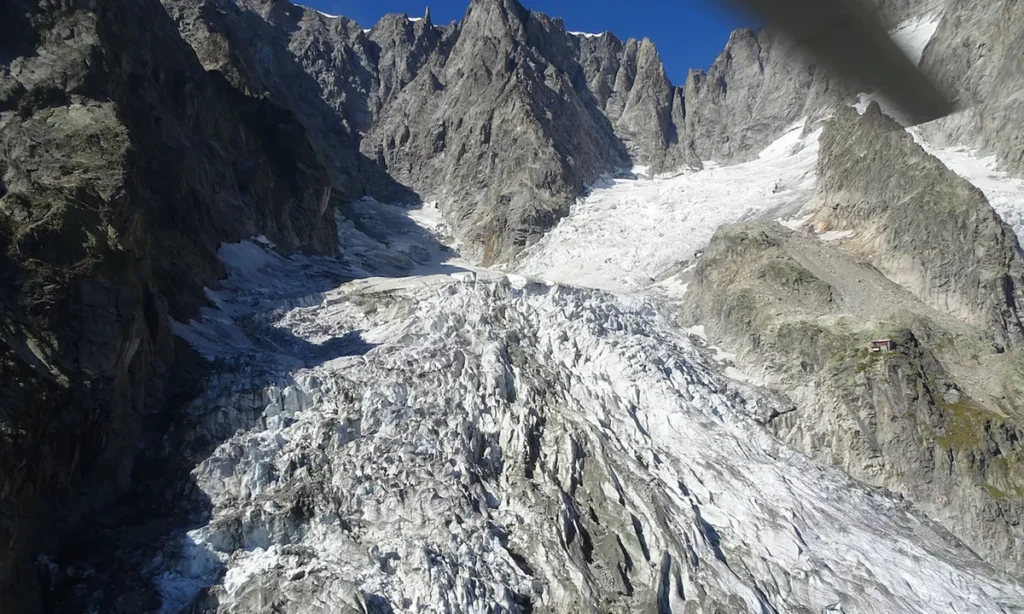
The snow-capped peak of Mont Blanc, also known as Monte Bianco, has been experiencing a devastating impact from climate change. A section of the Planpincieux glacier on its Italian side is rapidly melting at an alarming rate. This situation has raised concerns about potential hazards and risks to nearby areas.
Climate change has become one of the most pressing issues of our time, with far-reaching consequences for ecosystems, human societies, and the planet as a whole. Rising temperatures have been linked to an increase in extreme weather events, sea-level rise, and melting glaciers. In this article, we will delve into the crisis unfolding on Mont Blanc and explore its implications for the region and beyond.
2. The Glaciological Reality
The Planpincieux glacier is losing mass at an impressive pace, with a portion of approximately 27,000 cubic meters separating from the main body. Although this event is not life-threatening for populated centers, it poses significant risks for the surrounding territory. The Regione Valle d’Aosta and the Fondazione Montagna Sicura di Courmayeur are working together with the Geohazard Monitoring Group to monitor changes in the climate.
The Planpincieux glacier is one of several glaciers on Mount Bianco that have been experiencing significant melting due to rising temperatures. These glaciers play a crucial role in regulating water flow and maintaining the region’s hydrological balance. As they melt, it can lead to increased risk of landslides and erosion in nearby areas.
3. Immediate Measures
In response to these concerns, Courmayeur’s Mayor Stefano Miserocchi has taken precautionary measures by ordering the evacuation of certain properties and closing a local road (Val Ferret) between two points, including the intersection with the Montitaz street and Planpincieux. However, residents will still have access via an alternative route available 24 hours a day.
The evacuation of properties and closure of roads are just some of the measures being taken to mitigate the risks associated with the melting glacier. While these measures may seem drastic, they are necessary to ensure public safety and prevent potential disasters.
4. Radar Technology to Monitor the Situation
To keep track of this dynamic situation, a radar system called Lisa has been installed on the glacier. This technology can detect small movements and create precise maps of any deformation present. While it helps forecast movement patterns more accurately, predicting whether the block of ice will break apart or occur in one single event remains uncertain.
The use of radar technology to monitor the situation is a crucial step in understanding the dynamics of the melting glacier. By providing real-time data on glacier movements and deformation, these systems can help scientists better predict potential hazards and take proactive measures to mitigate their impact.
5. Uncertainty About Future Developments
While some parts of the glacier are moving towards the valley floor at a rate of 90 centimeters per day, other sections are slipping backwards at varying speeds. Fabrizio Troilo from the Fondazione Montagna Sicura explains that current data does not allow for predictions about future developments.
The uncertainty surrounding future developments is a major concern in this situation. While scientists can provide valuable insights based on current data, predicting exactly what will happen next is impossible without further information or technological advancements.
6. Risks Beyond Planpincieux
However, this issue is just one part of a broader problem affecting all glaciers in these regions. Other notable cases have seen glacier summits experiencing similar stress as well; thus, continued monitoring is essential to prevent such disasters from occurring. Notably, Fabrizio De Blasi, researcher for the Institute of Polar Sciences under the Council of National Research, notes that even more extreme scenarios are emerging due to this melting.
The risks associated with melting glaciers extend far beyond Planpincieux and affect numerous other summits across these regions. As glaciers continue to shrink at an alarming rate, they pose significant threats to local ecosystems, human settlements, and the global environment as a whole.
7. The Consequences of Warming Temperatures
Glaciers have been shrinking over the past few decades. Renato Colucci from the CNR states that if temperatures continue to rise, many eternal glaciers in Eastern and Central Alps could disappear within 20-30 years. What’s more, since they’ve become darker due to melting, these glaciers are increasingly vulnerable to solar radiation.
The consequences of warming temperatures on glaciers are far-reaching and potentially catastrophic. As glaciers shrink, they can lead to increased risk of landslides, erosion, and changes in local hydrological balances. Furthermore, the loss of glacier mass can have significant impacts on global sea levels, ocean circulation patterns, and the Earth’s climate system as a whole.
8. Current State of Glaciers
Recent glacier surveys have indicated a 40% decrease in area from the last recorded data, with most recent figures standing at around 368 km2. These findings echo the alarming trend that has been noted for over four decades – from 519 km2 in 1962 to 609 km2 in 1989.
The decline of glacier area is a clear indication of the devastating impact of climate change on these natural wonders. As glaciers continue to shrink, they pose significant threats to local ecosystems and human societies that depend on them for water, energy, and other essential resources.
9. Urgency Needed
According to Sergio Costa, Minister of Environment, urgent collective action is required to prevent such extreme events from happening and having disastrous consequences. As the situation worsens due to melting glaciers worldwide, we must act swiftly to mitigate its impact on our planet.
The urgency surrounding this issue cannot be overstated. As scientists continue to warn about the devastating impacts of climate change, it is essential that governments, corporations, and individuals work together to reduce greenhouse gas emissions, invest in clean energy, and protect natural ecosystems like glaciers.
FAQs:
- What triggered this crisis?
-
The primary cause behind the current situation involves an increase in global temperatures leading to rapid melting of snow and ice, notably affecting specific sections of glaciers on mountain ranges.
-
Is there a solution for preventing these disasters?
-
While no definitive answer exists yet, understanding and studying climate change are fundamental steps toward mitigating its effects and creating sustainable futures for our planet’s ecosystems.
-
What does the radar system Lisa do?
-
It continuously monitors movement patterns and creates precise maps of any deformation present within this specific area of melting ice to aid in predicting potential future movements or collapse events.
-
Why is it difficult to predict further developments?
-
Factors such as varying speeds, temperature fluctuations, and unpredictable environmental influences contribute to the complexity of forecasting what might happen next in the context of melting glaciers.
-
What other areas are at risk due to this phenomenon?
-
Not just Planpincieux but numerous other summits across these regions face similar threats from warming temperatures and increased rates of glacier melting.
-
How significant is the current situation for global environmental health?
-
Rising temperatures have far-reaching implications not only locally on mountain ranges but also worldwide, impacting ecosystems and human societies at large.
-
What can we do to help address this issue?
-
Collective efforts such as reducing carbon emissions through sustainable practices and supporting climate research are essential steps toward mitigating the effects of melting glaciers globally.
-
How do these findings relate to past data on glacier changes?
-
Studies have shown a notable decline in glacier area over several decades, with an alarming rate of loss evident from recent surveys.
-
What is the potential impact of continued climate change?
- The long-term effects remain uncertain but could include significant loss of biodiversity and ecosystems if drastic action isn’t taken soon to address this pressing global issue.
In conclusion, the crisis unfolding on Mont Blanc serves as a stark reminder of the devastating impacts of climate change. As scientists continue to study and monitor these natural wonders, it is essential that we take collective action to mitigate its effects and create sustainable futures for our planet’s ecosystems.


