
Introduction
Imagine a strip of paper that has been twisted and turned in such a way that it creates a surface that is not like any other. This is the Moebius strip, a mathematical concept that has fascinated people for centuries. It’s a paradoxical object that challenges our understanding of space and geometry, and it has inspired philosophers, mathematicians, and artists alike.
The Moebius strip is a fundamental concept in topology, a branch of mathematics that deals with the study of shapes and spaces. In this article, we will explore the history, significance, and impact of the Moebius strip on art, architecture, film, and beyond.
What is the Moebius Strip?
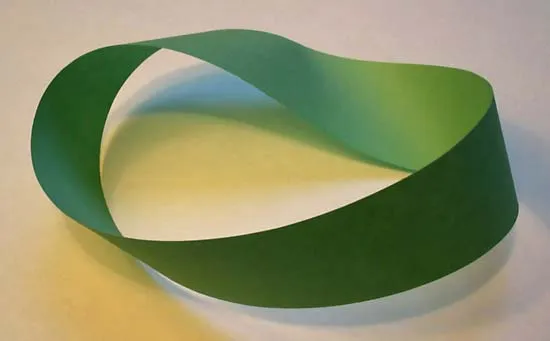
In mathematics, particularly in topology, the Moebius strip is a surface that is non-orientable, meaning that it does not have a clear “inside” or “outside”. It’s a two-dimensional object that has been twisted and turned in such a way that it creates a single continuous loop. This means that if you were to start at one end of the strip and walk along it, you would eventually return to the starting point without ever crossing an edge.
The Moebius strip can be created by twisting a strip of paper and then joining the ends together in a loop. The twist creates a surface that is continuous but non-orientable, meaning that if you were to start at one end of the strip and walk along it, you would eventually return to the starting point without ever crossing an edge.
The Significance of the Moebius Strip
So why is the Moebius strip so important? Well, for one thing, it’s a fascinating example of how mathematics can create objects that challenge our intuitive understanding of the world. It’s also a powerful tool for exploring complex concepts in geometry and topology.
The Moebius strip has been used to illustrate many mathematical concepts, including topological equivalence, non-orientability, and the concept of a Klein bottle. These concepts are fundamental to modern mathematics, and the Moebius strip is an excellent way to understand them.
But beyond its purely mathematical significance, the Moebius strip has also had an impact on art, architecture, and even fashion. It’s been used as an inspiration for artists and designers who want to create unique and innovative designs that challenge our understanding of space and geometry.
A Brief History of the Moebius Strip
The Moebius strip was first discovered by August Ferdinand Möbius, a German mathematician, in the early 19th century. Möbius was interested in exploring the properties of surfaces, particularly those that were non-orientable. He realized that the strip he had created could be used to illustrate these concepts, and it has since become one of the most famous mathematical objects in history.
Möbius’s discovery of the Moebius strip was a major breakthrough in mathematics, as it challenged our understanding of space and geometry. It also led to the development of new mathematical tools and techniques that are still used today.
The Philosophy Behind the Moebius Strip
But the Moebius strip is more than just a mathematical concept – it’s also a philosophical one. Think about it: if we can create an object that has no clear “inside” or “outside”, what does that say about our understanding of reality? It challenges our intuitive notions of space and geometry, and it forces us to think creatively about the nature of existence.
The Moebius strip is often used as a symbol of creativity and innovation, as it represents a challenge to our understanding of the world. It’s also been used as a metaphor for the complexity of human experience, where our perceptions of reality are constantly shifting and evolving.
Creating a Moebius Strip
So how do you create a Moebius strip? It’s actually quite easy. All you need is a piece of paper and a pair of scissors. Simply fold the paper in half lengthwise, twist one edge so that it meets the other edge, and then unfold the paper to reveal your Moebius strip!
Creating a Moebius strip requires some patience and attention to detail, but it’s a fun and rewarding project for anyone interested in mathematics and geometry.
The Moebius Strip in Art and Architecture
The Moebius strip has inspired artists and architects for decades. It’s been used as a symbol of creativity and innovation, and it continues to be an inspiration today.
From fashion designers who have incorporated the Moebius strip into their designs, to architects who have built buildings that incorporate this fascinating mathematical object, the Moebius strip is a true marvel.
The Moebius strip has also inspired some of the most famous art movements in history, including Surrealism and Dadaism. These movements sought to challenge our understanding of reality and to push the boundaries of creativity and innovation.
The Moebius Strip in Film
But the Moebius strip has also appeared in film, most notably in Kim Ki-duk’s 2013 movie “Moebius”. This film is based on the life of August Ferdinand Möbius and explores the mathematical concepts that inspired him. It’s a thought-provoking film that challenges our understanding of reality and inspires us to think creatively.
The Moebius strip has also appeared in other films, including “Inception” and “Interstellar”. These movies use the Moebius strip as a metaphor for the complexity of human experience and the nature of reality.
Conclusion
In conclusion, the Moebius strip is a fascinating mathematical object that has inspired artists, mathematicians, and philosophers alike. Its non-orientability and single continuous loop challenge our intuitive understanding of space and geometry, and it forces us to think creatively about the nature of existence.
Whether you’re interested in mathematics, art, or philosophy, the Moebius strip is a true marvel that is sure to inspire. It’s a reminder that there is always more to learn and discover, and that the boundaries of creativity and innovation are constantly evolving.
Frequently Asked Questions
- Q: What is the difference between a Moebius strip and a Klein bottle?
A: A Klein bottle is another mathematical object that is non-orientable, but it has a different structure than the Moebius strip. While the Moebius strip is a single continuous loop, the Klein bottle is a torus-like shape with a hole in it. - Q: Can I create a Moebius strip at home?
A: Yes! All you need is a piece of paper and a pair of scissors to create a Moebius strip. Simply fold the paper in half lengthwise, twist one edge so that it meets the other edge, and then unfold the paper to reveal your Moebius strip. - Q: What inspired August Ferdinand Möbius to create the Moebius strip?
A: Möbius was interested in exploring the properties of surfaces, particularly those that were non-orientable. He realized that the strip he had created could be used to illustrate these concepts, and it has since become one of the most famous mathematical objects in history. - Q: Can I use a Moebius strip in architecture?
A: Yes! The Moebius strip can be used as an architectural element to create unique and innovative spaces. It’s been used in building designs that incorporate this fascinating mathematical object. - Q: Is the Moebius strip still relevant today?
A: Absolutely! The Moebius strip continues to inspire artists, mathematicians, and philosophers alike. Its non-orientability and single continuous loop challenge our intuitive understanding of space and geometry, and it forces us to think creatively about the nature of existence. - Q: Can I see a Moebius strip in person?
A: Yes! You can see a Moebius strip at museums and exhibitions that showcase mathematical art. Some museums even have interactive exhibits where you can create your own Moebius strip. - Q: Is the Moebius strip just for mathematicians?
A: No! The Moebius strip is for anyone who is interested in mathematics, art, or philosophy. It’s a true marvel that challenges our understanding of reality and inspires us to think creatively. - Q: Can I use a Moebius strip in fashion design?
A: Yes! The Moebius strip has been used as an inspiration for fashion designers who want to create unique and innovative designs that challenge our understanding of space and geometry.
Additional Resources
If you’re interested in learning more about the Moebius strip, here are some additional resources:
- Books: “The Moebius Strip” by August Ferdinand Möbius, “Mathematics for Dummies” by Mark Ryan, and “The Oxford Handbook of Mathematics” edited by Timothy Gowers.
- Movies: “Moebius” (2013), “Inception” (2010), and “Interstellar” (2014).
- Museums: The Museum of Modern Art (MoMA) in New York City, the British Museum in London, and the National Gallery of Art in Washington D.C.
- Exhibitions: Mathematical art exhibitions at museums and galleries around the world.


