
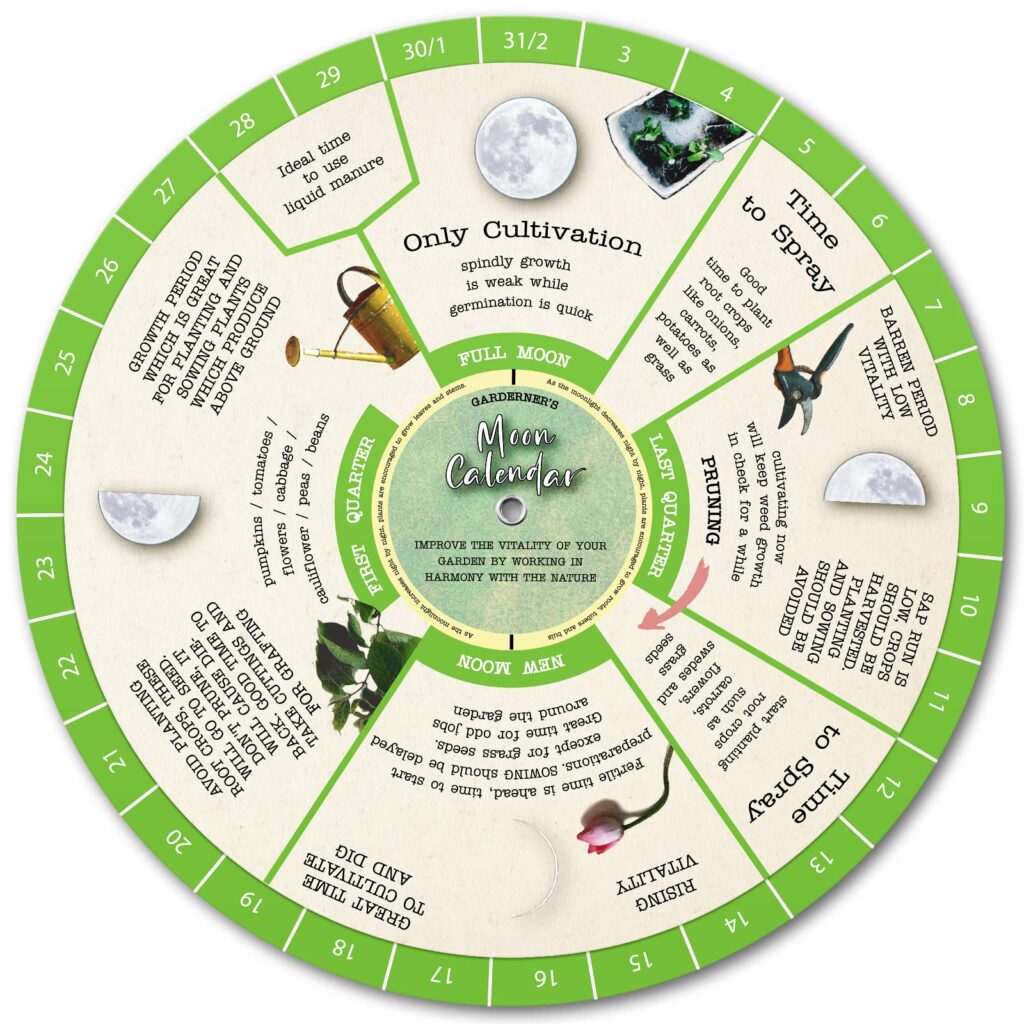
As we often hear, the lunar cycle is closely related to the possibility of following a calendar that can help us tap into the main characteristics of each phase “gravitational.” But what exactly does the lunar seed according to this calendar entail? What are its key features, and how can we make use of them?
The Science Behind the Lunar Cycle
Let’s break it down. The lunar cycle in gardening is an ancient idea that has gained popularity in folklore and superstition, although there are indeed scientific ideas backing it up.
It’s known that Earth is located in a large gravitational field influenced by both the Sun and Moon. Tides are higher during new moon and full moon phases when the Sun and Moon align with Earth. Just like the Moon “pulls” ocean tides, our satellite would also be capable of pulling thin water bodies, causing increased humidity on land, which in turn encourages growth.
The highest amount of moisture in the soil during specific lunar phases has been demonstrated, as well as how seeds absorb most of the water at full moon. Planting according to the lunar cycle keeps pace with the gravitational pull’s alternating forces.
Understanding the Four Lunar Quarters
Now that we’ve covered the basics, let’s move on to the four lunar quarters – each lasting about seven days – and explore what advice is given for gardening!
Luna New: The Seedling Stage
At new moon, the lunar gravity pulls in water and expands/separates seeds. This factor, combined with increasing clear light of Luna, promotes balanced growth of roots and leaves.
This phase is considered ideal for planting seeds over fertile land with annual crops that produce seeds outside their fruit. Examples include lettuce, spinach, celery, broccoli, cabbage, cauliflower, and cereals. The new moon also marks the beginning of the lunar cycle, making it an excellent time to start sowing seeds for summer crops.
Tips for Planting During Luna New
- Choose a location with good drainage and fertile soil.
- Plant seeds at a depth that is two to three times their diameter.
- Water seeds gently but thoroughly after planting.
- Keep the area around the plants free of weeds to prevent competition for water and nutrients.
Luna First Quarter: Growth and Expansion
In the first quarter, the gravitational pull is weaker, but the clear light of Luna remains strong, creating a healthy leaf growth. This phase is generally good for planting, especially just before full moon.
The types of crops that prefer the first quarter for cultivation are annuals that produce fruit on the surface but their seeds form inside the fruit, such as beans, melons, peas, peppers, zucchini, and tomatoes. Planting during this phase allows the seedlings to establish themselves before the full moon’s increased humidity.
Tips for Planting During Luna First Quarter
- Prepare the soil by adding organic matter such as compost or manure.
- Choose a location that receives at least six hours of direct sunlight per day.
- Water plants regularly, but avoid overwatering to prevent root rot.
- Provide support for climbing plants like peas and beans.
Luna Plena: Root Development
We arrive at the third and final quarter with Luna, when light decreases or diminishes, and energy is depleted.
The gravitational pull is high, creating more humidity in the soil, but the clear light of Luna is waning. This is a favorable time for planting roots for some crops like carrots and turnips that attract force below ground. It’s also a good time for perennial plants, bulbs, and transplants due to active root growth.
Tips for Planting During Luna Plena
- Choose a location with partial shade to full sun.
- Plant seeds or seedlings at the correct depth and spacing.
- Water thoroughly after planting, and keep the soil consistently moist during the growing season.
- Mulch around plants to retain moisture and suppress weeds.
Luna Last Quarter: Rest and Rejuvenation
Finally, we reach the last quarter of Luna, where gravitational pull weakens, and lunar light fades away. This phase is considered a period of rest, making it an ideal moment for gardening, harvesting, transplanting, fertilizing, and pruning.
This phase is also known as the “dark moon” or “waning moon,” and it’s believed that during this time, the energy of the Moon is released from the soil. This allows for a natural process of renewal and rejuvenation to take place.
Tips for Gardening During Luna Last Quarter
- Harvest crops that are ready, such as tomatoes, peppers, and squash.
- Prune or trim back plants to maintain shape and promote healthy growth.
- Fertilize with organic matter like compost tea or fish emulsion.
- Transplant seedlings or bulbs to new locations.
Conclusion
The lunar cycle is a complex phenomenon that has been observed and utilized by gardeners for centuries. By understanding the four lunar quarters and their corresponding characteristics, we can optimize our gardening practices to tap into the natural forces of nature.
While the lunar calendar may not be suitable for all types of gardens or climates, it can certainly provide valuable insights and tips for those who are willing to experiment and adapt.
Expert Advice
If you need a renovation of your green area, it’s better to consult with a good gardener who will step by step guide you through the best practices for sustained growth compatible with the characteristics of the land you have available.
By following expert knowledge in this field, you’ll be able to create a thriving and sustainable garden that flourishes under the guidance of the lunar cycle.
Final Tips
- Observe and record your own experiences with the lunar cycle to develop a deeper understanding of its effects on your garden.
- Experiment with different crops and gardening practices to see how they respond to the lunar phases.
- Keep an open mind and be willing to adapt your gardening techniques as needed.
By embracing the lunar calendar and incorporating its principles into our gardening practices, we can create a more harmonious and sustainable relationship between ourselves and the natural world.


