
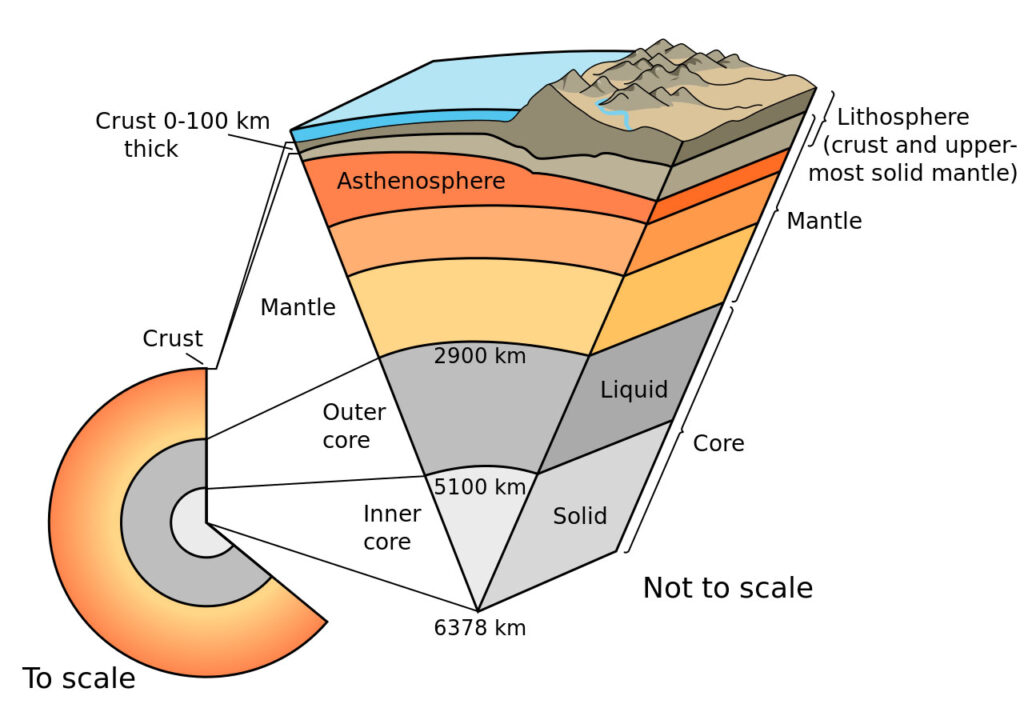
As we gaze at our planet, it’s easy to think of the Earth’s atmosphere as a complex system consisting of multiple layers. However, one layer that often gets overlooked is the lithosphere – the solid shell that makes up the outermost part of our planet. But what exactly is the lithosphere, and how does it impact our world?
Defining the Lithosphere
The term “lithosphere” comes from the Greek words “lithos,” meaning “rock,” and “sphaira,” meaning “sphere.” However, this definition doesn’t always apply to all areas of the Earth. The lithosphere is not a uniform layer; its thickness varies greatly depending on location, with zones in the oceans being thinner than those on continents.
Oceanic vs. Continental Lithospheres
There are two main types of lithospheres: oceanic and continental. Oceanic lithospheres are characterized by their thinness, ranging from 100 km to 200 km in depth. This thinness is due to the continuous rise of magma from the Earth’s mantle, which forms new oceanic crust as it cools and solidifies. In contrast, continental lithospheres can be up to 200 km thick, with varying compositions and properties.
Lithosphere vs. Asthenosphere
Another division in the Earth’s interior is between the lithosphere and asthenosphere – a layer of viscous rock beneath the lithosphere. The primary difference between these two layers lies in their response to seismic waves. When earthquakes occur, the lithosphere behaves as a rigid body, while the asthenosphere slows down or even absorbs the energy.
Lithospheric Dynamics
Despite its rigidity, the lithosphere can still move and deform over time. This movement is driven by plate tectonics, where large plates of rock glide over the more fluid asthenosphere below. These movements can lead to significant geological events, such as earthquakes, volcanic eruptions, and the creation of mountain ranges.
Visualizing the Lithosphere
Imagine a vast, dynamic system that covers our entire planet – this is what the lithosphere looks like. From its formation in the oceans to its interactions with other layers of the Earth’s interior, the lithosphere plays a vital role in shaping our world.
The Role of Tectonic Plates
Tectonic plates are large, rigid slabs of rock that move over the asthenosphere below. These plates can be broken into several major and minor plates, each with its own unique characteristics and movements. The interaction between these plates leads to the formation of mountain ranges, volcanoes, and earthquakes.
The Role of Mantle Convection
Mantle convection refers to the slow movement of hot, viscous rock in the Earth’s mantle. This process drives plate tectonics by causing the asthenosphere to rise, creating new crust as magma rises to fill the gap. The rate of this convection is relatively slow, but its effects can be profound.
Thermal Properties of the Lithosphere
The thermal properties of the lithosphere are crucial in understanding its dynamics. The lithosphere has a low thermal conductivity, meaning it acts as an insulator, retaining heat from the mantle below. This property contributes to the rigidity of the lithosphere and affects its response to seismic waves.
Seismic Wave Propagation
When earthquakes occur, seismic waves travel through the Earth’s interior, providing valuable information about the structure and composition of the lithosphere. By studying these waves, scientists can gain insights into the dynamics of plate tectonics and the behavior of the asthenosphere.
Earthquakes and Volcanic Eruptions
Earthquakes and volcanic eruptions are two significant geological events that occur due to the movement and deformation of the lithosphere. Earthquakes occur when rocks in the lithosphere break, releasing stored energy as seismic waves. Volcanic eruptions occur when magma from the mantle rises to the surface, often accompanied by earthquakes.
Mountain Formation
The movement of tectonic plates leads to the formation of mountain ranges through a process known as orogenesis. As plates collide and crumple, rocks are pushed upwards, creating mountains. Examples include the Himalayas formed by the collision of India and Asia, and the Andes formed by the subduction of the Nazca plate beneath South America.
The Lithosphere’s Impact on Climate
The lithosphere plays a significant role in shaping our climate by influencing the Earth’s energy balance. The color and composition of rocks within the lithosphere can affect how much solar radiation is absorbed, while changes in the oceanic crust can impact global ocean circulation patterns.
Conclusion and FAQs
In conclusion, understanding the lithosphere is essential for grasping the complexities of our planet’s geology and internal dynamics. The next time you hear about earthquakes or volcanic eruptions, remember that they are connected to the movement of this solid shell – the lithosphere.
Frequently Asked Questions (FAQs)
- What is the main difference between oceanic and continental lithospheres?
Oceanic lithospheres are thinner due to continuous magma rise from the mantle, while continental lithospheres can be up to 200 km thick with varying compositions.
- How does the asthenosphere affect seismic waves?
The asthenosphere slows down or absorbs seismic energy, unlike the rigid lithosphere which responds more quickly.
- What drives plate tectonic movements in the Earth’s interior?
These movements are driven by the interaction between the lithospheres and the asthenosphere, along with the flow of magma from the mantle.
- Can the lithosphere change shape or move over time?
Yes, the lithosphere can deform through processes like isostasy and plate tectonics, leading to significant geological events.
- Why are earthquakes important to study in relation to the lithosphere?
Earthquakes provide valuable insights into the dynamics of the Earth’s interior, helping us understand how the lithosphere interacts with other layers.
- How does the composition of the lithosphere affect its properties?
The varying compositions of rocks within the lithosphere lead to diverse mechanical and thermal properties.
- Can we predict when and where earthquakes will occur based on our understanding of the lithosphere?
While predicting specific events is challenging, studying the dynamics of the lithosphere helps us better understand seismic hazards and prepare for potential disasters.
- What role does the lithosphere play in shaping the Earth’s surface features?
The movement and deformation of the lithosphere contribute to the formation of mountains, volcanoes, and oceanic trenches through processes like plate tectonics.
By exploring the intricate world of the lithosphere, we gain a deeper understanding of our dynamic planet – its geological history, internal dynamics, and ongoing transformations.


