
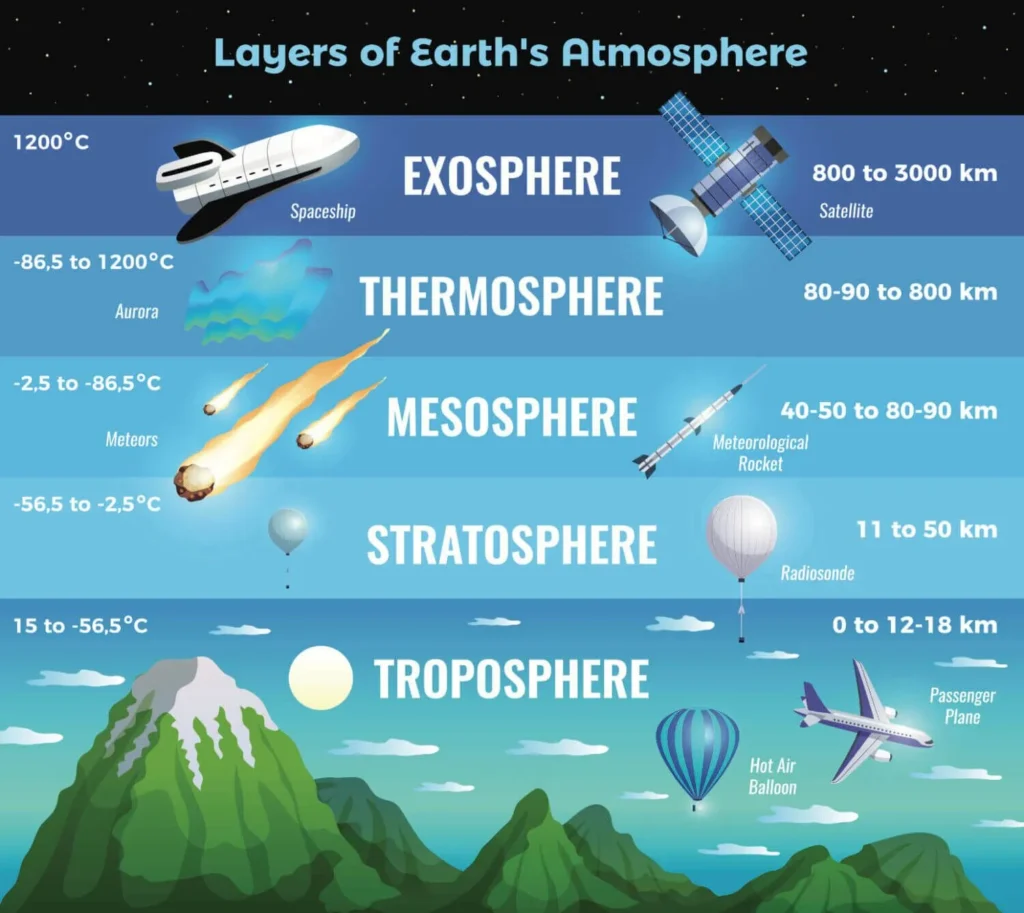
As we explore the fascinating world of atmospheric science, it’s essential to understand the different layers that make up our planet’s atmosphere. But what exactly are these layers, and how do they impact our daily lives? Let’s embark on a journey to discover the five main strata of the atmosphere.
What is the Atmosphere?
Before diving into the specifics of each layer, it’s crucial to understand what we mean by “atmosphere.” The atmosphere is an invisible blanket of gases that surrounds our planet, composed of approximately 78% nitrogen, 21% oxygen, and trace amounts of other gases. This complex system plays a vital role in regulating Earth’s temperature, weather patterns, and the water cycle.
The Five Main Strata
Meet the five main strata of the atmosphere:
- Troposphere: The lowest layer, extending from the surface to an altitude of approximately 11 km (6.8 miles). This is where most of our weather occurs.
- Temperature decreases with increasing altitude, ranging from -20°C (-4°F) at high altitudes to warm temperatures near the surface.
- Weather phenomena such as clouds, precipitation, and wind occur in this layer.
- Stratosphere: Above the troposphere, this layer stretches from about 11 km to 50 km (6.8-31 miles) in height. It’s home to the ozone layer, which protects us from harmful ultraviolet radiation.
- The stratosphere is characterized by a stable temperature profile, with temperatures ranging from -70°C (-94°F) at high altitudes to around 0°C (32°F) near the tropopause.
- This layer plays a crucial role in regulating Earth’s climate and weather patterns.
- Mesosphere: This middle layer reaches altitudes of up to 80 km (49.7 miles). Temperatures decrease rapidly with increasing altitude, resulting in spectacular phenomena like nightglow clouds.
- The mesosphere is known for its weak gravitational pull, which allows objects to float and drift through the atmosphere.
- Meteors entering this layer can create spectacular light displays, such as the Northern Lights.
- Thermosphere: The highest layer, extending from approximately 50 km to 600 km (31-373 miles), features temperatures that increase dramatically with altitude, reaching up to 1,200°C (2,192°F).
- The thermosphere is home to the aurora borealis (Northern Lights) and aurora australis (Southern Lights), caused by charged particles from the sun interacting with atmospheric gases.
- This layer plays a crucial role in regulating Earth’s magnetic field and climate patterns.
- Exosphere: The outermost layer, spanning from about 600 km to several thousand kilometers into space. This region is characterized by extremely rarefied gases and scorching temperatures of up to 2,000°C (3,632°F).
- The exosphere is the region where atmospheric gases interact with interstellar gas and solar winds.
- It’s also where spacecraft can escape Earth’s gravitational pull and travel into space.
Exploring the Ionosphere
Within the thermosphere lies a distinct stratum: the ionosphere. Composed primarily of gases that become electrically charged due to solar radiation, this layer plays a crucial role in radio wave propagation and communication.
- The ionosphere acts as a giant antenna for radio waves, reflecting and amplifying signals from space.
- It’s also responsible for the formation of spectacular aurora displays.
The Ozone Layer: A Protective Shield
One of the most well-known features of the stratosphere is the ozone layer, which safeguards us from harmful UV radiation. This vital component of the atmosphere is formed when oxygen molecules (O2) are split by ultraviolet light, resulting in the creation of ozone molecules (O3).
- The ozone layer plays a crucial role in protecting life on Earth from harmful solar radiation.
- However, human activities such as deforestation and climate change have led to a significant depletion of the ozone layer.
Understanding Atmospheric Changes
The Earth’s atmosphere has been subject to numerous changes throughout history, influenced by factors such as volcanic eruptions, human activities, and global climate patterns. As we continue to study these dynamics, it becomes increasingly clear that our actions have a significant impact on the health of our planet.
- Volcanic eruptions can release massive amounts of ash and sulfur dioxide into the atmosphere, influencing global temperature patterns.
- Human activities such as burning fossil fuels and deforestation contribute to greenhouse gas emissions, leading to climate change.
Exploring Atmospheric Phenomena
Some atmospheric phenomena are awe-inspiring, while others hold secrets waiting to be uncovered. For instance:
- Nimbus clouds: These dark, rain-bearing clouds can stretch across entire continents.
- Morning glory clouds: Rare, tubular clouds that form in the mesosphere and have been observed rolling across the globe.
Key Takeaways
The Earth’s atmosphere is a complex, dynamic system comprising five distinct layers. Understanding these strata allows us to better appreciate the intricacies of our planet’s climate, weather patterns, and natural phenomena. By continuing to explore and study atmospheric science, we can gain valuable insights into the intricate web of relationships that governs our world.
Frequently Asked Questions
- What is the primary function of the ozone layer?
- The ozone layer protects us from harmful UV radiation.
- How does human activity impact the Earth’s atmosphere?
- Human activities such as burning fossil fuels and deforestation contribute to greenhouse gas emissions, leading to climate change.
- Can we predict weather patterns with certainty?
- While we can make predictions based on current data and models, accurate forecasting remains a challenge due to the complexities of atmospheric science.
- What are some common atmospheric phenomena observed in different regions?
- Examples include nimbus clouds, morning glory clouds, and aurora borealis displays.
- How do changes in atmospheric composition affect global climate patterns?
- Changes in atmospheric composition can have a significant impact on global temperature patterns, leading to climate change.
Additional Resources
- National Oceanic and Atmospheric Administration (NOAA)
- NASA: Climate Change
- European Space Agency (ESA): Earth Science
Feel free to explore these resources further and discover more about the fascinating world of atmospheric science!


