
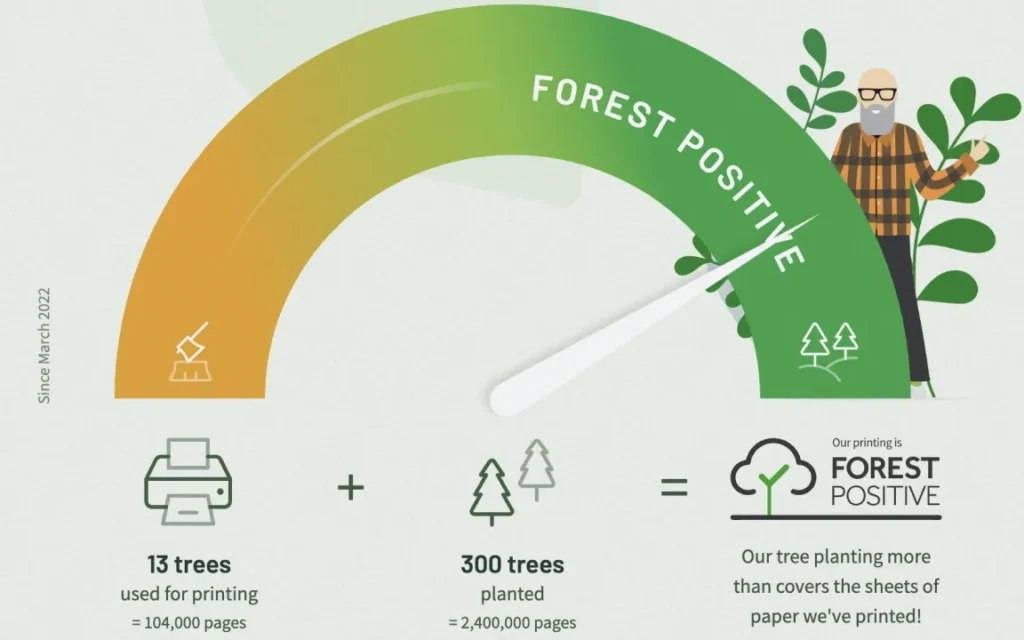
The printing industry is one of the most sensitive sectors when it comes to environmental concerns. As a result, an increasing number of service providers are looking to innovate their business model by adopting sustainable practices. Many printers have already started to differentiate themselves on the market by obtaining certifications such as ISO 14001, FSC and PEFC, demonstrating their commitment to reducing their environmental impact.
The Carbon Balanced Printing Programme is a new initiative launched by Ricoh that aims to help printers reduce their carbon footprint in a more effective way. By analyzing industry needs, Ricoh has developed a methodology specifically designed for the printing industry of production. This program enables printers to calculate the emissions of CO2 connected to each printed work, reduce them as much as possible and neutralize any remaining emissions through certified projects.
What is the Carbon Balanced Printing Programme?
The program is based on three stages: analysis, optimization, and neutralization.
Analysis
The program starts with a detailed analysis of annual emissions related to printing activities. The types of paper used and energy consumption are considered, as well as the distance between the client and the technical support centers.
Optimization
In this second stage, printers identify sustainable technologies, printing methods, and best practices to minimize energy consumption and waste. For example, the type of paper typically used is analyzed to find alternative options with a lower impact, and work cycles and waste management are revised.
Neutralization
Even after implementing all possible measures to optimize production processes and reduce environmental impact, there will always be a residual amount of CO2 emissions that cannot be eliminated. These remaining emissions are compensated through projects developed by the United Nations. Ricoh has obtained credits by investing in an important renewable energy project in India, which will save 138,000 tons of CO2 over the next 10 years.
How does it work?
The program attributes a certain amount of CO2 to each client. Ricoh releases certificates (CER, Certified Emission Reductions) to printers that adhere to the program, which are valid for one year and must be renewed by recalculating emissions.
By adopting the Carbon Balanced Printing Programme, printers can demonstrate their commitment to sustainability and reduce their environmental impact. This initiative is a game-changer for the printing industry, as it provides a clear framework for measuring and reducing carbon emissions.
Benefits of the Carbon Balanced Printing Programme
The program offers several benefits to printers, including:
- Reduced carbon footprint
- Increased transparency and accountability
- Enhanced reputation on the market
- Compliance with environmental regulations
Conclusion
The Carbon Balanced Printing Programme is a significant step towards reducing carbon emissions in the printing industry. By analyzing, optimizing, and neutralizing emissions, printers can demonstrate their commitment to sustainability and reduce their environmental impact.
FAQs
- Q: What is the main objective of the Carbon Balanced Printing Programme?
- A: The program aims to help printers reduce their carbon footprint in a more effective way.
- Q: How does the program calculate emissions?
- A: The program analyzes industry needs and uses a methodology specifically designed for the printing industry of production.
- Q: What types of paper are considered in the analysis?
- A: All types of paper used, including recycled paper, are considered in the analysis.
- Q: Can printers choose their own projects for neutralization?
- A: No, the program attributes a certain amount of CO2 to each client and recommends certified projects developed by the United Nations.
What is carbon offsetting?
Carbon offsetting is the process of compensating for greenhouse gas emissions by investing in projects that reduce or remove emissions from the atmosphere. This can include renewable energy projects, reforestation, and other activities that help to mitigate climate change.
How does carbon offsetting work?
Carbon offsetting works by calculating the amount of CO2 emissions produced by a particular activity or organization. This is then matched with an equivalent reduction in greenhouse gas emissions from another project or organization. The difference between the two amounts is used to fund the new project, which reduces emissions and helps to mitigate climate change.
What are some common examples of carbon offsetting projects?
Some common examples of carbon offsetting projects include:
- Renewable energy projects: Investing in wind farms, solar panels, and other renewable energy sources to reduce greenhouse gas emissions.
- Reforestation projects: Planting trees in areas where they have been lost or degraded to restore forests and promote biodiversity.
- Energy-efficient building projects: Upgrading buildings with energy-efficient lighting, insulation, and HVAC systems to reduce energy consumption.
By understanding how carbon offsetting works, individuals and organizations can make informed decisions about their environmental impact and contribute to reducing greenhouse gas emissions.
Implementing the Carbon Balanced Printing Programme
Implementing the Carbon Balanced Printing Programme requires a multi-step approach:
- Conduct a thorough analysis of current production processes: This includes assessing energy consumption, paper usage, and waste management practices.
- Identify opportunities for optimization: Printers can implement sustainable technologies, printing methods, and best practices to minimize energy consumption and waste.
- Neutralize remaining emissions: Printers can compensate for residual emissions through certified projects developed by the United Nations.
- Monitor and report progress: Printers should track their emissions reductions and report their progress to stakeholders.
Conclusion
The Carbon Balanced Printing Programme is a significant step towards reducing carbon emissions in the printing industry. By analyzing, optimizing, and neutralizing emissions, printers can demonstrate their commitment to sustainability and reduce their environmental impact.


