
When it comes to trees, not everyone is aware of the incredible diversity that Japanese trees can offer to tree enthusiasts, especially in the southern part of the country.
The reason for this is quite simple: throughout Japan, but mainly in the south, rainfall is relatively abundant and soils are rich in nutrients, making most areas naturally forested. This combination creates an ideal environment for a wide variety of tree species to thrive.
Of course, different altitudes also contribute to the diversity of Japanese trees: types of forests vary from a subtropical approach to a fresh and temperate one, resulting in numerous microclimates that cannot be reflected positively on various environmental characteristics. These microclimates create unique conditions for different tree species to grow, leading to an astonishing array of shapes, sizes, and colors.
Additionally, Japan’s extensive shape from north to south means that tree species span from boreal to tropical ones… along with everything in between! This diversity is not limited to the types of trees themselves but also extends to their habitats, which range from dense forests to open fields and even rocky landscapes.
The Unparalleled Forest Heritage of Japan
Deepening what we’ve already anticipated, we can notice how the “forest on the plain” is almost extinct in Japan. Consequently, nearly all of the country’s wooded area lies in mountains and… there’s little to be surprised about: 73% of Asia’s largest nation is mountainous, and approximately 67% is forested. The proximity between these two data points doesn’t seem to be a coincidence, as generally, mountainous areas are less developed (tending to be more unstable) and therefore exhibit a higher forest cover.
A remarkable statistic, indeed: when we talk about Japan, we’re talking about a country that’s almost 2/3 forested and, despite everything, hosts over 130 million permanent residents. This indicates the importance of these forests not only for environmental conservation but also for providing habitats for numerous plant and animal species.
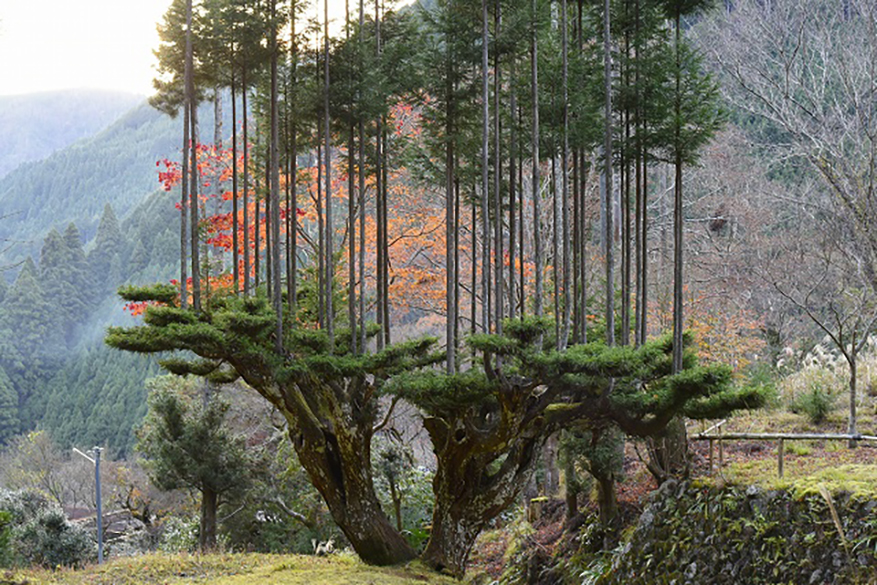
The truth is that most of these forests are not natural but are instead organized with specific timber trees. In the south, sugi (Cryptomeria japonica) and hinoki (Chamaecyaris obtusa) are the primary species used for this purpose, with plantations that often constitute the majority of a mountain’s forest.
These plantations are composed of trees of similar age that usually don’t need to grow much before being harvested. This process is known as “crown thinning,” where older trees are removed to allow younger ones to grow and reach maturity more quickly. This technique helps maintain the health and productivity of the forest while also promoting a more even distribution of sunlight.
Furthermore, such forests lack diversity in terms of biology, being unsuitable for most vegetation species and therefore not providing a suitable habitat for many animals either. However, these plantations have played an essential role in Japan’s economic development by providing timber for construction, paper production, and other industries.
Hence, a figure that can be read differently: only 1% of Japan’s forests can be considered ancient and primeval. This is the case with the forests of Kyushu, Shikoku, and Honshu, which host the most northerly extension of deciduous evergreen forests in Southeast Asia.
Here, forests are dominated by species from the Fagaceae family (beeches), Lauraceae (laurels), and Theaceae (asterids). Many other trees are also present, such as conifers and a wide range of deciduous trees, although in minority. These ancient forests have been preserved for centuries, providing a glimpse into Japan’s natural past.
From Japanese Trees to Bonsai
Japanese trees have undoubtedly been a great source of inspiration for the creation of true works of art, namely Bonsai. The term “Bonsai” literally means “tray plant” in Japanese, but it has come to represent the highly specialized and artistic practice of growing miniature trees.
In summary, when we find ourselves facing Bonsai trees both indoors and outdoors, the astonishment is general. Just as one can be amazed when confronted with a large tree that has, maybe, hundreds of years on its back, the same can be said when we’re in front of accurate miniature versions of these giant trees.
Bonsai trees are widespread in Italy as well, but often far removed from the natural art pieces found in Japan. One can remain astonished by admiring the forms and details of small pines or oaks, which are entirely identical to those of secolary trees, with the only difference being their relative proportions. Such that, if Bonsai trees are placed having a mountain or a beautiful sky as a backdrop, these tiny plants will seem to rise up and transform into giant trees.
This is precisely why we consider Bonsai to be a true form of art, where “the canvas” is the tree. They also have an esthetic similar to other traditional arts like Japanese gardening and ikebana (flower arrangement), and this has led to an increasing number of people from all over the world declaring themselves interested in Bonsai, particularly in Europe.
The Importance of Preserving Japan’s Forests
Japan’s forests are facing numerous threats, including deforestation, urbanization, and climate change. It is essential that we take action to protect these unique ecosystems and preserve their natural beauty for future generations.
By supporting organizations that work to conserve and restore Japan’s forests, we can help ensure the long-term health of these vital ecosystems. Additionally, promoting sustainable forestry practices and raising awareness about the importance of forest conservation can also play a crucial role in protecting Japan’s forests.
Conclusion
Japanese trees are a unique forest heritage that deserves appreciation and recognition. Their diversity is shaped by Japan’s extensive geography, with different altitudes contributing to various microclimates. However, it’s essential to acknowledge that most of these forests are not natural but have been organized for timber production, lacking diversity in terms of biology and providing insufficient habitat for many species.
Despite this, there are areas of ancient primeval trees, such as those found in Kyushu, Shikoku, and Honshu, which host the northernmost extension of deciduous evergreen forests in Southeast Asia. These forests are a testament to Japan’s unique natural heritage and deserve conservation efforts to protect them.
As we explore the world of Bonsai trees, we’re struck by their beauty and artistry, inspiring artists and enthusiasts alike. The combination of Japanese trees and Bonsai has led to an appreciation for these miniature trees as a true work of art, with many people around the world expressing interest in cultivating and admiring them.
Frequently Asked Questions (FAQs)
-
What are the most common types of trees found in Japan’s forests?
Japanese forests host a wide variety of tree species, including sugi (Cryptomeria japonica), hinoki (Chamaecyaris obtusa), beeches (Fagaceae family), and many others. -
Why is 1% of Japan’s forests considered ancient and primeval?
Only 1% of Japan’s forests can be considered ancient and primeval due to their age, location, and preservation efforts. -
What are Bonsai trees, and how did they become popular in the world?
Bonsai trees are miniature versions of larger trees grown using specific techniques. They have gained popularity worldwide for their beauty, artistry, and unique cultural significance. -
Are Japanese forests suitable habitats for many species of plants and animals?
Unfortunately, most Japanese forests lack biodiversity due to human management practices, making them unsuitable as natural habitats for many plant and animal species. -
How can we protect Japan’s ancient primeval forests from destruction or degradation?
Conservation efforts are necessary to preserve these unique ecosystems and protect the species they harbor. -
What is the significance of Japanese trees in Japanese culture and history?
Japanese trees hold cultural, spiritual, and historical value, serving as a connection between humans and nature. -
Can anyone learn how to cultivate Bonsai trees, or are there specific requirements?
Anyone can learn about Bonsai tree cultivation with the right training, equipment, and dedication.



