
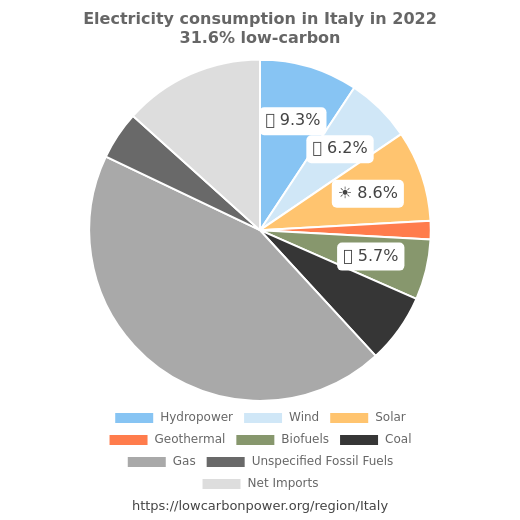
As we rely on external sources to power our homes, transport, and industries, is Italy’s energy balance secure? How much do we depend on imports from abroad, including EU countries, for electricity, gas, and oil? Let’s break down the facts.
The State of Italy’s Energy Balance: A Mixed Picture
The answer to the first question is “no”: Italy has a critical situation regarding energy security and independence, as defined in the PAEE 2014 (Piano d’Azione per l’Efficienza Energetica). The country’s energy balance, which includes electricity, gas, and oil, is not positive.
The High Dependence on Imports
The answer to the second question is “yes”: by 2012, an astonishing 82% of Italy’s energy needs (worth 163.2 million tons of oil equivalent according to EUOSTAT) were covered by imports. Fast forward to 2014, and this number has only increased.
Renewable Energy Production: A Small Share
The production of electricity from renewable sources, gas, and crude oil accounted for a relatively small share of Italy’s energy needs in 2012: 11.1% for electricity, 4.3% for gas, and 3.5% for oil.
A Comparative Look at EU Energy Balances
To put things into perspective, the average import dependency rate among EU countries is significantly lower, standing at around 55%.
The Financial Burden of Importing Energy
In 2012, Italy spent a staggering €57.9 billion on importing petroleum and natural gas.
Positive Trends: Renewable Energy Growth and Efficiency Efforts
However, there are some bright spots. In 2013, the growth in renewable energy production was notable: hydroelectric power +21.4%, photovoltaic +18.9%, wind power +11.6%, and geothermal power +1.0%. On the other hand, the production of electricity from fossil fuels decreased by -12%.
The Italian Energy Strategy
A more secure and less dependent energy balance is the cornerstone of Italy’s National Energy Strategy (SEN), adopted in March 2013. The strategy outlines four key objectives:
- Improving energy security through a reduction in foreign energy costs, estimated at around €14 million per year.
- Promoting growth and job creation by investing in traditional sectors and green economy initiatives, with an estimated spend of €170-180 billion by 2020.
- Reducing energy costs by aligning prices with European levels, which is expected to save households €9 billion per year on their electricity and gas bills.
- Exceeding the European Union’s climate and energy targets set out in the Climate-Energy Package 2020.
The Challenges Facing Italy’s Energy Balance
Despite positive trends in renewable energy production, several challenges need to be addressed in order to improve Italy’s energy balance. These include:
- Diversifying Energy Sources: Italy needs to diversify its energy sources and reduce its dependence on fossil fuels.
- Improving Energy Efficiency: Improving energy efficiency is crucial to reduce energy consumption and reliance on imports.
- Investing in Renewable Energy Infrastructure: Investing in renewable energy infrastructure, such as wind farms and solar panels, can help increase the share of renewable energy in Italy’s energy mix.
Conclusion
In conclusion, Italy’s energy balance remains a concern due to its high dependence on imports. However, there are encouraging signs of growth in renewable energy production and efforts to improve energy efficiency. A more secure and independent energy balance is essential for Italy’s economic and environmental sustainability.
Frequently Asked Questions (FAQs)
- Q: What percentage of Italy’s energy needs is covered by imports?
- An estimated 82% of Italy’s energy needs were covered by imports in 2012.
- Q: How much did Italy spend on importing energy in 2012?
- Italy spent an estimated €57.9 billion on importing petroleum and natural gas in 2012.
- Q: What is the average import dependency rate among EU countries?
- The average import dependency rate among EU countries is around 55%.
- Q: How has renewable energy production grown in Italy since 2013?
- Renewable energy production, particularly from hydroelectric power and photovoltaic sources, has increased significantly since 2013.
- Q: What are the main objectives of Italy’s National Energy Strategy (SEN)?
- The main objectives of SEN include improving energy security, promoting economic growth and job creation, reducing energy costs, and exceeding EU climate and energy targets.


