
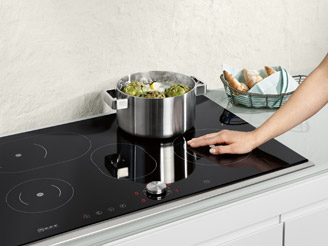
Before diving into the world of induction cooking, let’s first understand how it works. Induction cooking utilizes the principle of electromagnetic induction to distribute heat to cookware used for cooking food.
How Induction Cooking Works
Unlike traditional gas stoves, an induction cooking surface doesn’t require gas to function but is powered by alternating current electricity that flows through a covered bobbin made of ceramic materials.
The flowing electrical current generates a magnetic field that induces currents in the surrounding metal objects (such as pots and pans), causing them to heat up. This heating process leads to the cooking of food.
Induction Cooking: The Benefits
A stylish design
Efficiency at 92%
Less thermal dispersion.
Easy cleaning.
No gas risks.
Automatic recognition zones for cookware: only activated when the pot is placed.
The ceramic parts surrounding the cooking area remain cold, eliminating scalding risks.
Uniform heat distribution due to homogeneous heating.
Temperature control capabilities.
Modern induction cooking models allow users to choose from a variety of pre-programmed cooking settings (roasts, broths, and more).
Many modern induction cooking units come equipped with built-in aspirators that prevent fumes and vapors from dispersing during cooking.
Induction cooking offers numerous benefits for cooks. Here are some reasons why you might consider using an induction cooktop:
- Efficiency: Induction cooking is incredibly efficient, with a heat transfer rate of up to 92%. This means that more energy is converted into usable heat, reducing the risk of food burning or overcooking.
- Less thermal dispersion: Unlike traditional stoves, which can cause hotspots and uneven heating, induction cooktops distribute heat uniformly throughout the cooking surface. This reduces the risk of undercooked or overcooked areas in your dishes.
Induction Cooking: The Drawbacks
Higher initial purchase price
Replacing parts (non-stick coatings): many cookware materials are incompatible.
Incompatibility with certain cookware types:
• Pots and pans made of aluminum do not work well with induction cooktops.
• Metal coffee makers also don’t work properly.
Induction cookers require more energy, similar to gas stoves but the problem is that standard electrical systems usually supply only 3.3 kW.
To use induction cookers, users must ask their energy providers to upgrade their electricity plans from 3.3 to 4.5 or 6 kW.
A single induction cooker can absorb up to 3300 watts of electricity.
The High Cost of Induction Cooktops
Materials used for production are responsible for the significant cost of induction cooktops. The primary material is glass-ceramic, a unique and expensive product derived from unstable glasses that undergo devitrification processes.
Glass-ceramics have high melting temperatures (up to 700-800°C) without suffering any damage.
They are highly resistant to corrosive substances, which makes them easy to clean; thus, induction cooktops are easy to maintain. Cucinas in vetroceramica are also widely used as a base for cookware positioning.
Glass-ceramic covers are not exclusive to induction cooktops: they are also found on radiant cooking surfaces.
Induction Cooktop Alternatives
If you’re unsure whether to buy or use an induction cooktop, consider purchasing an optional induction cooking unit. Optional induction units, often called “induction accessories,” are more affordable (typically priced between 100 and 300 euros). These cooking units perform adequately, with some models featuring advanced features at a lower price.
One suitable option is the Hi-Tech Chef G3 Ferrari model available on Amazon for a promotional price of 119 euros. The same product may be purchased in retail stores for 189 euros.
We recommend this induction accessory because it offers an excellent technical specification list. It has a large, digital display with soft-touch commands, and can accommodate cookware up to 26 cm in diameter. Other notable features include adjustable power consumption (500-2000 watts), automatic timer settings, temperature control from 60°C to 240°C, and support for cookware diameters ranging from 12 to 26 cm.
Recommended Pentole for Induction Cooking
For the best cooking experience with your induction cooker, we recommend selecting suitable pots and pans. These can be found in our detailed guide on pentoles and plates compatible with induction cooking units.
The choice of pentoles and plates is a crucial decision when using an induction cooktop. The right pentoles and plates can make all the difference in achieving perfectly cooked meals every time. In this article, we’ll explore some key factors to consider when choosing pentoles and plates for your induction cooktop.
- Material compatibility: Not all materials are compatible with induction cooking. Look for pentoles and plates made from compatible materials like stainless steel or cast iron.
- Heat distribution: Choose pentoles and plates that distribute heat evenly, reducing the risk of hotspots and uneven cooking.
- Non-stick coatings: Non-stick coatings can be a great option for induction cooktops, but not all non-stick coatings are created equal. Look for pentoles and plates with high-quality non-stick coatings that won’t wear off over time.
In conclusion, induction cooking is an efficient and versatile way to prepare meals. While it offers numerous benefits, including efficiency and ease of cleaning, there are also some drawbacks to consider, such as the higher initial purchase price and potential incompatibility with certain cookware types. By understanding how induction cooking works and choosing the right pentoles and plates, you can unlock the full potential of your induction cooktop and enjoy perfectly cooked meals every time.


