
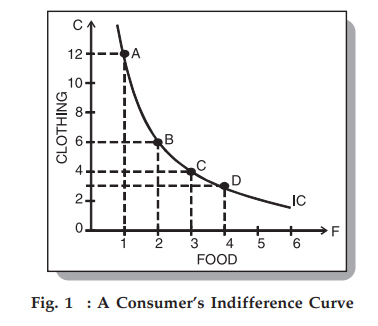
In economics, the concept of indifference curves is a powerful tool for understanding how consumers make decisions about the goods and services they buy. But what exactly is an indifference curve? In this article, we’ll explore the concept of indifference curves, their history, and how they can help us better understand consumer behavior.
What are Indifference Curves?
Indifference curves are a graphical representation of the combinations of two or more goods that provide a constant level of utility to a consumer. The idea behind indifference curves is simple: if a consumer is indifferent between two different combinations of goods, then they will choose the combination that provides the same level of satisfaction.
To illustrate this concept, let’s consider an example. Suppose we have two goods: bananas and chocolate. A consumer might want to buy either one or both of these goods, but they don’t necessarily want both in equal quantities. For example, if a consumer loves bananas more than chocolate, they might be willing to trade off some chocolate for more bananas.
On an indifference curve, the combinations of bananas and chocolate that provide the same level of satisfaction are plotted on a graph. The curve shows the various combinations of goods that the consumer is indifferent between.
History of Indifference Curves
The concept of indifference curves was first introduced in economics by the Austrian School in the late 19th century. However, it wasn’t until the early 20th century that indifference curves became a standard tool for understanding consumer behavior.
One of the key contributors to the development of indifference curves was the economist Alfred Marshall. In his book “Principles of Economics,” Marshall introduced the concept of utility as a measure of satisfaction. He also developed the idea of indifference curves, which became a central part of economics.
Types of Indifference Curves
There are several types of indifference curves, each representing different levels of utility or satisfaction. The main types of indifference curves include:
- Direct Substitution Curve: This curve represents the combinations of goods that provide equal satisfaction when one good is substituted for another.
- Cross-Substitution Curve: This curve represents the combinations of goods that provide equal satisfaction when two goods are substituted for each other.
- Total Indifference Curve: This curve represents all the combinations of goods that provide a constant level of utility.
Characteristics of Indifference Curves
Indifference curves have several key characteristics that make them useful for understanding consumer behavior. These include:
- Negatively Sloped: Indifference curves are negatively sloped because as one good increases, the other good must decrease in order to maintain a constant level of satisfaction.
- Convex: Indifference curves are convex because combinations of goods that provide higher levels of satisfaction also provide lower costs.
Applications of Indifference Curves
Indifference curves have several applications in economics and consumer behavior. Some of these include:
- Consumer Choice: Indifference curves help consumers make informed decisions about the goods and services they buy.
- Resource Allocation: Indifference curves can be used to allocate resources efficiently, by identifying combinations of goods that provide maximum satisfaction at a given cost.
Conclusion
Indifference curves are a powerful tool for understanding consumer behavior and decision-making. By analyzing indifference curves, economists and marketers can gain insights into consumer preferences, needs, and behaviors. Whether you’re a student looking to improve your understanding of economics or a business professional seeking to better understand your customers’ needs, indifference curves offer a valuable framework for analysis.
Frequently Asked Questions
- What is the main purpose of an indifference curve?
Indifference curves are used to represent the combinations of goods that provide equal satisfaction. - How do indifference curves differ from other types of curves in economics?
Indifference curves differ from other types of curves because they represent equality of satisfaction, not price or quantity. - What is the slope of an indifference curve?
The slope of an indifference curve is negative, indicating that as one good increases, the other must decrease. - How do indifference curves help with resource allocation?
Indifference curves can be used to identify combinations of goods that provide maximum satisfaction at a given cost, helping with efficient resource allocation.
Additional Resources
- “Principles of Economics” by Alfred Marshall: A classic economics textbook that introduces the concept of utility and indifference curves.
- “Microeconomics” by Gregory Mankiw: A comprehensive textbook on microeconomics that covers indifference curves in detail.
- The Indifference Curve Model: An online resource that provides a detailed explanation of indifference curves and their applications.
Real-World Examples
Indifference curves can be seen in various real-world examples, such as:
- Consumer Choice Models: Companies use indifference curves to understand consumer preferences and make informed decisions about product development.
- Resource Allocation Models: Governments and businesses use indifference curves to allocate resources efficiently and maximize satisfaction at a given cost.
- Market Research Studies: Market researchers use indifference curves to gain insights into consumer behavior and preferences.
Limitations of Indifference Curves
While indifference curves are a powerful tool for understanding consumer behavior, they also have some limitations. These include:
- Assuming Perfect Utility: Indifference curves assume that consumers have perfect utility, which may not always be the case.
- Ignoring Externalities: Indifference curves ignore externalities such as environmental impacts and social costs.
- Not Accounting for Uncertainty: Indifference curves do not account for uncertainty in consumer preferences.
Future Directions
The study of indifference curves is an active area of research, with ongoing developments in the field. Some future directions include:
- Integrating Machine Learning: Researchers are exploring ways to integrate machine learning algorithms into indifference curve models.
- Considering Non-Linear Preferences: Scholars are investigating non-linear preferences and their implications for indifference curves.
- Incorporating Environmental and Social Factors: Researchers are working on incorporating environmental and social factors into indifference curve models.
Conclusion
Indifference curves are a fundamental concept in economics that helps us understand consumer behavior and decision-making. By analyzing indifference curves, economists and marketers can gain insights into consumer preferences, needs, and behaviors. While there are limitations to indifference curves, ongoing research is helping to address these challenges. As we move forward, it will be interesting to see how indifference curves continue to evolve and improve our understanding of human behavior.


