
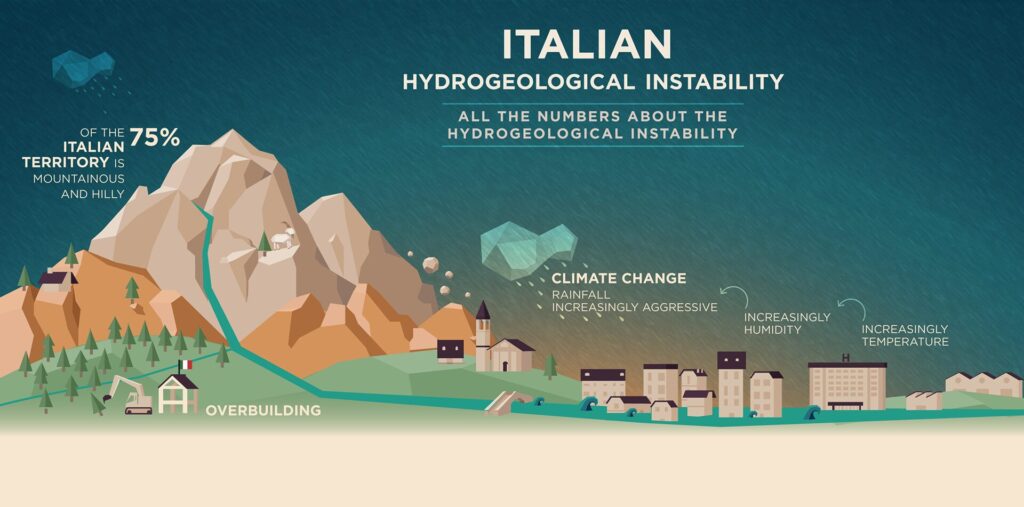
Before diving into the details of the hydrogeological disaster in Italy, let’s explore what it means. The term “hydrogeological disaster” refers to all phenomena that destroy the soil, including coastal erosion, landslides, and floods. To put this definition into perspective, a hydrogeological disaster is essentially the combination of processes that have a highly destructive impact on the land.
The Significance of Hydrogeological Disaster in Italy
The issue of hydrogeological disaster in Italy is indeed pressing and disturbing. In just the last 10 years, over 300 victims have been recorded. To delve deeper into this topic, let’s examine some statistics: between 2010 and 2022, there were 93 floods, 287 landslides with a total of 290 fatalities.
The high frequency and severity of hydrogeological disasters in Italy are causing significant concern among policymakers, scientists, and the general public. The Italian government has acknowledged the need for a comprehensive approach to address this issue, investing billions of dollars in infrastructure, research, and community education programs.
Causes of Hydrogeological Disaster
The causes can be either natural or man-made. Natural factors include geological instability, climate change, and heavy rainfall events. Human activities such as deforestation, urbanization, and pollution also contribute to the risk of hydrogeological disasters.
Man-made factors are particularly relevant in Italy, where centuries of urban planning and development have led to increased construction in high-risk areas. The lack of effective regulations, inadequate infrastructure, and poor land management practices have exacerbated the problem.
Hydrogeological Disaster in Italy: Facts and Figures
A report from the Ministry of Environment in 2008 stated that areas with high hydrogeological risk affect 5.8 million people, accounting for an impressive 82% of municipalities. The most recent study by Ance (Association of Builders and Contractors) and Cresme (Center for Economic and Social Research on Market for Construction and Territory), published in 2012, reported that the hydrogeological risk affects 6,250 schools, 550 hospitals, and approximately 500,000 businesses.
These numbers give us a clearer understanding of how fragile Italy’s territory is. The issue at hand cannot be reduced to poor land management alone but also involves mismanagement of public funds: between 2010 and 2012, the estimated cost of hydrogeological disaster in Italy was around $7.5 billion, while over the past 65 years, the total value of damages (adjusted for inflation) has been approximately $54 billion.
In its report from 2008, the Ministry of Environment suggested investing at least $40 billion to secure the most vulnerable regions in our country.
What this means is that with the money spent on repairs and compensation alone for locations hit by floods and landslides, we could have built a comprehensive defense system across Italy, reducing future costs and saving lives. For more information on flood victims and damages caused by floods, I recommend reading “Floods in Italy: A Tragic Balance”.
Additionally, you might find it interesting to read about “Hydrogeological Risk: Definition and Situation in Italy”.
1. Understanding Hydrogeological Disaster
Hydrogeological disasters are a complex issue that requires a multidisciplinary approach to understand and address. The term “hydrogeology” refers to the study of the movement, distribution, and quality of groundwater.
A hydrogeological disaster occurs when natural or human-induced factors disrupt the balance between groundwater recharge and discharge, leading to an increase in water levels, landslides, or floods. This can have devastating consequences for communities, infrastructure, and the environment.
2. The Significance of Hydrogeological Disaster
The significance of hydrogeological disasters cannot be overstated. In Italy, these events are becoming increasingly common and severe, with significant economic and human costs. The high frequency and severity of these disasters are causing concern among policymakers, scientists, and the general public.
The impact of hydrogeological disasters on communities is multifaceted. They can lead to loss of life, property damage, displacement of people, and long-term psychological trauma. In addition, these events can also have a significant economic impact, affecting local businesses, agriculture, and tourism.
3. Causes of Hydrogeological Disaster
The causes of hydrogeological disasters in Italy are complex and multifaceted. Natural factors such as geological instability, climate change, and heavy rainfall events contribute to the risk of these disasters. Human activities such as deforestation, urbanization, and pollution also play a significant role.
Man-made factors are particularly relevant in Italy, where centuries of urban planning and development have led to increased construction in high-risk areas. The lack of effective regulations, inadequate infrastructure, and poor land management practices have exacerbated the problem.
4. Hydrogeological Disaster in Italy: Facts and Figures
A report from the Ministry of Environment in 2008 stated that areas with high hydrogeological risk affect 5.8 million people, accounting for an impressive 82% of municipalities. The most recent study by Ance (Association of Builders and Contractors) and Cresme (Center for Economic and Social Research on Market for Construction and Territory), published in 2012, reported that the hydrogeological risk affects 6,250 schools, 550 hospitals, and approximately 500,000 businesses.
These numbers give us a clearer understanding of how fragile Italy’s territory is. The issue at hand cannot be reduced to poor land management alone but also involves mismanagement of public funds: between 2010 and 2012, the estimated cost of hydrogeological disaster in Italy was around $7.5 billion, while over the past 65 years, the total value of damages (adjusted for inflation) has been approximately $54 billion.
In its report from 2008, the Ministry of Environment suggested investing at least $40 billion to secure the most vulnerable regions in our country.
What this means is that with the money spent on repairs and compensation alone for locations hit by floods and landslides, we could have built a comprehensive defense system across Italy, reducing future costs and saving lives. For more information on flood victims and damages caused by floods, I recommend reading “Floods in Italy: A Tragic Balance”.
Additionally, you might find it interesting to read about “Hydrogeological Risk: Definition and Situation in Italy”.
5. Investment Needed for a Safe Future
The investment needed to address the hydrogeological disaster issue in Italy is significant. According to the Ministry of Environment, investing $40 billion would be necessary to secure the most vulnerable regions.
In addition to this investment, there are other measures that need to be taken to mitigate the impact of hydrogeological disasters. These include:
- Implementing effective regulations and standards for construction and land use
- Improving infrastructure, including flood defenses and emergency response systems
- Conducting regular monitoring and assessment of high-risk areas
- Providing education and training programs for communities at risk
By taking these steps, we can reduce the likelihood of hydrogeological disasters and minimize their impact on communities.
6. Historical Context: Understanding the Evolution of Disaster Management in Italy
Disaster management has evolved significantly over time in Italy. In the past, the focus was primarily on responding to individual disasters rather than proactively managing risk. However, recent events have highlighted the need for a more comprehensive approach to disaster management.
In 2008, the Italian government established the National System of Disaster Management (SINAD) to coordinate responses to natural disasters. The SINAD has since become a key player in disaster management, working closely with local authorities and emergency services to mitigate the impact of hydrogeological disasters.
7. The Economic Burden of Hydrogeological Disaster
The economic burden of hydrogeological disasters in Italy is significant. Between 2010 and 2012, the estimated cost of these events was around $7.5 billion. However, when adjusted for inflation, the total value of damages over the past 65 years has been approximately $54 billion.
This highlights the long-term consequences of hydrogeological disasters on local economies and communities. In addition to direct financial costs, there are also indirect costs associated with loss of productivity, business disruption, and infrastructure damage.
8. The Human Cost: A Look into Flood Victims and Damages
Hydrogeological disasters have a devastating impact on communities, particularly in terms of human life and property damage. Floods, landslides, and other hydrogeological events can lead to loss of life, displacement, and long-term psychological trauma.
In addition to the immediate impacts, there are also long-term consequences for flood victims. Many communities affected by floods have been left with damaged or destroyed homes, businesses, and infrastructure, leading to significant economic hardship.
9. Conclusion: What Can Be Done to Mitigate the Impact of Hydrogeological Disaster?
Mitigating the impact of hydrogeological disasters in Italy requires a comprehensive approach that addresses both natural and human-induced factors. This includes:
- Implementing effective regulations and standards for construction and land use
- Improving infrastructure, including flood defenses and emergency response systems
- Conducting regular monitoring and assessment of high-risk areas
- Providing education and training programs for communities at risk
By taking these steps, we can reduce the likelihood of hydrogeological disasters and minimize their impact on communities.
10. Future Directions
Future directions for disaster management in Italy will focus on proactive measures to mitigate the impact of hydrogeological disasters. This includes:
- Implementing a national flood warning system
- Conducting regular monitoring and assessment of high-risk areas
- Providing education and training programs for communities at risk
- Investing in infrastructure, including flood defenses and emergency response systems
By taking these steps, we can build a more resilient Italy that is better equipped to face the challenges of hydrogeological disasters.
I hope this report has provided a comprehensive overview of the issue of hydrogeological disaster in Italy. By understanding the causes, consequences, and solutions to this complex problem, we can work towards mitigating the impact of these events on communities and ensuring a safer, more sustainable future for all.


