
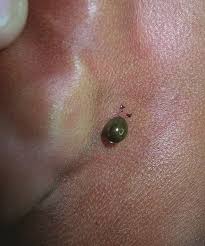
As we venture outdoors, it’s essential to know how to identify a tick from a mole. While it may seem like a straightforward task, it can be challenging to distinguish between these two common skin irritants. In this article, we’ll delve into the characteristics of ticks and moles, as well as provide guidance on how to safely remove them.
Understanding Ticks
Ticks are arachnids that belong to the class Arachnida, which also includes spiders and scorpions. There are two main types of ticks: hard-tailed ticks (Ixodidae) and soft-tailed ticks (Argasidae). Hard-tailed ticks have a rigid exoskeleton and are more difficult to confuse with moles, while soft-tailed ticks lack this protection and can be mistaken for them.
Ticks are typically oval in shape, about 3-5 millimeters long, and have eight legs. They come in two colors: males are reddish-brown, while females are grayer. Males are more likely to be mistaken for moles due to their coloration.
Characteristics of Ticks
To identify a tick, look for the following characteristics:
- A hard exoskeleton (in hard-tailed ticks)
- Eight legs
- A reddish-brown color (males) or gray color (females)
- An oval shape, about 3-5 millimeters long
Characteristics of Moles
Moles are growths on the skin that can be mistaken for ticks. To identify a mole, look for the following characteristics:
- A uniform color, often mottled or patchy
- Asymmetrical shape with irregular borders
- An unusual color, such as blue, pink, or red
Distinguishing Between Ticks and Moles
If you’re still unsure whether a growth on your skin is a tick or a mole, consult with a medical professional. However, here are some general guidelines:
- If the growth is symmetrical, round, and has well-defined borders, it’s likely not a tick.
- If the growth is asymmetrical, irregularly shaped, and has poorly defined borders, it may be a tick.
- If the growth is uniform in color and has smooth, rounded edges, it’s unlikely to be a tick.
How to Safely Remove a Tick
If you suspect that you have a tick on your skin, follow these steps:
- Avoid using home remedies: Refrain from using petroleum jelly, nail polish, or other substances to try to remove the tick.
- Use fine-tipped tweezers: Grasp the tick as close to your skin as possible and pull upwards with clean, dry tweezers.
- Remove the tick completely: Continue to pull on the tick until it comes off completely.
- Clean the bite area: Wash the affected area with soap and water, then apply an antiseptic to prevent infection.
- Dispose of the tick: Place the removed tick in a sealed container or bag for further examination.
Prevention is Key
To avoid getting ticks on your skin, take the following precautions:
- Wear protective clothing, such as long pants, long-sleeved shirts, and closed-toe shoes.
- Use insect repellents containing DEET, picaridin, or oil of lemon eucalyptus.
- Avoid areas with high grass, leaf litter, or wooded areas.
Common Symptoms of Tick Bites
If you’ve been bitten by a tick, watch for the following symptoms:
- Redness and swelling around the bite area
- Pain or itching at the bite site
- Fever
- Headache
- Muscle pain
Conclusion
Identifying ticks and moles can be challenging, but understanding their characteristics and taking preventative measures can help you avoid getting infested. Remember to safely remove any tick that attaches itself to your skin and take steps to prevent future bites.
Frequently Asked Questions
- What is the difference between a hard-tailed tick and a soft-tailed tick?
Hard-tailed ticks have a rigid exoskeleton, while soft-tailed ticks lack this protection. - Can I use home remedies to remove a tick?
No, it’s essential to avoid using petroleum jelly, nail polish, or other substances that can cause the tick to release its mouthparts and burrow deeper into your skin. - How long does it take for a tick bite to develop symptoms?
Symptoms may appear anywhere from 3-14 days after the bite. - Can I get infected with Lyme disease from a tick bite?
Yes, if you’re bitten by an infected tick, you can contract Lyme disease. -
How do I prevent ticks from attaching themselves to my skin?
Wear protective clothing, use insect repellents, and avoid areas with high grass or leaf litter. -
Can moles be a sign of Lyme disease?
No, moles are not a symptom of Lyme disease. If you’re experiencing symptoms such as fever, headache, or muscle pain, consult with a medical professional. - How do I treat a mole that may be infected?
Consult with a medical professional for proper diagnosis and treatment. - Can ticks transmit other diseases besides Lyme disease?
Yes, some species of ticks can transmit diseases like anaplasmosis, ehrlichiosis, and spotted fever rickettsiosis.
Tick Prevention Tips
To avoid getting ticks on your skin, follow these additional tips:
- Avoid tick-prone areas during peak season (spring and summer)
- Use permethrin-treated clothing and gear to repel ticks
- Conduct regular tick checks after spending time outdoors
- Remove any debris or leaf litter from your yard
Mole Removal Tips
If you suspect that you have a mole on your skin, follow these steps:
- Consult with a medical professional: Before attempting to remove a mole, consult with a dermatologist or healthcare professional for proper diagnosis and treatment.
- Use a biopsy: If the mole is large or has irregular borders, it’s essential to obtain a tissue sample (biopsy) for further examination.
- Avoid scratching the mole: Scratching can cause irritation and lead to infection.
Conclusion
Understanding the difference between ticks and moles is crucial for safe removal and prevention. By following these guidelines and taking preventative measures, you can minimize your risk of getting infested with ticks. If you suspect that you have a tick or mole on your skin, consult with a medical professional for proper diagnosis and treatment.
Additional Resources
- Centers for Disease Control and Prevention (CDC): Ticks and Tick-Borne Diseases
- American Academy of Dermatology: Moles and Skin Growths
- National Institute of Allergy and Infectious Diseases (NIAID): Lyme Disease
By staying informed and taking proactive steps, you can protect yourself from tick-borne diseases and enjoy the great outdoors with confidence.


