
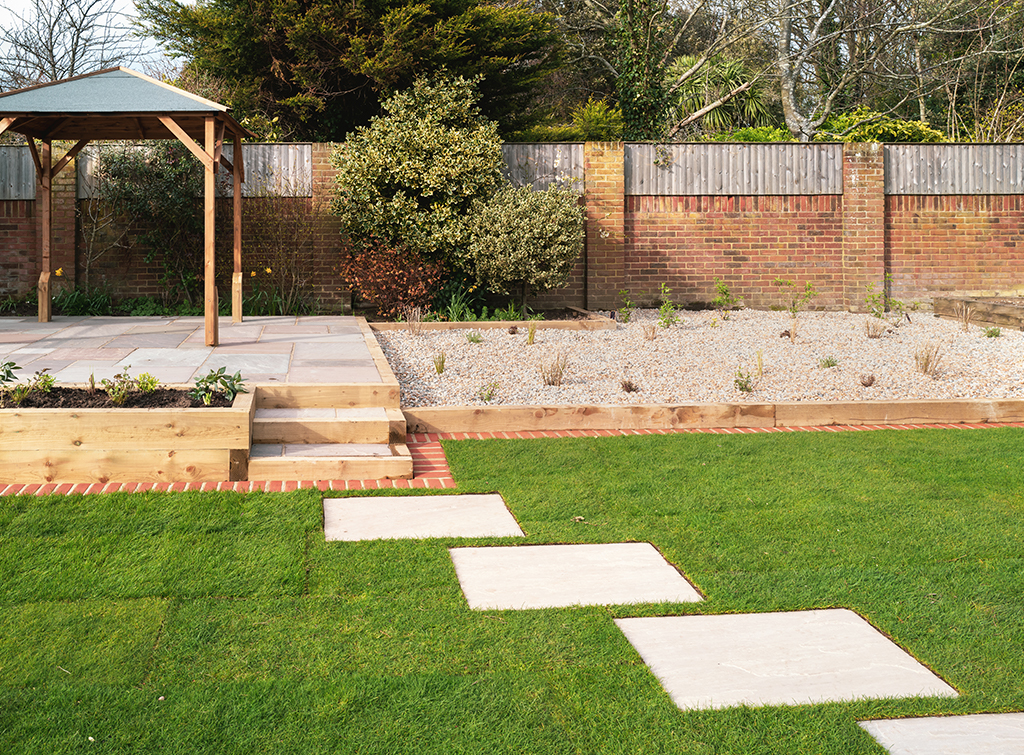
As you’ve seen how to build a wooden exterior floor, we’ll explore the various options available for paving your garden, covering large areas or individual sections with different materials.
Choosing the Right Paving Material
There are numerous options for paving your garden, including river stones, beeches, cubettes of porphyry, autoblackers, tile pieces, pots, and wood elements. With so many choices, it’s truly a matter of selecting the perfect one!
Pavement Type: Pedestrian or Vehicle Access
Before we dive into how to pave your garden, let’s remember that if the pavement is intended only for pedestrians, the installation process can be done directly on the ground. On the other hand, if vehicles will be using the area, a layer of sand or crushed surface material will need to be created.
Designing a Pedestrian Path or Pavement
If you’re planning a path or pavilion for pedestrians only, we recommend exploring our article “How to Create a Walking Trail.” In this section, we’ll guide you on how to pave your garden using porphyry.
Porphyry Cubettes: A Robust and Versatile Option
Porphyry cubettes are ideal for creating robust and visually appealing pavements with geometric shapes and designs. They can be arranged in a circular pattern, linearly, or by combining different-colored cubettes to create unique motifs. With the right underlayment, porphyry pavements can also accommodate vehicles.
The Paving Process: A Step-by-Step Guide
To create your garden pavement, follow these steps:
- Prepare the Base
Remove any existing vegetation and thoroughly rake the soil to create a level surface. -
Define the Pavement Area
Mark out the boundaries of your pavimentation using stakes or rope, and consider installing perimeter cordons made of concrete. -
Lay Down the Foundation
Create a sand base by moistening it with water and mixing in cement. Rake the surface to create an even, smooth finish. Compact the soil and use a spirit level to ensure it’s perfectly flat. Next, check that the sand depth is sufficient to support the porphyry cubettes at the perimeter cordons. -
Design Your Pavement Pattern
Use a compass to draw out the shape of your pavement on the ground, taking into account any curves or corners you want to include. -
Place the Porphyry Cubettes
Begin by placing each cubette in turn along the curve, ensuring that they are as close together as possible to fill all the spaces within the designated area. -
Seal Gaps and Fills
Once all the cubettes have been placed, use a sealant made from sand mixed with water and cement to fill any gaps between them.
Additional Tips
- For added durability, consider applying a sealer or protective coating to your pavement.
- Keep in mind that different materials may require different preparation and installation procedures.
- Don’t forget to clean up thoroughly after the paving process to prevent dirt and debris from accumulating on your new surface.
By following these guidelines, you’ll be able to create a beautiful and functional garden pavimentation that meets your needs. Happy paving!
Frequently Asked Questions
- What are some common types of pavement materials available?
A variety of materials can be used for paving gardens, including river stones, beeches, cubettes of porphyry, autoblackers, tile pieces, pots, and wood elements. - Is it necessary to create a separate layer for vehicle access?
Yes, if vehicles will be using the area, a layer of sand or crushed surface material must be created to provide adequate support for the pavement. - Can I pave my entire garden at once, or should I break it down into smaller sections?
It’s recommended to break down your project into smaller sections, as this allows you to work on each area individually and ensure a more even, smooth finish. - How often do I need to seal or protect my pavement?
The frequency of sealing or protective coating application will depend on the material used for your pavimentation, environmental conditions, and foot traffic. -
What are some common mistakes people make when paving their gardens?
Common mistakes include failing to properly prepare the base soil, not following recommended installation procedures, and neglecting to seal or protect the pavement after completion. -
What is the best way to clean my garden pavement?
Regular cleaning of your garden pavement should be done with a mild detergent and water, and in some cases, a power washer can also be used for tougher stains. - How often should I inspect my garden pavement?
Regular inspections are necessary to identify any potential issues or damage to the pavimentation. - What is the typical lifespan of a well-maintained garden pavement?
The average lifespan of a well-maintained garden pavement can range from several years to decades, depending on various factors such as material choice, maintenance frequency, and environmental conditions.
By asking these questions and following our guide, you’ll be well-equipped to create a beautiful and functional garden pavimentation that meets your needs.


