
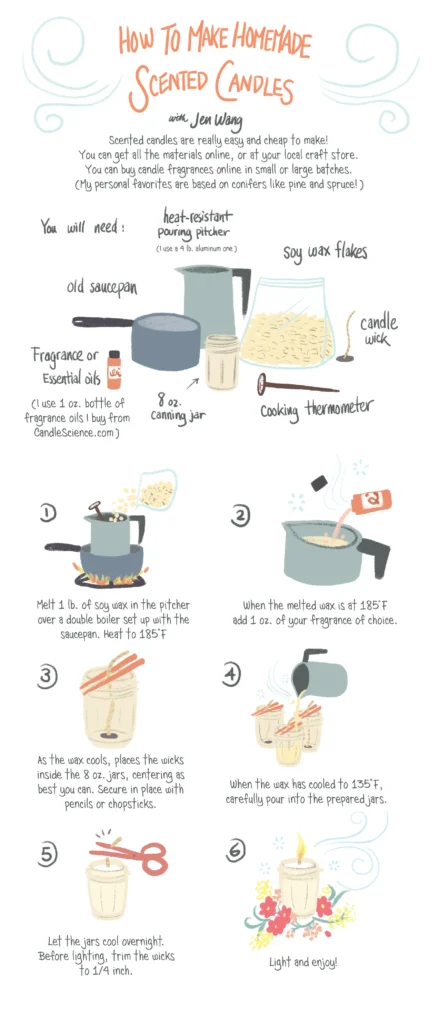
Creating scented candles at home can be a fun and rewarding experience. Not only will you have the opportunity to customize your candle’s color, fragrance, and design, but you’ll also save money on store-bought candles. In this article, we’ll take you through the process of creating scented candles at home, from preparing the necessary materials to enjoying the fruits of your labor.
Gathering Materials
Before you begin, gather the following materials:
- A mold or container (e.g., a glass jar, plastic bottle, or metal tin) with a diameter that fits comfortably in your hand
- Wax (available at craft stores or online)
- Wick (made from cotton, paper, or another material)
- Melting pot (a double boiler or dedicated candle-making pot)
- Thermometer (to monitor the temperature of the melted wax)
- Colorants (optional, for creating a unique hue)
- Fragrance oils (your choice of scents)
Preparing the Melting Pot
To begin, prepare your melting pot by heating the wax until it reaches a temperature between 160°F and 180°F. Stir occasionally to ensure even melting.
Adding Color and Fragrance
Once the wax has reached the desired temperature, add colorants (if using) and fragrance oils. Stir well to combine.
Adding the Wick
Carefully place the wick into the melted wax, making sure it’s centered and straight.
Pouring the Wax
Using a spatula or spoon, pour the wax mixture into the prepared mold.
Allowing the Wax to Cool and Solidify
Let the wax cool and solidify completely. This can take several hours, depending on the size of your candle.
Removing the Candle from the Mold
Once the wax is solid, carefully remove the candle from the mold.
Tips and Variations
- Experiment with different colors, fragrances, and mold shapes to create unique candles.
- Consider adding herbs or spices to create a more complex scent profile.
- Use a variety of materials, such as essential oils, absolutes, or absolute essences, to craft distinctive fragrances.
Common Issues and Solutions
- Wax not melting evenly: Stir the wax occasionally, ensuring it reaches the correct temperature. If still issues persist, try using a different type of wax.
- Candle too soft or too hard: Check the melting point of your wax and adjust accordingly. Also, ensure that you’re not adding too much fragrance oil.
Safety Precautions
When working with heat, flammable materials, and fragrances, it’s essential to take safety precautions:
- Always use a well-ventilated area when melting wax or using fragrance oils.
- Keep the melting pot away from children and pets.
- Wear protective gloves and eyewear when handling hot equipment or fragrances.
- Never leave a burning candle unattended.
Conclusion
Creating scented candles at home can be a fun and rewarding experience. With the right materials, knowledge, and practice, you’ll be well on your way to crafting unique candles that reflect your personality and style. Don’t be afraid to experiment with different colors, fragrances, and mold shapes – after all, it’s all part of the creative process!
FAQs
- What type of wax should I use for candle-making?
Wax types vary in melting points, hardness, and scent retention. Soy wax, beeswax, and paraffin wax are popular choices for candle-making. - How do I ensure my candles burn evenly?
To achieve even burning, make sure the wick is centered and straight, and trim it to about 1/4 inch before each use. - Can I add herbs or spices to my candle?
Yes! Adding herbs or spices can create a unique scent profile. However, be cautious not to overdo it, as strong scents may overpower the fragrance of your candle. - How do I remove stubborn wax residue from my hands?
Use soap and water to clean your hands, or try using a mixture of baking soda and water to gently scrub away any remaining wax. - What is the ideal temperature for melting wax?
The ideal temperature for melting wax depends on the type of wax used. Generally, it ranges from 160°F to 180°F. - Can I use essential oils in my candle-making process?
Yes! Essential oils can be a great addition to your candles, offering unique fragrances and potential health benefits. - How do I store my candles to prolong their burn time?
Store your candles in a cool, dry place away from direct sunlight. This will help prevent the wax from melting or degrading over time. - What is the best way to remove the wick from my candle after it’s solidified?
Use a pair of scissors or tweezers to carefully cut the wick close to the bottom of the candle, then gently pull it out.
Tips for Beginners
- Practice makes perfect! Don’t be discouraged if your first few candles don’t turn out as expected.
- Experiment with different fragrances and colors to find what works best for you.
- Keep a record of your experiments, including notes on temperatures, wax types, and fragrance combinations.
Conclusion
Creating scented candles at home can be a fun and rewarding experience. With the right materials, knowledge, and practice, you’ll be well on your way to crafting unique candles that reflect your personality and style. Happy candle-making!


