
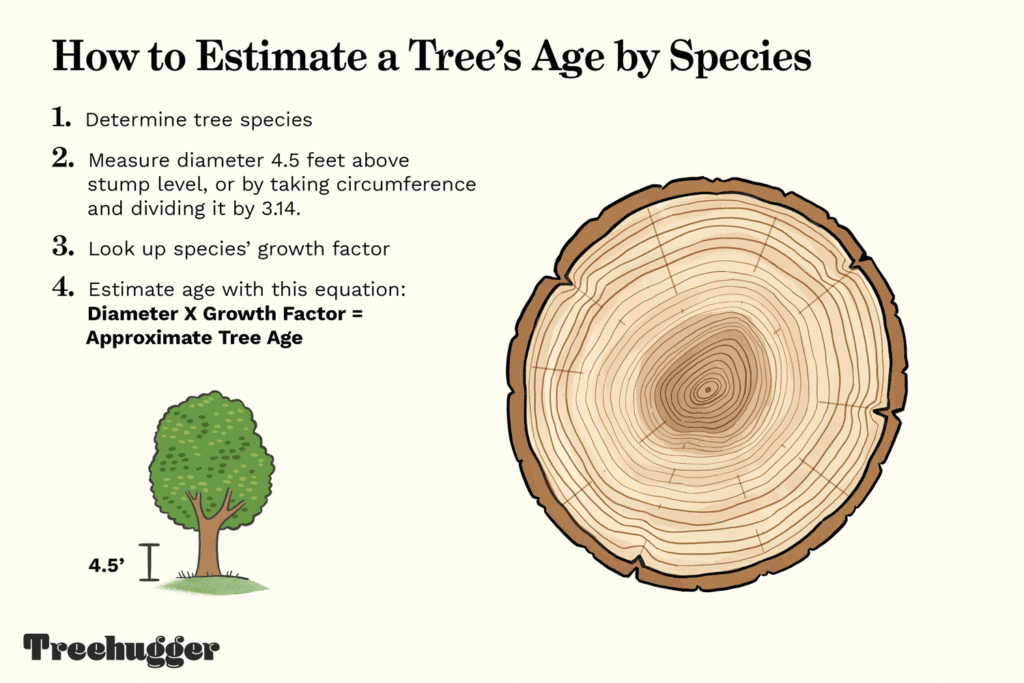
As tree enthusiasts, we often find ourselves wondering about the age of our beloved trees. While it’s not always possible to determine an exact age, there are several methods that can provide a reliable estimate. In this article, we’ll explore two popular methods for calculating the age of a tree: one based on its circumference and another using dendrochronology.
Understanding Dendrochronology
Dendrochronology is a scientific method used to determine the age of trees by analyzing their growth rings. The term “dendrochronology” comes from the Greek words “dendron,” meaning tree, and “chronos,” meaning time. This method involves counting the number of growth rings in a tree’s trunk, which represents the number of years the tree has been alive.
How Growth Rings Form
Tree growth occurs both in height and width. In terms of horizontal growth, trees tend to expand their diameter at a rate that is roughly proportional to their current diameter. This phenomenon is known as “ring expansion.” As a result, each year, a new layer of wood grows inward from the trunk’s surface, forming a distinct ring.
Anatomy of a Growth Ring
A typical growth ring consists of two layers:
- The earlywood, which is lighter in color and composed of larger cells.
- The latewood, which is darker in color and made up of smaller cells.
The combination of these two layers creates the characteristic ring pattern that dendrochronologists use to determine a tree’s age.
Measuring Growth Rings
To measure growth rings, you’ll need:
- A caliper or tape measure to assess the diameter of the trunk.
- A photograph or video of the trunk to help identify individual rings.
By counting the number of growth rings and using a standard formula, dendrochronologists can estimate the age of a tree.
Calculating Age Based on Circumference
This method is less accurate than dendrochronology but still provides a useful estimate. The idea is that trees grow at different rates depending on factors like climate, soil quality, and species.
Here’s a simple calculation:
- Measure the circumference of the trunk using a flexible measuring tape.
- Divide the circumference by 2.5 to get an estimate of the tree’s age in years.
Caveats
Keep in mind that this method is not as precise as dendrochronology and may vary depending on factors like:
- Tree species
- Climate conditions
- Soil quality
Bonsai Trees: A Special Case
Bonsai trees are a unique case when it comes to estimating age. While the growth ring method can be used, it’s not always possible to determine an exact age due to the tree’s pruning history.
Instead, consider factors like:
- Pruning frequency and timing
- Tree species and growth habits
Dendrochronology in Practice
Dendrochronology is widely used in various fields, including:
- Archaeology: By analyzing the rings of trees that grew during historical periods, researchers can reconstruct past environments.
- Ecology: Dendrochronology helps scientists understand climate patterns, forest dynamics, and ecosystem changes over time.
How to Collect Core Samples
Collecting core samples is an essential step in dendrochronological analysis. This involves using a specialized tool to extract a small section of the tree’s trunk without damaging it. The core sample should be:
- Taken from a straight branch with minimal knots
- Collected at a height that allows for easy handling and measurement
Interpreting Core Samples
Once collected, the core sample is typically analyzed using specialized equipment, such as:
- A laser caliper: Measures the diameter of the core sample.
- A microscope: Examines the texture and structure of the wood.
By analyzing these factors, dendrochronologists can identify individual growth rings and reconstruct a tree’s history.
The Science Behind Dendrochronology
Dendrochronology relies on several key principles:
- Tree-ring formation: The process by which trees grow new layers of wood each year.
- Climate influence: The impact of environmental factors, such as temperature and precipitation, on tree growth.
- Species-specific patterns: The unique characteristics of individual tree species that allow for identification.
Dendrochronology in the Real World
Dendrochronology has numerous applications beyond research:
- Forestry: By analyzing tree-ring chronologies, foresters can predict climate changes and optimize forest management.
- Conservation: Dendrochronology helps conservationists track the spread of invasive species and monitor ecosystem health.
Challenges and Limitations
While dendrochronology is a powerful tool, it’s not without its challenges:
- Sampling errors: Collecting core samples can be difficult, especially in dense forests.
- Tree-ring ambiguity: Individual growth rings may be hard to distinguish, particularly for younger trees.
The Future of Dendrochronology
As technology advances, dendrochronology will likely become even more sophisticated:
- High-throughput sequencing: New methods for analyzing tree genetic material can improve accuracy and speed.
- Artificial intelligence: AI-powered tools may help automate the analysis process.
Conclusion
Determining the age of a tree requires patience, attention to detail, and a basic understanding of tree biology. By combining these methods and considering individual circumstances, you can gain valuable insights into your beloved trees’ ages.
Stay curious, keep exploring, and remember that every tree has its own story to tell.


