
When electricity is generated from fossil fuels, we take advantage of the thermal energy to produce steam. The steam then acts on a turbine connected to a generator. In the combustion process, not all the energy produced is converted into useful work (turbine operation), the energy contained in the chemical bonds of the fuel is wasted as heat.
Fuel cells aim to resolve this waste by leveraging electrons from chemical bonds to produce electricity directly, bypassing the transformation that involves steam production, turbine action, and generator use. This is what happens in fuel cells, where the chemical energy of the bonds is converted directly into electricity.
If we compare conventional fossil fuel use with an efficiency rate of 20-25%, fuel cells have an efficiency higher than 60%. The functioning of a fuel cell is similar to that of a battery, but the main difference lies in the fuel supply: unlike batteries that use internal fuel sources, fuel cells receive their fuel from the outside, ensuring continuous operation.
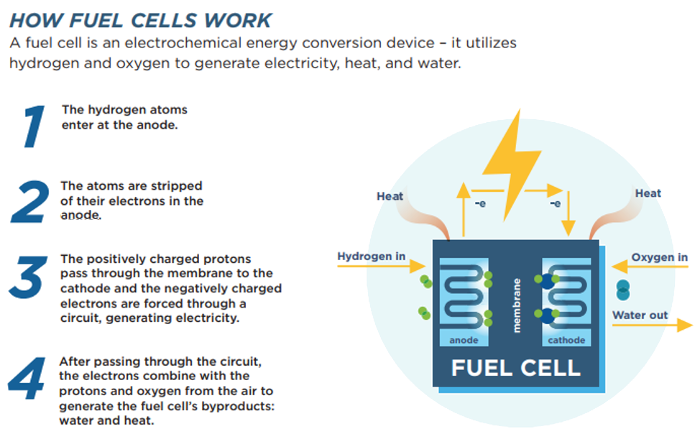
Like any other battery, the structure of a fuel cell can be divided into two compartments where oxidation and reduction take place. In one compartment, an element loses electrons (oxidation) and in the other, another chemical species gains electrons (reduction). The two compartments are connected to allow for a spontaneous electron flow, so electrons pass from the oxidation chamber to the reduction chamber. This flow constitutes electricity.
Since electrons are negatively charged particles that must be balanced, the two chambers are separated by a permeable membrane allowing only positive ions (protons) to pass through and balance the net negative charge flow.
The oxidation of a fuel involves electrons flowing into the other compartment where they react with an oxidizing agent, typically oxygen. The oxidation of the fuel produces positively charged ions (the fuel loses electrons and remains with a net positive charge), which are exactly those ions needed to balance the negative charge.
Why does no energy get wasted as heat?
The fuel and the oxidizing agent are located in separate compartments and never come into direct contact, so there is no combustion but only a balanced reaction that sees the oxidation of the fuel and the consumption of oxygen. In the electrical circuit, the chemical reaction’s energy is converted directly into electricity.
There exist fuel cells based on hydrogen, methane, or other hydrocarbons. Fuel cells do not break free from dependence on fossil fuels but significantly increase their efficiency. The hydrogen-powered shuttle uses a different kind of fuel cell. Hydrogen gas is introduced into the compartment where it is converted to hydrogen ions. These electrons then flow into the external circuit via a conductor, eventually arriving at the reduction chamber (cathode). The produced electrons are used by oxygen, which produces water through combination with hydrogen ions.
A more apparent reaction occurs in fuel cells based on hydrocarbons like methane. In this case, however, the products of the reaction include not only water but also carbon dioxide. Taking the example of methanol, a reaction can be observed as follows:
2 CH3OH (two molecules of liquid methanol) + 3 O2 (three molecules of oxygen gas) —> 2 CO2 (two molecules of carbon dioxide gas) + 4 H2O (four molecules of water liquid).
This reaction is estimated to produce approximately 23 kilojoules per gram of methanol used (equivalent to 727 kJ/mol). This energy is equivalent to a power of 200 watt-hours for every mole of methanol or better, 5.0 kWattora for every liter of methanool used. Making a comparison, the oxidation of one liter of methanol in a fuel cell would result in the production of over 5,000 W of power for a period of 24 hours.
Understanding Fuel Cell Mechanisms
To understand how fuel cells work, it is essential to delve into their internal mechanisms. The primary components of a fuel cell include:
- Anode: This is where oxidation takes place.
- Cathode: This compartment is where reduction occurs.
- Electrolyte membrane: A thin layer that separates the anode and cathode chambers, allowing only ions to pass through.
During operation, the fuel cell receives fuel (such as hydrogen or methanol) and an oxidizing agent (usually oxygen). The fuel undergoes oxidation at the anode chamber where it releases electrons. These electrons then flow into the external circuit via a conductor, eventually arriving at the cathode chamber.
At the cathode chamber, the released electrons combine with oxygen to produce water through combination with hydrogen ions from the electrolyte membrane. This reaction results in the production of electricity in the external circuit.
Fuel Cell Types
There are various types of fuel cells available, each with its unique characteristics and applications. Some common types include:
- Proton Exchange Membrane (PEM) Fuel Cells: These are the most widely used type of fuel cell, particularly for transportation applications.
- Solid Oxide Fuel Cells (SOFCs): These use a solid oxide material as the electrolyte membrane and operate at high temperatures.
- Phosphoric Acid Fuel Cells: These use phosphoric acid as the electrolyte membrane and are typically used in stationary power generation applications.
Fuel Cell Advantages
Fuel cells have several advantages over traditional fossil fuel-based power generation methods:
- Higher Efficiency: As mentioned earlier, fuel cells have an efficiency higher than 60%, while conventional fossil fuels have a rate of 20-25%.
- Reduced Waste Heat: Fuel cells produce only water as their by-product, significantly reducing waste heat compared to traditional power generation methods.
- Clean Energy Source: Many fuel cells use renewable energy sources such as hydrogen or methanol, making them an attractive option for reducing greenhouse gas emissions.
Fuel Cell Applications
Fuel cells have various applications across different industries:
- Transportation: Fuel cells are being used in electric vehicles and hybrid vehicles to provide a cleaner and more efficient alternative to traditional fossil fuel-based powertrains.
- Stationary Power Generation: Fuel cells are used in stationary power generation applications, such as data centers and backup power systems.
- Portable Devices: Fuel cells are being used in portable devices, such as laptops and smartphones, due to their compact size and high energy density.
Challenges and Future Directions
While fuel cells show great promise for reducing waste heat and increasing efficiency, there are still challenges to be addressed:
- Fuel Cell Durability: Fuel cells have relatively short lifetimes compared to traditional power generation methods.
- Cost: Fuel cells are currently more expensive than traditional power generation methods.
- Scalability: Fuel cells need to be scaled up for widespread adoption.
To address these challenges, researchers and developers are working on improving fuel cell design, materials, and manufacturing processes.
Conclusion
Fuel cells offer a promising solution for reducing waste heat and increasing efficiency in electricity generation. By leveraging electrons from chemical bonds to produce electricity directly, fuel cells bypass the transformation that involves steam production, turbine action, and generator use. While there are challenges to be addressed, ongoing research and development efforts aim to improve fuel cell performance, reduce costs, and increase scalability.
Fuel cells have various applications across different industries and offer several advantages over traditional fossil fuel-based power generation methods. As technology continues to advance, fuel cells will play a crucial role in reducing greenhouse gas emissions and promoting sustainable energy solutions for the future.


